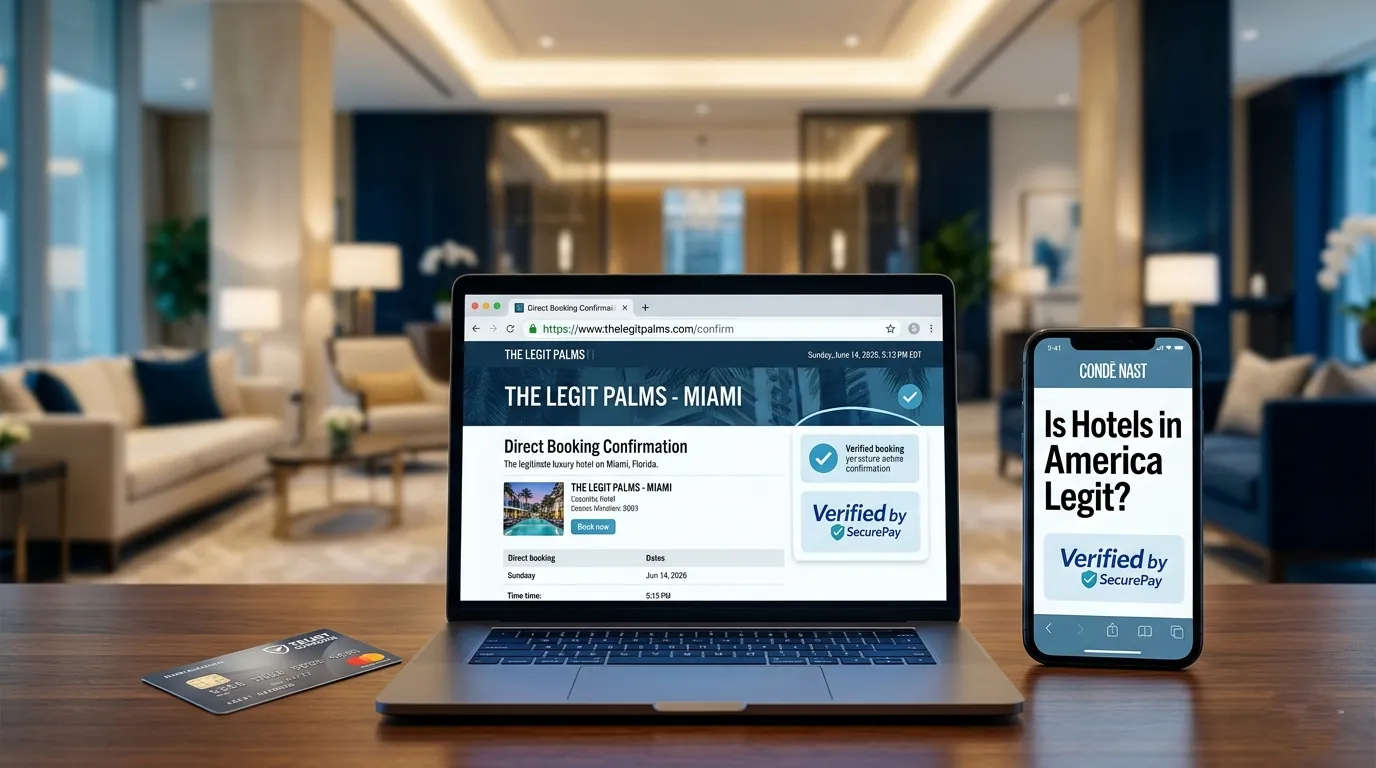
Is Hotels in America Legit? The 2026 Booking Safety Guide
Hotels in America are overwhelmingly legitimate businesses subject to strict brand standards and state laws. The risk lies almost entirely with how you book the room, not with the physical hotel property itself.
The Federal Trade Commission logged over 55,000 travel-related fraud reports in a recent year. Most originated from third-party mimic sites and phishing links, not from the hotels.
This guide breaks down exactly where the scams hide. You will learn to spot a fake booking site in seconds and lock in a genuine reservation confidently.
Is Hotels in America Legit? The Direct Answer
Yes, the physical hotel industry in America is a heavily regulated, legitimate sector. Major chains and independent properties must follow state lodging laws and safety codes.
The danger is almost entirely digital. It exists in the space between you and the real hotel’s reservation system when you use the wrong middleman.
A real roadside motel or a downtown luxury high-rise is a fixed, inspected, tangible asset. Scammers cannot easily fake a massive physical building that you can see on Google Street View.
According to the American Hotel & Lodging Association (AHLA), the US hotel industry generated over $200 billion in annual revenue pre-pandemic. These are not fly-by-night cash operations.
Couples and families often worry most. Their fear is usually about arriving to find no room, which results from third-party payment processor errors far more than from hotel fraud.
Solo travelers using opaque discount sites face higher risk. Their specific reservation details are often blurred until after payment is made, preventing pre-arrival verification.
Key Takeaway: The US hotel is legitimate, but the booking link you clicked to find it might not be.
Hotel Booking Scams America: The Three Most Common Types
Three specific scams account for nearly all hotel booking fraud in the USA. Knowing their mechanics is your best protection.
The first is the clone website. It mimics a real hotel’s official page almost perfectly, down to the stolen photos and slightly altered logo.
These clone sites rank high through paid search ads. They will often have a URL like “marriott-hotel-booking.com” instead of the brand’s verified official domain.
The second scam is the phantom listing. Scammers post a beautiful, fake hotel listing on a legitimate Online Travel Agency or rental platform.
The property simply does not exist. You discover this only when your GPS leads you to an empty lot or a private residence.
The third is call center phishing. You dial a phone number from a fraudulent listing and a scammer impersonates hotel staff to steal card details.
Insider Tip:
- Legitimate hotels rarely call you unsolicited to demand full prepayment over the phone with gift cards.
- If a booking phone number appears only on a non-official site, delete it immediately.
- Families rushing to book during peak holiday seasons are the primary targets for these emotional-pressure scams.
Legitimate Hotel Booking Sites USA: A Tiered List
Not all booking sites carry the same legitimacy risk. There is a clear hierarchy of safety and reliability.
Tier one is the official hotel brand websites. Marriott.com, Hilton.com, Hyatt.com, and IHG.com offer zero intermediary risk.
Your contract is directly with the property that owns the bed. There is no third party to blame if the reservation fails to transfer correctly.
Tier two holds the major public Online Travel Agencies. Expedia, Booking.com, and Hotels.com use secure payment gateways and have dedicated customer service teams.
They are legitimate companies with real operational infrastructure. The risk is not theft but occasional inventory syncing failures with the actual hotel.
Tier three consists of opaque or wholesale discounters. Hotwire, Priceline Express Deals, and blind-booking apps sell you the room without revealing the hotel name.
You save money, but you trade away certainty. Confirming your reservation’s existence before travel becomes nearly impossible with a blind booking.
Budget travelers often accept tier three risk for the lowest price. Business travelers requiring ironclad certainty should never leave tier one.
| Platform Tier | Booking Type | Legitimacy Verdict | Profile Best For |
|---|---|---|---|
| Tier 1: Hotel Brand | Direct | Safest | Business, Luxury, Families |
| Tier 2: Major OTA | Third Party | Safe | Leisure, Price Comparison |
| Tier 3: Opaque/Discount | Third Party | Moderate Risk | Solo, Extreme Budget |
Key Takeaway: The closer your financial relationship is to the actual hotel, the safer you are.
Third Party Booking Sites Safe: How They Actually Work
Third-party booking sites are safe when you understand they are data aggregators, not hotel operators. They sell you a voucher that the hotel must honor.
These sites use a “merchant model.” You pay the OTA, and the OTA pays the hotel a lower wholesale rate on a virtual card.
The hotel’s front desk often cannot see your payment details. If you need to modify the booking, the hotel will send you back to the OTA.
This creates a customer service no-man’s-land. You stand at the front desk while the clerk says, “We can’t touch an Expedia booking.”
Honeymooners should avoid this for their stay. A romantic trip is too valuable to risk on a payment error that the desk cannot fix quickly.
Seasoned road-trippers can use them effectively. If a single night’s rate is significantly lower and plans are firm, the minor risk is sometimes acceptable.
The Federal Trade Commission notes that disputes over third-party hotel cancellations are one of the most common travel complaints. The hotel blames the site, and the site blames the hotel.
Direct Booking vs Online Travel Agency: The Real Difference
The price often looks identical, so travelers assume the experience is identical. The real difference only reveals itself when something goes wrong.
Direct booking means the hotel has total control of your reservation file. They can upgrade you, change dates, or cancel the stay instantly.
The front desk sees a direct reservation as a profit. They see an OTA reservation as a heavily discounted room paying a 15 to 25 percent commission.
A flight gets canceled during a connection in Chicago. A direct booking hotel in Ohio can cancel your night with a single key press.
An OTA booking often requires a 45-minute phone call to a foreign call center just to ask if a cancellation is even possible. Time is precious when you are stranded in an airport.
Couples facing travel disruption need direct booking flexibility the most. Families with rigid schedules might not need to pay extra for that flexibility if nothing changes.
Business travelers gain the most from direct booking. Late check-out, room preference, and loyalty points almost never transfer through a third party.
| Feature | Direct Booking | Third Party (OTA) |
|---|---|---|
| Problem Resolution | Instant at desk | Requires calling OTA |
| Loyalty Points | Yes, almost always | No, usually excluded |
| Room Choice | Specific room type | Run-of-house |
| Cancellation | Flexible by hotel | OTA policy, often strict |
Key Takeaway: Book direct when plans might change, use an OTA when plans are locked in and the discount is real.
How to Verify a Hotel Reservation Is Real
Never trust a confirmation email alone. A six-digit alphanumeric code on a PDF does not prove a room is held in your name.
Call the hotel directly after booking through any third party. Do not use the phone number listed on your booking confirmation email.
Find the hotel’s official contact number through a new Google search of the physical property’s address. Ask the front desk agent to read your reservation back to you.
Ask for your room type, your rate, and your check-out date specifically. If the agent cannot find your name immediately, you have a serious problem.
Perform this check 48 hours after booking online. Then perform it again 72 hours before your arrival.
Insider Tip:
- The most common error is a mismatch between the OTA’s virtual credit card and the hotel’s billing system.
- If the hotel cannot process the OTA’s card 24 hours before check-in, your room gets released.
- Calling ahead catches this before you are stranded in a sold-out city late at night.
Fake Hotel Websites How to Identify Them Quickly
Scammers are excellent web designers. They copy every pixel of a legitimate Hilton or Marriott property page in hours.
Look past the photos to the browser bar immediately. The domain must end exactly in the official brand string like marriott.com, not marriott.reservation-help.com.
Check for the true padlock symbol indicating a valid SSL certificate. A missing or broken padlock is a non-negotiable stop sign.
Fake sites often demand wire transfer or full prepayment for a standard reservation. Real US hotels almost never require a bank wire for a standard leisure stay.
The language will feel slightly off. Look for British spelling like “colour” or “centre” on a site claiming to be a Holiday Inn in Kansas City.
PhishTank data shows hotel phishing sites have an average lifespan of less than 48 hours. They pop up, steal money, and vanish before Google delists them.
Luxury seekers looking for a Ritz-Carlton deal are prime targets. The promise of a penthouse at a 70% discount overrides their instinct to check the URL.
Prepaid Hotel Risks USA: Why Flexibility Matters
Prepaid rates are the dark pattern of hotel booking. They promise a deep discount in exchange for giving up your right to a refund.
The hotel charges your card the moment you book, not when you sleep. Cancel that same day, or even an hour later, and the money is often gone.
A prepaid OTA rate means the agency holds your cash entirely. The hotel has zero financial incentive to help you change or cancel the reservation.
Any change to a prepaid stay requires canceling and rebooking. You lose the original payment and must pay current rates, which often spike closer to arrival.
Families should rarely prepay for vacation stays. Kids get sick, school schedules shift, and sports tournaments change venues.
Budget travelers can safely prepay only when they are completely certain. The savings from a prepaid rate at a mid-tier Hampton Inn can be worth the rigidity.
Medical travelers must never prepay a hotel booking. A canceled surgery or a delayed procedure changes everything, and a non-refundable hotel penalty is a devastating addition to stress.
| Rate Type | Payment Timing | Cancel Risk | Best For |
|---|---|---|---|
| Flexible Rack Rate | At hotel | Low | All travelers |
| Member Flexible | At hotel | Low | Loyalty members |
| AAA/AARP Rate | At hotel | Low | Verified members |
| Advance Purchase | Immediately | Very High | Ironclad plans only |
Key Takeaway: Prepaid rates are a gamble where you bet your trip will run perfectly, and travel rarely does.
Hotel Credit Card Deposit Holds: The Policy Explained
A deposit hold is not a scam or a hidden charge. It is a temporary freeze of funds, not a permanent debit.
US hotels universally place an incidental hold on your credit card at check-in. This covers potential damage, room service, or minibar usage.
The hold amount varies dramatically. An economy motel might block $50, while a luxury resort may freeze $250 per night immediately.
Debit cards are dangerous for this transaction. The bank removes the cash from your available balance instantly, and refunds take days to post after check-out.
Solo road-trippers using a debit card need a cash buffer. The incidental hold at a Courtyard by Marriott can leave you without gas money until the hold drops.
Credit card users barely notice the hold. It sits pending against the credit line but never requires paying interest or actually moving cash.
Insider Tip:
- Always ask, “What is the exact incidental hold amount per night?” before handing over a card.
- Use a traditional credit card with a high limit for the check-in swipe.
- Avoid debit cards for hotel deposits completely unless you have at least $500 in buffer funds.
Is Booking.com Safe for USA Hotels? A Platform Check
Booking.com is a legitimate, publicly traded company and is safe to use for US hotel reservations. The transactional security is bank-grade.
The risk is not that Booking.com will steal your money directly. The risk is the “partner offer” inventory sourced from obscure bed banks.
Sometimes a listing on Booking.com says “property collects payment.” This means Booking.com is just a billboard, and a small motel will bill you directly.
That small motel in rural Montana might be running a decade-old payment terminal. It is a secure but technically less monitored transaction chain.
The platform’s “Genius” loyalty discounts offer genuine value for repeat users. The discount tiers are transparent and apply automatically at checkout.
Travelers with complex multi-city US road trips find Booking.com efficient. Managing 15 different direct hotel logins is a headache that a single OTA dashboard solves.
Couples on a tight schedule should verify each “partner” booking carefully. An overbooked independent inn can ruin a perfectly planned romantic itinerary.
Key Takeaway: Booking.com is safe for payments, but always check if you are booking via them or a “partner.”
Expedia vs Hotels.com Legit: What’s the Catch?
Both Expedia and Hotels.com are fully legitimate, owned by the same parent company, Expedia Group. The catch is not legitimacy, but loyalty mathematics.
Hotels.com previously ran the “stamp” program. You earned a free night after 10 stays, which was a simple and visible return.
Expedia now uses One Key Cash, a unified loyalty program. The earn and burn rates are less generous and far more complex to track for casual users.
You can trust either platform with your credit card securely. The main difference is whether the rewards program aligns with your spending volume.
A user booking 20 room nights a year will find better value in the old stamp system, which is now defunct. The new One Key system rewards bundled trips more than pure hotel stays.
Brand-loyal business travelers should avoid both platforms entirely. You cannot double-dip; a booking on Expedia earns One Key Cash, never Marriott Bonvoy points.
The user who books one hotel a year sees almost zero practical difference between the two. Pick whichever interface annoys you less during the search process.
Are Hotel Resort Fees Legit? Yes, and Here’s Why
Resort fees, also called destination fees or urban fees, are unfortunately legitimate charges. They are not a hidden charge under US law if disclosed properly.
The FTC requires hotels to show the total price, including mandatory fees, before checkout. This is the “drip pricing” rule now enforced more strictly in 2026.
A hotel can legally charge a $45 nightly resort fee for the pool and Wi-Fi. It cannot bury that $45 charge on page five of the terms.
Las Vegas and Hawaii are the epicenters of resort fee culture. A $79 nightly room rate in Vegas can easily become $124 after the mandatory fee.
Budget travelers must filter search results by “total price including taxes and fees.” Never compare two properties using only the base nightly rate.
Hilton and Hyatt now waive resort fees on award stays booked with points. This is a massive loyalty perk that makes direct booking drastically cheaper on premium redemptions.
Luxury seekers often get genuine value from the fee if it includes premium Wi-Fi and fitness access. A family of four paying $50 for pool and beach chair access might be getting a deal compared to per-person rental charges.
Key Takeaway: Resort fees are legal, but filtering by total price eliminates the shock at check-in.
Marriott Hilton Direct Booking Benefits: Value Beyond Price
The rate might be the same, but the value of booking direct with Marriott or Hilton extends far beyond a few dollars saved. The soft benefits compound quickly.
You earn loyalty points and elite qualifying night credits. An Expedia stay earns you absolutely nothing toward status with the hotel brand.
Marriott Bonvoy members receive free in-room Wi-Fi and mobile check-in only on direct bookings. A third-party guest is often given the worst-located room on the floor.
Elite members get space-available upgrades. The front desk manager will always upgrade a direct Platinum member before touching an OTA guest.
Couples celebrating an anniversary gain immensely from direct booking. A simple note in a direct Hilton Honors reservation often triggers champagne or a room with a view.
Hilton’s official terms explicitly state that elite status benefits are “exclusive to stays booked through Hilton channels.” The front desk has no discretion to apply them to an Expedia reservation.
The 24-hour flexible cancellation on direct bookings is more than a policy. It is a relationship between the hotel and the guest, not a rigid third-party terms sheet.
| Benefit | Direct Booking | OTA Booking |
|---|---|---|
| Loyalty Points | Yes | No |
| Elite Night Credit | Yes | No |
| Upgrade Eligibility | Yes (based on status) | Extremely rare |
| Wi-Fi | Free for members | Often charged |
| Late Check-out | Priority | Rarely available |
Red Flags Third Party Hotel Booking: Before You Pay
You are one click from entering card details. Pause for 60 seconds to scan for these instant deal-breakers.
The site demands payment via Zelle, Venmo, wire transfer, or cryptocurrency. No legitimate hotel booking platform or US hotel requires these payment methods.
A high-end resort listing uses only stock photos or images that perfectly match a well-known Maldives property. Do a reverse image search.
The nightly rate for a 5-star hotel in New York City appears as $89. This is not a deal; this is a stolen credit card waiting to be used for your reservation.
The contact email address ends in Gmail, Yahoo, or a random domain. Legitimate hotels use branded corporate email addresses.
The website lacks a physical business address or a working US-based customer support phone number. Scam sites need no customer service department.
Insider Tip:
- If a third-party booking confirmation email lacks a direct hotel confirmation number from the brand’s system, you are in danger.
- An OTA giving you an “Expedia itinerary number” does not equal a “Marriott confirmation code.”
- Call the hotel and ask for the brand-specific confirmation number immediately after booking.
Key Takeaway: If the deal shatters your understanding of reality, the booking site is shattering your financial security.
What to Do If Hotel Booking Is a Scam
You opened your confirmation email and realized the disaster. The link is dead, and the phone number is a Google Voice recording.
Call your credit card issuer instantly. State clearly: “I need to initiate a dispute for services not rendered due to a fraudulent merchant.”
Call the actual hotel where you believe the reservation was for. Give them your name and ask if any reservation ever existed.
If the real hotel has no record of you, inform them their brand is being spoofed. This helps the next victim.
File a report with the FBI’s Internet Crime Complaint Center (IC3). This creates a formal record and helps aggregate data on large-scale fraud rings.
Report the fraudulent listing to the OTA or Google Ads platform. They can delist the fake ad quickly to protect future search traffic.
Change your email password immediately. Assume the fake confirmation email was a phish designed to harvest more data beyond just a single booking.
Verify Hotel Legitimacy USA: A One-Minute Method
You do not need to be a cybersecurity expert. You just need a one-minute drill before every single booking.
Step one: Look up the physical street address on Google Maps Street View. Does a building that looks like a real hotel actually exist there?
Step two: Call the phone number listed on the Street View business profile. Ask a human voice, “Do you have a reservation booked under my name for my dates?”
Step three: Check the URL bar for the official domain spelling. hilton.com is real, hilton-support.com is a criminal enterprise.
Step four: Verify the SSL certificate by clicking the padlock icon. The certificate should be issued to the actual company running the site.
A solo traveler in a strange city can perform this entire drill at the airport after landing. It takes less time than ordering a coffee.
This method bypasses every single digital scam tactic because it connects you directly to the fixed, physical asset. Fraudsters cannot intercept a call to a building that exists.
Key Takeaway: The one-minute drill of phone call plus URL check is the ultimate verification tool.
Safety and Seasonal Warnings for US Hotel Bookings
Major event weeks create a frenzy of price gouging and scam site creation. The 2026 Super Bowl, Mardi Gras, and major festivals are peak scam periods.
Scammers know desperation is high and hotel inventory is extremely low. They launch fake listings for “last-minute cancellations” at sold-out official hotels.
Holiday weekends like the Fourth of July and Thanksgiving see phishing call center activity spike. Posing as hotels demanding “reconfirmation” of credit card details is a known fraud pattern.
Spring break beach zones from Florida to Texas are hotbeds for phantom condo and hotel listings. Verify beachfront property claims with a direct video call if renting a condo.
Never wire money for a reservation during a hurricane or natural disaster. FEMA and state authorities warn that price gouging and fake relief housing listings multiply within hours.
Extreme caution is required when booking any independent motel from a Craigslist or Facebook Marketplace ad. Use the official hotel website or a trusted OTA only.
Frequently Asked Questions About Hotel Booking Legitimacy
How do I know if a hotel booking site is legit?
Check the URL for the exact, official domain spelling of the hotel brand or known booking company.
A padlock icon and “https” are mandatory but do not prove the site is the real brand.
Call the hotel directly at a number found from a separate search to confirm the booking exists.
Are prepaid hotel reservations on booking sites ever a good idea?
Yes, if the discount is significant and your travel dates are absolutely locked in with zero chance of change.
A prepaid rate from a major OTA is safe if the site itself is legitimate.
Never prepay for a trip involving connecting flights, medical procedures, or small children.
What is the safest way to book a hotel in the US?
Book directly through the hotel’s official website or the hotel’s official mobile app.
This removes every intermediary payment risk and gives the hotel full control over your reservation.
You also earn loyalty points and receive priority treatment for problem resolution.
Why do hotels place a hold on my credit card at check-in?
The hold secures funds to cover incidental charges like room service, minibar use, or potential property damage.
The amount is held temporarily and released a few days after you check out if no charges are made.
Using a credit card is vastly safer than a debit card for these holds.
Is it safer to book directly with a Marriott or Hilton?
Yes, it is objectively safer and offers more value than any third-party booking.
You get the best rate guarantee, full loyalty points, and direct control over your booking modifications.
The hotel will protect a direct guest’s stay far more aggressively than a third party’s booking.
What are the signs of a fake hotel listing on an OTA?
The listing uses only generic stock photography with no identifiable location markings.
The price is unrealistically low, often 60 to 80 percent below comparable neighboring properties.
The contact information links to a Gmail address or a disconnected phone number.
The Direct Booking Verdict
The American hotel industry is a legitimate fortress of real estate, regulation, and brand standards. A fraudulent “hotel” is almost never the physical building you walk into.
The fraud is in the digital front door. A fake URL, a spoofed ad, or a phantom listing is what steals your cash.
Book directly with a known hotel brand to guarantee your room, your points, and your recourse. Use a credit card, verify the domain, and call the hotel on a number you find yourself.
Resort packages, loyalty terms, and platform policies can shift with the season. Verify the specific cancellation and fee terms before submitting final payment for your 2026 stay.