Extended Stay Hotels Monthly Rates in 2026: Full Cost Guide
Extended stay hotels cost between $1,200 and $5,000 per month depending on the brand, city, and room type. A budget suite in a small town runs far less than a premium suite in Manhattan.
The real price is not the nightly rate multiplied by 30. Most hotels drop the local occupancy tax after 30 consecutive nights, which instantly saves you 10 to 15 percent off the total bill.
This guide explains the exact cost tiers of every major extended stay brand in 2026. You will learn how to negotiate a lower monthly rate, which brand to pick for a full kitchen, and how to avoid the tax trap that inflates your bill.
How Much Are Extended Stay Hotels Per Month
Monthly rates at extended stay hotels typically range from $1,200 to $2,200 for a budget property. Midscale brands generally run $2,200 to $3,500, and upscale extended stay suites cost $3,500 to $5,000 or more.
These prices assume a standard studio or one-bedroom suite. A two-bedroom suite in a major coastal city can push the monthly bill well past $6,000.
The nightly rate on the hotel website is rarely the price you pay for a month. You must call the property directly to access the unpublished monthly rate, which is almost always lower than the online booking engine total.
Budget and value travelers will find the cheapest rates at economy extended stay brands in suburban or highway-adjacent locations. These properties trade a central address for a genuinely lower monthly cost.
| Brand Tier | Monthly Range | Best For |
|---|---|---|
| Budget | $1,200 to $2,200 | Unfussy solo travelers, tight budgets |
| Midscale | $2,200 to $3,500 | Families, relocating couples |
| Upscale | $3,500 to $5,000+ | Executives, insurance housing clients |
Key Takeaway: Expect to pay $1,200 to $2,200 for a budget extended stay month, but only if you call and negotiate directly.
What Hotels Offer Weekly Rates
Extended Stay America, WoodSpring Suites, and Intown Suites are the three economy brands that most consistently offer genuine weekly rates without a corporate contract.
These weekly rates are a simple discounted nightly price. They typically run 15 to 25 percent below the standard nightly rate and are available to anyone who asks at the front desk.
Midscale and upscale brands like Marriott Residence Inn and Homewood Suites by Hilton publish weekly rates but hide them behind a “long stay” search filter. The discount at these brands is often smaller, around 10 to 15 percent off the nightly rate.
- Weekly rates almost never trigger the tax exemption. You need 30 consecutive nights.
- Weekly rates often reset housekeeping to a once-a-week schedule instead of daily.
- The lowest weekly rates appear at properties near highway exits, not city centers.
What Hotels Have Weekly Rates
Most extended stay hotels in the economy and midscale tiers offer a weekly rate. The brands that do not are typically upscale, full-service hotels where long-term guests are rare.
Candlewood Suites and Sonesta Simply Suites are two midscale brands with transparent weekly pricing. Their websites and front desk staff are trained to quote weekly and monthly rates immediately.
Boutique and independent hotels rarely offer a published weekly rate. You must ask the general manager directly, and the answer depends entirely on the property’s current occupancy and business mix.
According to the American Hotel and Lodging Association, extended stay hotels as a category are designed specifically for guests staying five nights or more. Weekly rates are a core part of their business model, not a favor.
Cheapest Extended Stay Hotels Monthly
WoodSpring Suites and Intown Suites are typically the cheapest extended stay hotels for a monthly booking. Their rates in low-cost suburban markets can dip as low as $1,000 to $1,400 per month for a basic studio.
These rock-bottom rates come with a genuine trade-off in amenities. WoodSpring Suites charges extra for basic items like a coffee maker, a dish pack, and even weekly linen exchange.
Extended Stay America sits one small step above WoodSpring in price and quality. The kitchenette includes a full refrigerator and a two-burner stovetop, and the nightly-to-monthly rate conversion is straightforward and well-documented at the front desk.
- Intown Suites requires a credit check for monthly stays. WoodSpring does not.
- The cheapest monthly rates are found in the Midwest and Southeast, not coastal cities.
- Verify the kitchen inventory before you book. Some budget suites have a microwave but no cooktop.
Extended Stay America Monthly Rates
Extended Stay America monthly rates typically fall between $1,500 and $2,800 depending on the city and suite size. This range has held relatively consistent, with urban coastal locations commanding the high end of the spectrum.
The brand offers a genuine full kitchen in every suite, including a full-size refrigerator, a microwave, and a two-burner stovetop. Cookware and dishes are available at the front desk, often as a free loaner kit rather than an in-room amenity.
The genuine limitation of Extended Stay America is the inconsistency between properties. Some locations are recently renovated and clean, while others show significant wear in the elevators, hallways, and bathroom fixtures.
Insider Tip:
- Join the Extended Perks loyalty program before booking. Even a basic membership can unlock a small rate discount.
- Ask for a room on the top floor facing away from the highway for a quieter stay.
- Grab and Go breakfast is included but is genuinely basic: coffee, a granola bar, and a muffin.
Key Takeaway: Extended Stay America offers a reliable full kitchen in every room, but property quality varies wildly by location.
Weekly Rate Motels Near Me
Independent motels and smaller local chains offer the lowest weekly rates in most cities. These properties rarely appear on major booking platforms and must be found through a direct phone call or an in-person visit.
A weekly rate at a local motel in a low-cost region can be as low as $250 to $400 per week. This is often the cheapest temporary housing option available, but the trade-off is a complete lack of kitchen facilities and often a more dated, less secure environment.
Budget travelers in genuine financial transition should search for motels near interstate exits, not tourist areas. These properties survive on long-term guests and price accordingly.
- Always inspect a room before committing to a week. Look for working locks, clean linens, and a lack of pest evidence.
- Pay week by week rather than upfront for a month. This protects you if the property is unacceptable.
- Weekly motel rates are almost never advertised online. Pick up the phone and call.
Hotel Monthly Rates vs Apartment
A month in an extended stay hotel is often cheaper than signing a short-term apartment lease once you factor in utility setup fees, furniture rental, and the lack of a security deposit. The true comparison is not just the rent figure on paper.
An apartment requires a security deposit, first and last month’s rent, utility activation fees, internet installation, and furniture purchases. A hotel wraps all of these costs into a single monthly bill with zero setup effort.
The hotel loses on space, privacy, and the ability to personalize your environment. An extended stay suite is a functional place to sleep and cook simple meals, not a home where you can host a dinner party.
| Cost Factor | Extended Stay Hotel | Furnished Apartment |
|---|---|---|
| Upfront Cost | One month’s rate | Deposit, first, last, fees |
| Utilities | Included | Separate, often $150 to $300/month |
| Internet | Included | Separate, often $50 to $80/month |
| Furniture | Fully furnished | Included in corporate rental |
| Minimum Stay | 1 night | Typically 3 to 12 months |
| Kitchen | Basic cooktop, microwave | Full oven, full-size fridge |
Long Term Hotel Stay Discounts
Long-term hotel stay discounts are almost never published on the website. The best discount is negotiated directly with the general manager or sales department over the phone.
A typical long-term discount for a 30-night stay ranges from 20 to 40 percent off the standard nightly rate. The deeper discount usually requires a non-refundable prepayment or a signed contract for the full month.
Couples and families who are relocating for work should specifically ask for a “corporate relocation rate” or mention their employer’s name. Many hotels have unpublished negotiated rates with major local employers, hospitals, and military bases.
- The longer the stay, the more leverage you have. Ask for a better rate at 60 and 90 days.
- Fluctuating demand kills negotiation leverage during a citywide event. Time your call for a quiet week.
- The front desk agent cannot approve a deep discount. Politely ask to speak with the sales manager.
30 Day Hotel Stay Tax Exempt
A 30-day hotel stay becomes exempt from local occupancy taxes in most states. This tax break, typically 10 to 15 percent of the room rate, is automatically triggered on the 31st day of a continuous stay.
The tax exemption is a huge part of the monthly value proposition. On a $3,000 monthly bill, the tax savings alone can equal $300 to $450, effectively giving you three to four free nights compared to paying the full taxed rate.
The hotel must correctly apply the exemption to your folio. Some front desk systems require a manual override, so you must check your bill at the 30-day mark and confirm the tax has been removed for the full stay.
- The exemption applies retroactively to day one in most jurisdictions. Do not let the hotel charge you tax for the first 30 days.
- This rule applies to a single continuous stay at a single hotel. Checking out and back in resets the clock.
- Confirm the specific state law before booking. A small number of states have different exemption thresholds.
Key Takeaway: A 30-day hotel stay drops local taxes entirely, saving 10 to 15 percent on your total monthly bill.
Extended Stay Hotel Kitchen
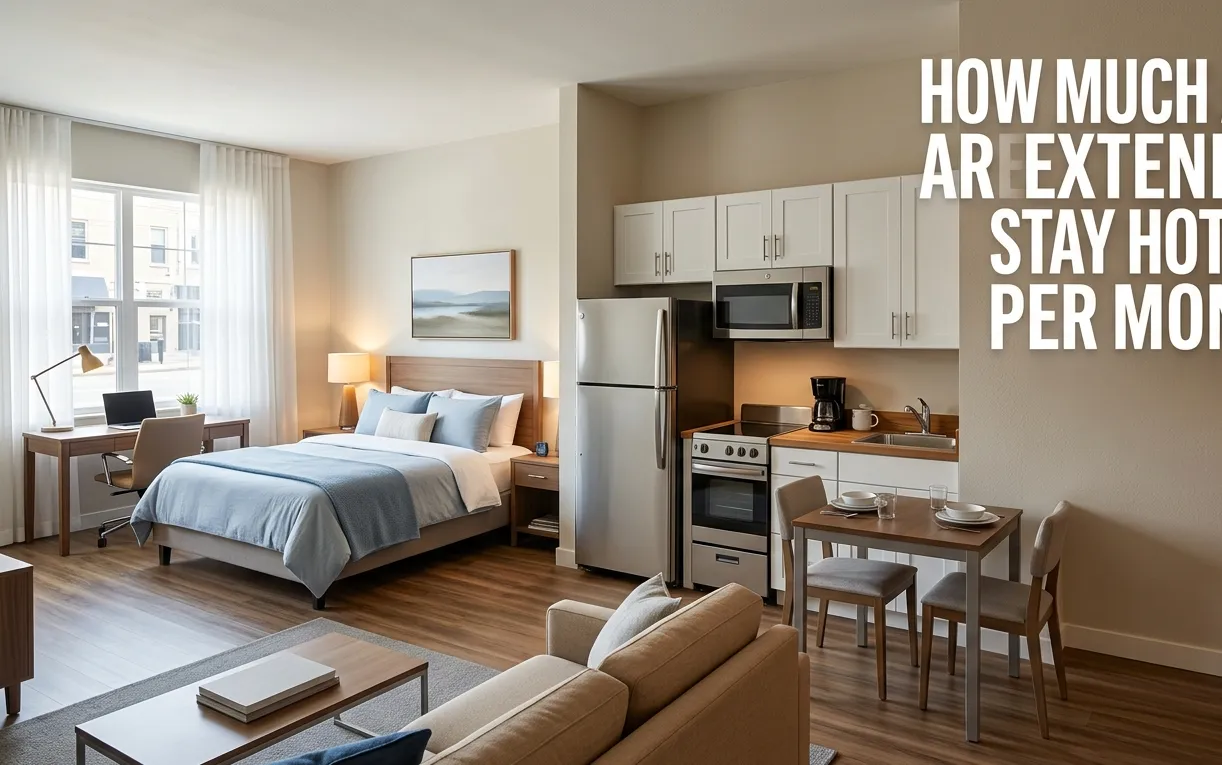
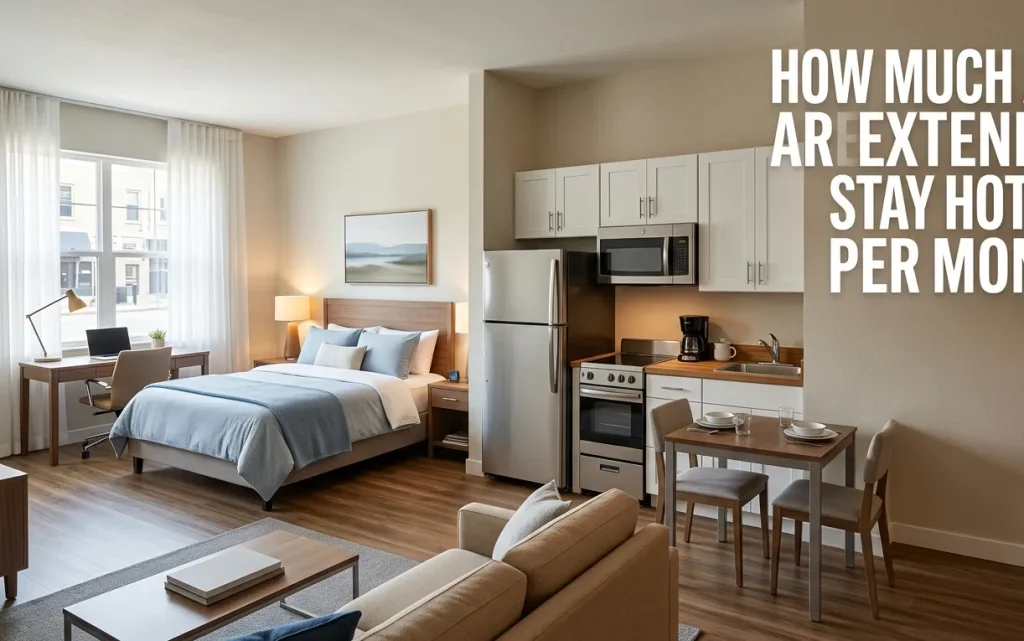
An extended stay hotel kitchen includes a full-size refrigerator, a microwave, and a two-burner cooktop at minimum. Upscale brands add a full oven, a dishwasher, and proper cookware already in the cabinets.
The kitchen quality is the single most important feature to verify before booking a budget extended stay brand. A poorly equipped kitchen forces you into expensive takeout meals, which destroys the cost-saving logic of booking an extended stay in the first place.
WoodSpring Suites charges extra for a kitchen kit that includes a coffee maker, toaster, and basic cooking utensils. Paying this one-time fee is essential for a functional kitchen and should be budgeted into the total cost.
- Call the specific property and ask, “What is already in the kitchen when I arrive?”
- A full refrigerator is the most important appliance for monthly grocery savings.
- Budget suites often lack an ice maker. Pick up a bag of ice on your first grocery run.
Corporate Housing vs Extended Stay
Corporate housing providers offer fully furnished apartments with separate living and sleeping areas, a full kitchen, and in-unit laundry. An extended stay hotel is a hotel room with a kitchenette and limited living space.
Corporate housing typically requires a 30-day minimum stay and costs more per month than a budget extended stay hotel. The trade-off is significantly more space, a residential neighborhood setting, and a genuine separation between sleeping and living areas.
Solo travelers on a tight per diem should choose an extended stay hotel and pocket the savings. Families relocating with children should push for corporate housing, as the extra bedroom and residential setting make a huge difference in family sanity.
- Corporate housing often includes a garage or dedicated parking spot that a hotel charges extra for.
- Airbnb monthly stays now compete directly with both categories and should be priced into any comparison.
- Insurance companies often mandate corporate housing for displacement claims, not extended stay hotels.
How to Book Extended Stay Hotel
To book an extended stay hotel at the best monthly rate, call the property directly. Do not book a 30-night stay through the hotel’s website or a third-party booking platform.
The front desk agent answering the phone can usually quote a weekly rate but rarely has the authority to approve a deep monthly discount. Politely ask, “May I speak with the sales manager or general manager about a 30-night stay?”
Once you reach the decision-maker, state your exact dates, the room type you want, and that you are comparing rates with two other nearby properties. This signals you are a serious, informed guest who will book with the best offer.
- Search online to identify 3 candidate hotels in your target area and price tier.
- Call each property during weekday business hours and ask for the sales manager.
- State your exact 30-night dates and ask for the lowest available monthly rate.
- Mention you are comparing offers and ask if they can waive the pet fee or include parking.
- Confirm the tax exemption will apply and ask for the total, all-in monthly price in writing via email.
Key Takeaway: Call the sales manager directly during business hours to access the real monthly rate you cannot find online.
Negotiate Monthly Hotel Rate
Negotiating a monthly hotel rate is a standard business practice, not an awkward favor. The hotel’s sales team has monthly occupancy targets, and your 30-night booking moves their numbers meaningfully.
The strongest leverage is a genuine competing offer from a nearby property. Call two or three hotels, get their monthly quotes, and use the lowest one as your anchor.
The hotel’s biggest expense is turning over a room between guests. A 30-night stay eliminates daily housekeeping costs and the risk of an empty room, which is precisely why the manager can justify a rate they would never offer for a two-night booking.
- Be polite and direct. “I have a quote from the WoodSpring across town for $1,600. Can you match or beat that?”
- Ask for add-ons instead of a rate cut if the manager is stuck. Free parking or a waived pet fee adds real savings.
- Non-refundable prepayment is a powerful negotiation chip. Offering to pay upfront can unlock a 5 to 10 percent deeper discount.
Best Extended Stay Hotel Brands
The best extended stay hotel brand depends entirely on your budget and kitchen needs. Homewood Suites by Hilton is the best upscale option, Marriott Residence Inn leads the midscale tier, and Extended Stay America anchors the budget category.
Homewood Suites includes a full hot breakfast and an evening social with light dinner and drinks on weekdays. These inclusions can meaningfully offset the higher nightly rate for a traveler who would otherwise spend $15 to $25 per day on those meals.
Candlewood Suites is the best midscale option for a genuine kitchen. The full-size refrigerator, cooktop, and in-room recliner create a more apartment-like feel than the more corporate Residence Inn layout.
Insider Tip:
- Hilton and Marriott loyalty points accrue on extended stays and can be redeemed for future vacations.
- WoodSpring Suites is the cheapest national brand but charges for every small amenity. Read the fee sheet carefully.
- The best brand for you is the one with a clean, well-reviewed property in your exact target neighborhood.
Frequently Asked Questions About Extended Stay Hotels
How much does an Extended Stay America cost per month in 2026?
Extended Stay America monthly rates typically range from $1,500 to $2,800 depending on the city and suite size.
The rate includes a full kitchen, utilities, and basic WiFi but not daily housekeeping.
Call the specific property directly to get the exact monthly quote, as online prices rarely reflect the best long-term rate.
Is it cheaper to live in an extended stay hotel than rent an apartment?
A budget extended stay hotel can be cheaper than a short-term apartment lease once you factor in utility setup, furniture, and deposit costs.
The hotel wraps all utilities, internet, and furnishings into a single bill with zero upfront fees.
An apartment offers far more space and privacy but requires a larger initial cash outlay and a longer commitment.
Do hotels waive taxes after a 30-day stay?
Most states exempt hotel stays of 30 consecutive nights or more from local occupancy taxes.
This tax break typically saves 10 to 15 percent and is automatically applied on the 31st day, retroactive to check-in.
Confirm with the front desk that the exemption has been applied to your folio at the 30-day mark.
What is the cheapest extended stay hotel chain?
WoodSpring Suites and Intown Suites are typically the cheapest national extended stay chains for a monthly booking.
Rates in low-cost suburban markets can reach as low as $1,000 to $1,400 per month for a basic studio.
WoodSpring charges extra for amenities like a coffee maker, cookware, and weekly linen exchange.
What is included in an extended stay hotel room?
A standard extended stay hotel room includes a kitchenette with a full-size refrigerator, a microwave, a cooktop, and a dedicated workspace.
Utilities, basic WiFi, and weekly housekeeping are included in the rate at most brands.
Upscale brands add a free hot breakfast, an evening social, and a full oven in the kitchen.
Can you negotiate a lower monthly rate at an extended stay hotel?
You can and should negotiate a lower monthly rate by calling the property directly and speaking with the sales manager.
The online booking engine rarely displays the best monthly price, which is negotiated over the phone.
Mentioning a competing offer from a nearby property is the most effective negotiation tactic for a 30-night stay.
The most important step in booking a monthly extended stay hotel is calling the sales manager directly. The online rate is an opening offer, not the final price, and the 30-day tax exemption is money left on the table if you fail to confirm it on your bill.
Choose your brand based on the kitchen quality first, the location second, and the loyalty program points a distant third. A full-size refrigerator and a working cooktop save you more real money each month than any points redemption will ever return.
Rates and tax policies shift by state and property in 2026. Always get the total all-in monthly price in writing via email before you prepay a single night.