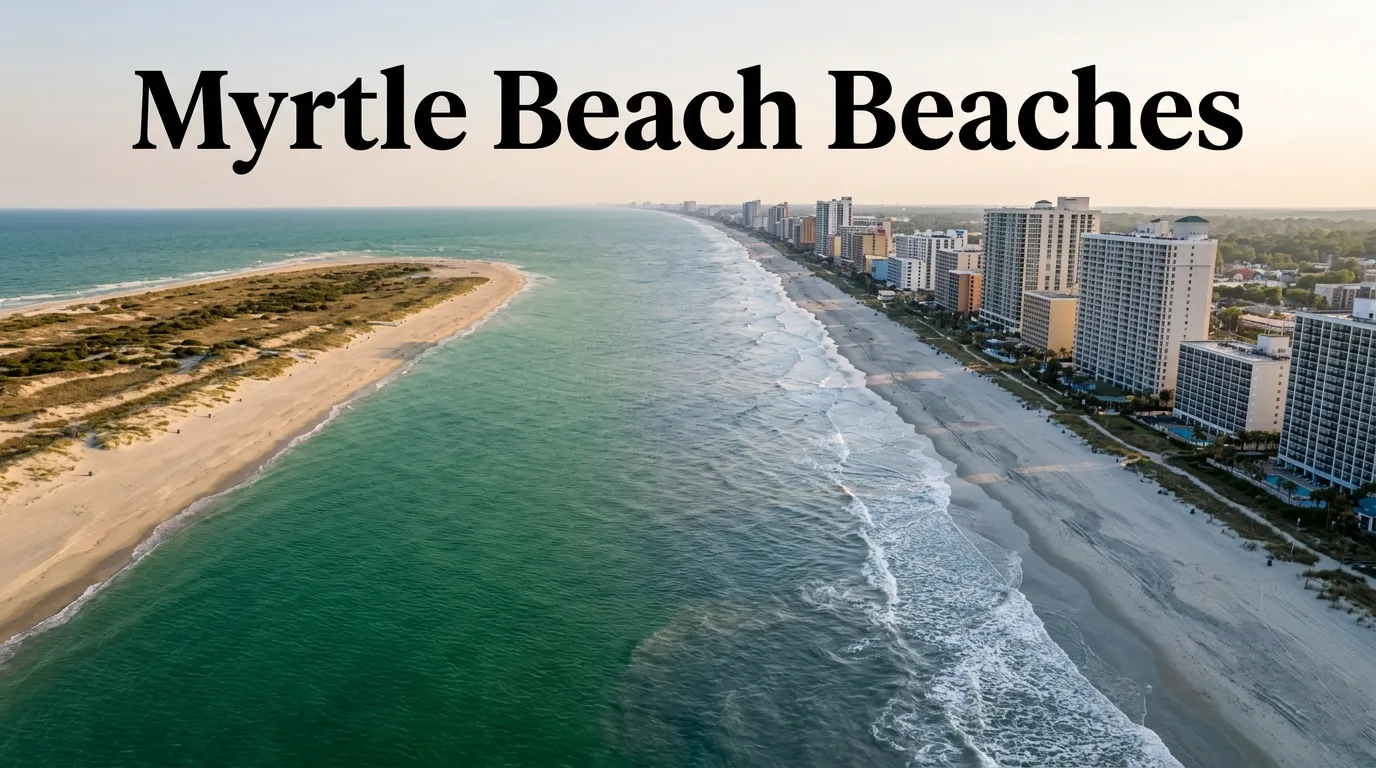
Best Myrtle Beach Beaches 2026: Which to Pick & Why
Choosing a Myrtle Beach beach without a plan can backfire within minutes of arrival. The 60-mile coastline spans vastly different worlds of noise, sand quality, and water access.
A rookie mistake is booking a hotel on the central Boardwalk and expecting a quiet, romantic sunrise. That central stretch delivers dense crowds and a high-energy, party-friendly atmosphere.
This guide matches specific beaches to your exact travel profile. I will name the best stretches for families, couples, surfers, and anyone wanting a peaceful escape.
Myrtle Beach Beaches: Know the 60-Mile Grand Strand
The Grand Strand is not one uniform beach but a chain of distinct coastal towns. Understanding this geography is your first and most crucial planning step.
The central zone hums with the Myrtle Beach Boardwalk, high-rise hotels, and the SkyWheel. This is the postcard image but also the most densely packed section.
A fifteen-minute drive north delivers you to the residential calm of North Myrtle Beach. A twenty-minute drive south puts you in the quiet, low-rise shores of Surfside Beach.
Visit Myrtle Beach identifies the Grand Strand as spanning from Little River down to Pawleys Island. Each town manages its own public access rules and beach maintenance schedule.
Water conditions also shift along this arc. The central strand sees a heavier shore break than the slightly protected points near Murrells Inlet and Cherry Grove.
The hard-packed sand is a defining feature across the entire region. You can bike or jog for miles at low tide on a surface that feels almost like concrete.
This sand also means a steeper drop-off at the waterline in certain areas. Small children need close supervision where the shore break scours a sudden ledge.
Key Takeaway: The Grand Strand is not one beach. A ten-minute drive can completely change your sand, crowd, and wave experience.
Best Beaches in Myrtle Beach: The Honest List
The best beach in Myrtle Beach is not a single spot. It is the one that correctly aligns your expectations with the reality of the surf, sand, and company.
Here is an unranked, honest list of what each named stretch genuinely does best and worst for 2026 planning.
| Beach | Best For | Crowd Level | Insider Note |
|---|---|---|---|
| Myrtle Beach Boardwalk | Action, people-watching, first-timers | Very High | Dense and loud. Avoid if you want a quiet book-read. |
| North Myrtle Beach | Families, wider sand, residential feel | Moderate to High | Cherry Grove section offers the best low-tide sandbars. |
| Surfside Beach | Families, budget-conscious travelers | Moderate | Low-rise, no-frills, excellent for long walks. |
| Garden City Beach | Mixed families and couples, pier fishing | Moderate to High | The pier area concentrates crowds; walk south for peace. |
| Myrtle Beach State Park | Quiet nature seekers, families | Low to Moderate | The only central escape. Pay the entry fee for instant peace. |
| Huntington Beach State Park | Nature lovers, photographers, birders | Low | More a natural preserve than a beach resort. No commercial vibe. |
| Pawleys Island | Laid-back couples, luxury-adjacent relaxation | Low | No high-rises. This is where you go to disconnect. |
| Atlantic Beach | History, local culture, solitude | Very Low | A historically significant Black beach community with a quieter pace. |
Myrtle Beach South Carolina Beaches for Families
North Myrtle Beach is the premier family choice for its combination of wide sand, gentle surf, and superior shallow-water access. The extra space gives kids room to run and build without crowding other groups.
The Cherry Grove section at the far north end is a standout. Low tide reveals massive, tidal-pool-filled sandbars that act like a natural, calm-water wading zone for toddlers.
Parking here uses a mix of paid public lots and limited free street spaces. Arrive before 9:00 AM on a summer Saturday or prepare for a long, hot walk with gear.
Hotels like the family-oriented Avista Resort sit directly on the Cherry Grove shore. Its limitation is its distance from the central Boardwalk action, which is exactly its strength for families.
Surfside Beach, south of the central zone, markets itself as “The Family Beach” for good reason. Its two-mile stretch is lined with low-rise beach houses, not massive resorts.
The beach has a neighborhood feel where the pace is slower and the commercial density drops. This means you carry your own cooler and there are fewer rental umbrellas.
The surf here is more moderate than the central shore break. It is forgiving enough for boogie-boarding children but always requires vigilance for sudden rip current formation.
According to the United States Lifesaving Association, always choose a beach near a lifeguard stand when swimming with children. Surfside maintains seasonal lifeguard coverage at key access points.
Key Takeaway: For families with young children, North Myrtle Beach’s Cherry Grove sandbars at low tide are the single best water-play feature on the entire Grand Strand.
Quiet Beaches Near Myrtle Beach for Couples
Couples seeking a quiet escape must immediately look north to Cherry Grove or south to Pawleys Island. The central Boardwalk zone actively works against a romantic, peaceful atmosphere.
Pawleys Island is the definitive answer for a laid-back, couples-oriented beach experience. It is a four-mile-long, narrow barrier island about 25 miles south of central Myrtle Beach.
This is not a beach for water sports or jet ski rentals. Pawleys Island is for unhurried beach walks, reading in a hammock, and watching the sunset with no commercial backdrop.
Accommodation here is almost entirely private beach homes and the historic Sea View Inn. You trade high-rise amenities for profound quiet and a sense of genuine escape.
The sand here is finer and softer than the central strand. The surf is typically gentle, making it ideal for a calm, shared float in salt water.
A limitation for some couples is the lack of fine dining directly on the beach. You will need to drive back toward Murrells Inlet for a diverse restaurant scene.
Litchfield Beach, just north of Pawleys, offers a similar quiet atmosphere with slightly more resort infrastructure. It is a middle ground between total isolation and resort convenience.
The main crowd here is families and retired couples. The 2026 beach nourishment projects have kept the sand wide and healthy, perfect for a long, uninterrupted couples’ walk.
Key Takeaway: Pawleys Island is the anti-Boardwalk. Choose it for a zero-commercial, low-rise romantic escape where the loudest sound is the surf itself.
Myrtle Beach State Park Beaches: A Complete Escape
Myrtle Beach State Park is the answer to the question, “Where can I find a quiet, natural beach in the center of the madness?” It is a one-mile coastal sanctuary just south of the Boardwalk.
The park gate is a literal entrance to a different world. For a small entry fee, you trade high-rise shadows for a maritime forest of live oaks that backs the beach.
The beach here is far less manicured than the hotel zone. Sand fencing, sea oats, and natural dune lines create a wilder, more private-feeling shoreline.
This is a top choice for families with young children and couples alike. The on-site pier offers fishing, and the nature trails provide a break from the sun.
The limitation is that you must pay to enter, and no commercial boardwalk is within walking distance. This is not a beach for an afternoon of bar-hopping.
Parking is in a designated lot, and you walk a forested path to reach the sand. This short walk filters out the beach-bucket-and-cooler crowd that wants to park right at the sand.
According to SCDHEC, the water at the state park is regularly monitored and generally scores well on cleanliness. The absence of dense stormwater runoff that affects central zones is a major factor.
I recommend this beach for a full, relaxing beach day. Bring everything you need, from food to shade, and settle into a quiet rhythm that the commercial beaches cannot offer.
Insider Tip: Arrive before 10:00 AM on summer weekends. The parking lot fills to capacity and the gate closes, turning away visitors for the rest of the day.
Myrtle Beach Boardwalk Beaches: The Center of the Action
The Myrtle Beach Boardwalk & Promenade beaches are the bustling, beating heart of the Grand Strand’s tourism. This is the place to be if your beach day must include immediate access to food, drink, and amusement rides.
The 1.2-mile oceanfront boardwalk runs from 14th Avenue North to 2nd Avenue North. The sand directly adjacent is the most densely packed with umbrellas and families on the entire coast.
This beach is loud, social, and brimming with energy. The sand is carefully groomed each morning, but by late afternoon in peak season, it can become a crowded grid of towels and tents.
The water here experiences the heaviest bather load. Pay close attention to the posted rip current forecast flags, as this section is the most closely monitored by the Horry County Beach Patrol.
This zone is not the place for a quiet, meditative ocean dip. It is where you go to be seen, to listen to music from the nearby Plyler Park stage, and to people-watch.
A significant logistical limitation is parking. Paid lots near the Boardwalk can command $20 or more for a full day during peak summer season.
The best strategy is to stay at a Boardwalk-adjacent hotel where you can walk. For day-trippers, the city’s metered street parking on Ocean Boulevard is your best-value target.
The Myrtle Beach SkyWheel rises directly from the Boardwalk. A beach day here is as much about the backdrop of this glowing attraction as it is about the Atlantic water.
Key Takeaway: The Boardwalk beach is a social scene, not a nature escape. Book a hotel within walking distance or face the most expensive and frustrating parking hunt on the Grand Strand.
Myrtle Beach Surfing Beaches: Where to Catch a Wave
Myrtle Beach is not Hawaii, but it offers consistent, accessible surf for beginners and intermediates, particularly around its pier structures. The waves are wind-driven and shore-break-heavy, not long, peeling point breaks.
Springmaid Pier, near the southern end of the city, is the most consistent and popular surf break. The pier’s pilings create sandbar formations that shape up reliable lefts and rights.
This is a wave for shortboards and bodyboards, especially during a summer south wind swell. The paddle-out is often a strenuous duck-dive through relentless sets of shore break.
The crowd in the water here is competitive during peak windows. Know the lineup etiquette before paddling out, as local surfers patrol the priority hierarchy.
Apache Pier in the Arcadian Shores section of Myrtle Beach also forms a reliable sandbar setup. It is typically less crowded in the water than Springmaid, with a chiller, more intermediate-friendly vibe.
North Myrtle Beach at the Cherry Grove Pier offers a more forgiving wave for longboarders. The wave here is softer and less punishing on smaller swell days.
Hurricane season, from August through October, sends the most powerful and organized groundswell to the Grand Strand. This is when the surf reaches its potential but also when rip currents are at their most lethal.
Surf City Surf Shop and local beach patrol advisories are the best daily resource for conditions. Never surf alone, and always verify the rip current risk level from the National Weather Service before entering.
A major limitation for the luxury traveler is the lack of surf butler services or high-end beach clubs. The surf culture here is genuine, gritty, and unglamorous.
Key Takeaway: Springmaid Pier delivers the best surf on the Grand Strand. The trade-off is a highly competitive, territorial lineup that can be unforgiving for newcomers.
Myrtle Beach Public Beach Access Guide
All Myrtle Beach beaches are public below the mean high tide line. Gaining legal, practical access to that public sand is the real logistical puzzle you must solve.
The City of Myrtle Beach maintains over 80 public access points. These range from full-service spots with restrooms and showers to narrow, unmarked sandy paths between oceanfront homes.
The most user-friendly access points in the central zone are at the ends of numbered avenues. Look for the blue “Public Beach Access” signs that mark these paths.
North Myrtle Beach uses a different system with access points labeled by street names rather than avenues. Many of these have no dedicated parking, making them only walkable for nearby rental occupants.
Access points with public restrooms and seasonal lifeguards are your best choice for a full family beach day. Use the city’s official website to locate these premium, amenity-rich entry points.
A common frustration is finding an access point but no parking. Knowing which entries have dedicated paid lots versus those relying on scarce street parking is everything.
The Myrtle Beach Area Chamber of Commerce provides a digital access point map. Download this resource before your trip to plan your entry route based on your accommodation or driving route.
The sand paths from street to beach are typically flat plywood walkovers. This makes stroller and wagon access manageable, a critical detail for families hauling gear.
Key Takeaway: Blue “Public Beach Access” signs are your gateway, but an access point without a parking strategy is useless. Match your entry point to a specific parking plan.
Myrtle Beach Beaches with Parking: A Block-by-Block Strategy
Parking near the beach in Myrtle Beach is a tactical game of timing, location, and payment method. Free, unlimited beachfront parking essentially does not exist during peak season.
The City of Myrtle Beach operates metered street parking on Ocean Boulevard and along many avenues perpendicular to the beach. This is your most affordable pay-by-space or pay-by-app option.
Download the city’s parking app before you leave your accommodation. Fumbling with coins at a kiosk while your car blocks traffic will immediately sour your morning.
Paid lots near the Boardwalk are the most convenient but command the highest rates, up to $25 per day in June and July. These lots fill by 10:00 AM on weekends and during summer holidays.
For central beach access, target the metered streets east of Kings Highway but west of Ocean Boulevard. These are a short walk to the sand and a fraction of the oceanfront lot cost.
In North Myrtle Beach, the parking landscape shifts. Public paid lots exist but are smaller, and a significant portion of beach-adjacent parking is reserved for those with a city-issued residential parking decal.
This is the single greatest frustration for visitors to North Myrtle Beach. You can see the sand but cannot legally park near it without a decal during the peak summer season.
Surfside Beach and Garden City Beach offer a mix of paid public lots and free street-end parking. Arrive before 9:00 AM to secure a free street spot, especially near the Garden City Pier.
Insider Tip: Myrtle Beach State Park provides the least stressful parking. The day-use lot is large, the fee is reasonable, and the walk to a quiet beach is a nature trail rather than a street crossing.
Beaches Near Myrtle Beach SC Worth the Drive
A short drive beyond the city limits of Myrtle Beach opens up shoreline that feels decades removed from the high-rise energy. These beaches reward travelers willing to exchange convenience for character.
Pawleys Island sits 25 miles south and is the ultimate prize for the anti-resort traveler. The beach is narrow, wild, and backed by historic cottages instead of condos.
The sand here is finer and darker than the central strand. This beach is not heavily groomed, leaving a more natural, shell-strewn shoreline for beachcombers to explore.
Pawleys Island is the perfect choice for couples and solo travelers seeking quiet contemplation. Families will find a lack of commercial bathrooms and rental concessions a genuine logistical challenge.
Huntington Beach State Park is adjacent to Pawleys and is the premier nature beach on the Grand Strand. The park is a designated birding hotspot with a causeway drive where you can spot alligators.
The beach at Huntington is a three-mile wild expanse with no commercial development. You pay an entry fee for profound, undeveloped beauty and a jetty known for exceptional surf fishing.
Litchfield Beach offers a curated middle ground. It is a planned, upscale community where the beach access is framed by sea oats and sand fencing rather than billboards.
This is the best choice for a luxury-leaning traveler who still wants a quiet, South Carolina family beach. You get a manicured, exclusive atmosphere without the pretense of a five-star price tag.
A common mistake is thinking these beaches are a quick, convenient jaunt. Summer traffic on Highway 17 can turn a 25-mile drive to Pawleys into a 90-minute crawl.
Key Takeaway: Huntington Beach State Park is the must-drive beach for a genuine lowcountry nature immersion. Allocate a full day and leave central Myrtle Beach before 8:00 AM.
Myrtle Beach Beach Water Quality: What to Know
The water at Myrtle Beach is safe for swimming the vast majority of the time, but it is actively monitored for a reason. Urban runoff after heavy rain is the primary threat to water quality.
The South Carolina Department of Health and Environmental Control (SCDHEC) tests water at multiple points along the Grand Strand from May through October. This is your official source for swim advisories.
A swim advisory means bacteria levels have temporarily exceeded safe standards. These advisories are most common after heavy rainfall, which washes pollutants from streets into the ocean through storm drains.
Avoid swimming near active stormwater outfall pipes, especially for 24 to 48 hours after a major storm. The plumes of outflow can concentrate contaminants where children play in the shallow surf.
The beaches at Myrtle Beach State Park and Huntington Beach State Park consistently test cleaner than the central Boardwalk area. The undeveloped watershed and lack of storm drain infrastructure are the reasons.
Water clarity in Myrtle Beach is a story of two seasons. During a calm, dry late-spring or early-fall window, the water can surprise you with a clear, emerald tint.
During the turbulent, stormy summer afternoons, the water quickly becomes a churned, opaque grey-brown. Both versions are normal for this part of the Atlantic and do not automatically indicate a water quality issue.
Sargassum seaweed is a less predictable but recurring nuisance. While not toxic, large mats can pile up on the shoreline in the heat, rotting and producing a pungent, sulfur-like smell.
The Horry County Beach Patrol works with SCDHEC to post advisory signs at affected beach access points. Always scan for these bright signs before spreading your towel for the day.
Best Time to Visit Myrtle Beach Beaches in 2026
The best time to visit Myrtle Beach beaches in 2026 for a premium, low-crowd, warm-weather experience is the window from late April to mid-May. The second golden window runs from mid-September through late October.
Air temperatures during these spring and fall shoulder seasons average a perfect 75 to 82 degrees Fahrenheit. The ocean water temperature in May is a bracing but swimmable 72 degrees, rising into the low 80s by late September.
The peak summer season from June through August delivers the full, classic Myrtle Beach experience. You get maximum heat, maximum crowds, and a water temperature that can feel like bathwater at 85 degrees.
The trade-off is enormous. The central Boardwalk beaches become a dense, chaotic grid of rental umbrellas. Traffic on Kings Highway and Highway 17 is stop-and-go from late morning until evening.
July is the hottest and most crowded month. It is also the month when the brief, intense afternoon thunderstorm is a near-daily occurrence, sending everyone scrambling from the sand.
Winter on the Grand Strand, from December through February, is a quiet world. Daytime highs hover in the 50s and 60s, the water is far too cold for swimming, and many beachfront businesses reduce their hours.
This is, however, a secret season for a solitary beach walker. You can have miles of hard-packed sand entirely to yourself, with only the wintering shorebirds for company.
Hurricane season officially runs from June 1st through November 30th. A direct hit is rare, but a passing tropical storm hundreds of miles offshore can generate days of dangerous rip currents and heavy surf.
Key Takeaway: Book your stay for late May or late September. You gain the trifecta of fully operational amenities, swimmable water, and half the peak-season crowd density.
Myrtle Beach Beach Rules and Regulations
Knowing the beach rules before you arrive prevents a confrontation with the Horry County Beach Patrol that can ruin a vacation afternoon. The laws are not mere suggestions.
The most important rule is the prohibition of alcohol. Possession and consumption of alcoholic beverages on any public beach in Horry County is illegal and actively enforced with fines.
Dogs are only permitted on the Myrtle Beach oceanfront boardwalk and beaches from 5:00 AM to 10:00 AM, May 1st through Labor Day. During the off-season, the rules are more relaxed, but leashes are always required.
Leaving tents, canopies, or umbrellas on the beach overnight is strictly forbidden. The city’s beach services will remove any items left out after dark, as they obstruct the nightly beach grooming and emergency vehicle access.
Fireworks and open fires are illegal on the beach. A small, contained propane grill may be permitted in some areas, but open-pit beach bonfires are not part of the South Carolina beach culture.
Fishing is allowed from the beach, but a valid South Carolina saltwater fishing license is required for anyone 16 years or older. The piers sell daily passes that cover this licensing requirement.
Myrtle Beach operates under a unified ordinance with North Myrtle Beach and Surfside Beach for many core rules, but there are local variances. For example, North Myrtle Beach has a distinct noise ordinance with strict enforcement.
The universal rule is to keep all beach gear below the high tide line to ensure sea turtles’ nesting paths remain clear. Sea turtle nesting season runs from May through October, and nest sites are clearly marked.
The City of Myrtle Beach website is the definitive, up-to-date resource for the full municipal code. Verify the specific rules for your beach section’s jurisdiction before heading to the sand in 2026.
Myrtle Beach Beaches vs Outer Banks: Which Is Yours?
Choosing between Myrtle Beach and the Outer Banks of North Carolina is a decision about vacation philosophy. The two destinations serve completely different traveler temperaments.
Myrtle Beach is about accessible, high-energy, amenity-rich convenience. The Outer Banks is about spacious, remote, and self-sufficient natural beauty.
The Myrtle Beach sand is wide, hard-packed, and urban-backed. You are never more than a few blocks from a restaurant, putt-putt course, or retail store selling beach floats.
The Outer Banks beaches are wilder, wind-swept, and backed by dunes and beach houses on stilts. The isolation is the point, and your daily planning requires a car and a cooler packed for the entire day.
Myrtle Beach wins decisively for families who want the full resort town infrastructure. The sheer density of kid-friendly restaurants, live entertainment theaters, and water parks is unmatched on the East Coast.
The Outer Banks wins for a couple or group of friends seeking a shared, quiet beach house experience. The vacation here is about the house itself, the long walks to a deserted shore, and the profound quiet.
Surf quality is comparable, with both regions offering wind-driven, sandbar break surf. The Outer Banks, particularly Cape Hatteras, accesses more powerful open-ocean swell, but Myrtle Beach has easier logistical access.
Price-wise, a budget Myrtle Beach trip is far more achievable. The competitive density of hotels and restaurants drives down the floor on cost, which the limited-supply, high-demand Outer Banks market cannot match.
Visit Myrtle Beach acknowledges this competition directly. They lean into their advantage of a dense, walkable, and highly programmed oceanfront that the Outer Banks deliberately avoids.
The core question is simple. Do you need a mini-golf course within walking distance of your condo, or do you need to not hear a single other person’s music while you read on your towel?
Key Takeaway: Choose Myrtle Beach for easy, multi-generational, activity-packed fun. Choose the Outer Banks for a remote, quiet, and self-contained beach house immersion.
Safety and Seasonal Warnings for Myrtle Beach Beaches
Rip currents are the single greatest natural danger on any Myrtle Beach beach, and they kill more swimmers than sharks, lightning, and jellyfish combined. A seemingly calm day can mask a lethal rip.
Key safety and seasonal facts every visitor should know:
- Check the rip current forecast daily. The National Weather Service issues a specific surf zone forecast. Learn to identify a rip: a channel of choppy, discolored water moving out to sea.
- Swim near a lifeguard. The United States Lifesaving Association calculates the chance of drowning on a lifeguarded beach is 1 in 18 million. Do not let the daily parking fee chase you to an unprotected beach.
- Supervise children at the shoreline, not just near the water. The Myrtle Beach shore break hits hard and can knock a toddler off their feet in an inch of water, creating a swift pull-out hazard.
- Jellyfish and stingrays are seasonal residents. Portuguese Man o’ War and sea nettles peak in the late summer. Do the “stingray shuffle” by sliding your feet when entering the water to avoid stepping on one.
- Heat exhaustion is an underestimated threat. The Grand Strand’s humidity combined with direct sun can overwhelm you. Beyond sunscreen, you must aggressively hydrate and retreat to shade between 11:00 AM and 3:00 PM.
In an emergency on the beach, immediately dial 911. Alert the nearest lifeguard, who has direct communication with the Horry County Beach Patrol and emergency response services.
Frequently Asked Questions About Myrtle Beach Beaches
Which part of Myrtle Beach has the clearest water?
The clearest water is typically found at Huntington Beach State Park and Pawleys Island during calm, dry weather in late spring.
These southern beaches are far from the stormwater outfalls that cloud the central Boardwalk zone after heavy rain.
The water here is not Caribbean-clear, but it can reach an emerald transparency during stable weather windows.
Is it free to get on the beach in Myrtle Beach?
Yes, accessing the sand on foot is completely free at all public access points in Myrtle Beach.
The major cost is parking, which can range from free street spots to paid lots exceeding $20 a day.
You pay for the convenience of proximity, not for the right to walk on the sand.
What is the least crowded beach in Myrtle Beach?
Pawleys Island and Atlantic Beach are the least consistently crowded beaches on the Grand Strand.
Myrtle Beach State Park is the least crowded option within the central city limits, thanks to its capacity-controlled, fee-entry system.
These three options provide a genuine escape from the dense umbrella grids of the peak-season Boardwalk.
Can you drink alcohol on Myrtle Beach beaches?
No, alcohol is strictly illegal on all public beaches in Horry County.
This prohibition is actively enforced by the beach patrol with tickets and confiscation.
This rule covers the entire Grand Strand, from the Boardwalk to the state parks.
What months can you swim in Myrtle Beach?
The most comfortable swimming water temperatures occur from late May through late October.
The absolute peak of bath-like warmth is in July and August, when the ocean can reach 85 degrees.
Some locals and cold-water-tolerant visitors swim from April through November, but the water is brisk outside the core window.
Which Myrtle Beach beach is best for toddlers?
North Myrtle Beach at Cherry Grove is the best beach for toddlers.
The massive tidal pools that form on the sandbars at low tide create a safe, shallow, and calm natural play zone.
This specific feature eliminates the worry of the strong shore break that is common on other central Myrtle Beach stretches.
The Final Verdict on Myrtle Beach Beaches
Myrtle Beach is the most masterful beach at being the complete opposite of a remote island. It wins by being the most accessible, amenity-stuffed, and unapologetically energetic coast in the Southeast.
Your job is to match your section of the sand to your actual personality. A quiet couple in a Boardwalk hotel will be miserable, while a family at Pawleys Island might be bored by day two.
Book your accommodation based on the specific beach atmosphere you want, not the lowest nightly rate. The distance between a perfect trip and a mismatch is often less than a ten-minute drive.
Resort packages, parking rates, and seasonal beach rules can shift from year to year. Verify the 2026 regulations and access fees with the official municipal website before your trip.
The Grand Strand is a menu of experiences, not a single dish. Pick your section smartly, and you unlock the exact beach vacation you came for.