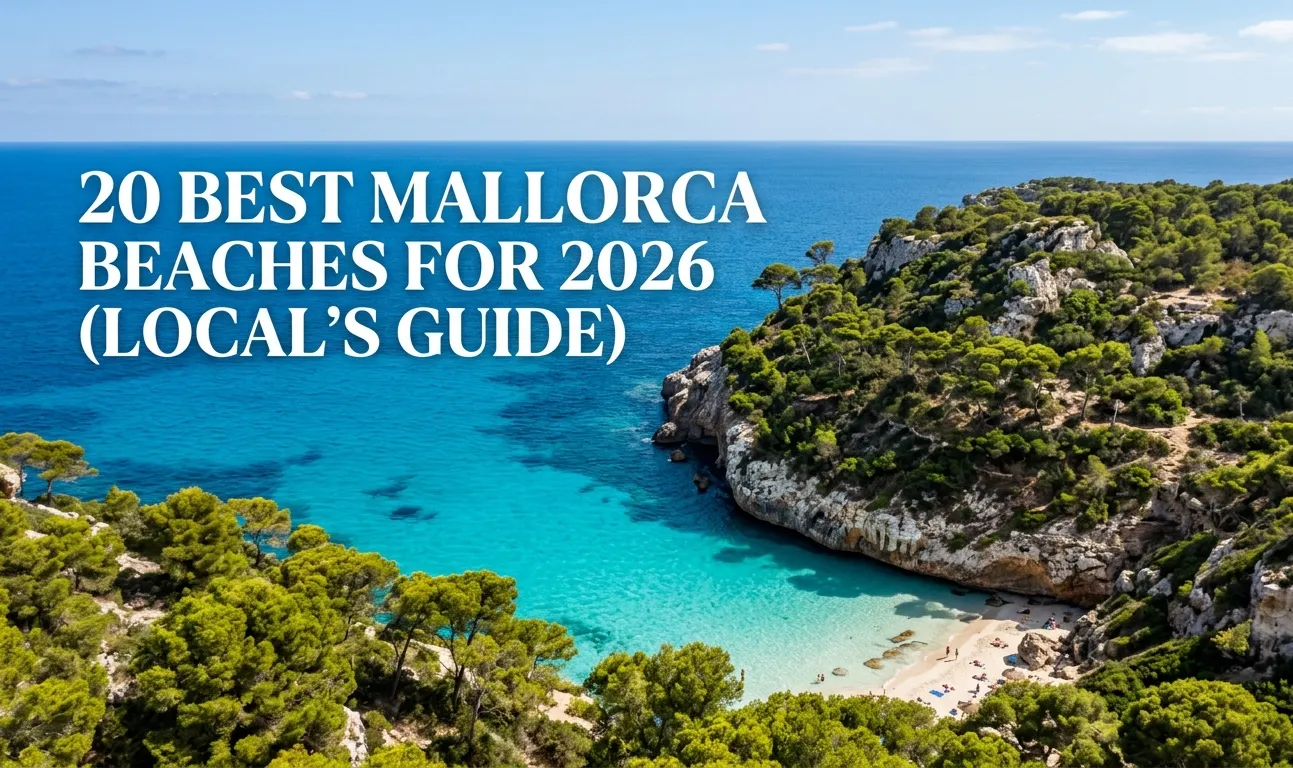
20 Best Mallorca Beaches For 2026 (Local’s Guide)
Mallorca beaches are among the Mediterranean’s most beautiful. The island has over 260 beaches, from white sand coves to dramatic rocky inlets .
But here is the honest truth. The famous coves are spectacular, but July and August crowds are extreme. Parking fills by 9 AM, and you may end up viewing from the cliffs rather than lying on the sand.
This local guide covers every beach worth visiting in 2026. You will learn which coves deliver on their Instagram fame, how to access them, and which regions suit your travel style.
Mallorca Beaches: Overview By Coast
Mallorca’s coastline divides into four distinct regions. Each region has different beach types, access methods, and crowd levels.
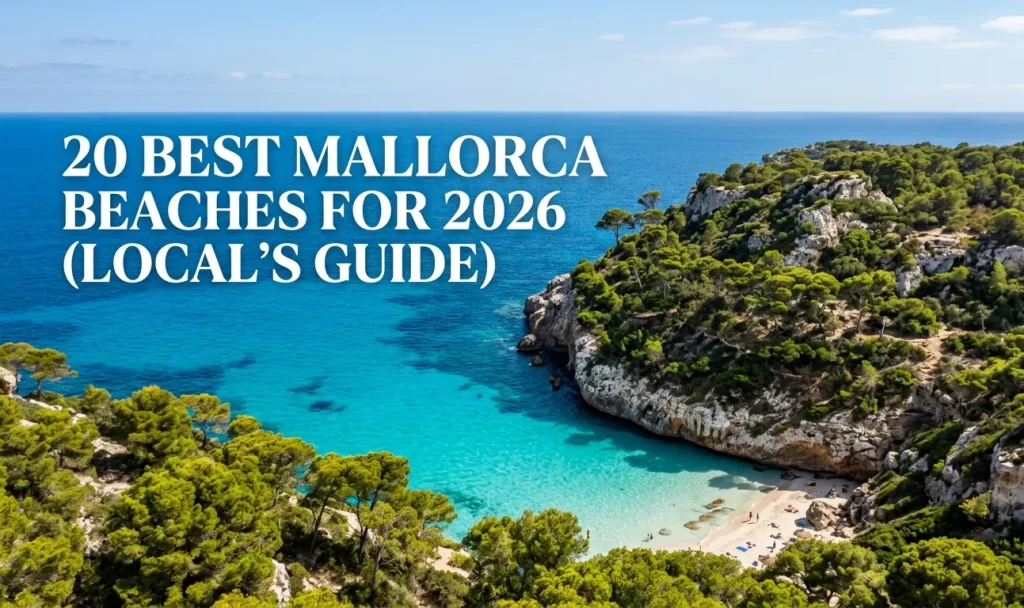
The Southeast Coast between Santanyí and Cala Figuera has the highest concentration of turquoise coves . Caló des Moro, Cala S’Almunia, and Cala Llombards are here. These coves are stunning but extremely crowded in summer.
The North Coast (Alcúdia, Pollença, Formentor) offers longer, shallower beaches. Playa de Muro stretches for 6km with calm water perfect for families . This region handles crowds better because the beaches are larger.
The Tramuntana Coast (west/northwest) has dramatic, rocky coves with mountain backdrops. Sa Calobra and Cala Deià are more about scenery than sand. These require careful driving on mountain roads.
The Palma Area has accessible urban beaches. Illetas and Cala Major are the best close to the city . Can Pere Antoni offers swimming with Palma Cathedral views.
According to the Balearic Government, 2026 is expected to maintain or exceed 2025 visitor numbers . Book rental cars and accommodations well in advance for July and August travel.
Key Takeaway: Southeast has the most beautiful water but worst crowds. North has the best family beaches. Tramuntana has the most dramatic scenery.
Mallorca Best Beaches: Southeast Coves (The Famous Ones)
The southeast coast delivers the postcard-perfect turquoise water Mallorca is famous for. These coves are small, so arrive early .
Cala Llombards is a sheltered cove with fine white sand and pine-fringed cliffs . The water is crystal-clear and calm, ideal for swimming.
The cove features charming fishermen’s boat garages with green doors right by the water. These are classic Mallorca photo spots.
You can walk along a small asphalted path on the cliffs to find private spots. Low rocks are perfect for beginners wanting to try cliff jumping .
Parking is limited. Arrive before 9 AM in July and August or visit in late afternoon.
Cala Mondragó is actually two beaches inside a natural park. S’Amarador is the prettier of the two, with softer sand and better snorkeling on the left side .
The water is shallow and calm. This makes it great for swimming without constant waves.
The beach is part of the Mondragó Natural Park, so development is minimal. Porto Petro harbor is a short walk away for lunch or dinner .
Cala d’Or is a resort town with multiple coves rather than one single beach. Cala Gran is the largest with a long sandy stretch and cafes above .
Cala Esmeralda is small but incredibly photogenic, with bright turquoise water and pines growing right to the water’s edge .
Caló d’es Pou is quieter and less crowded. Cala Ferrera is furthest from the town center and much quieter than Cala Gran .
All these coves have white sand and gentle water entry. They are accessible by bus, making them good options for low season trips .
Cala Figuera is not a beach but a scenic fishing port. The narrow bay with blue waters, white boats, and white fishermen’s houses is one of Mallorca’s most photogenic spots .
There is a trail along the coast called the “Photography Route.” This is an excellent stop between beach hops.
Key Takeaway: Cala Llombards and Cala Mondragó are the best southeast coves for actual swimming. Cala d’Or offers multiple options in one resort town.
Beaches In Mallorca: Es Trenc And The Salt Flats
Es Trenc is Mallorca’s most famous beach, and for good reason. The 2km stretch of white sand has no buildings behind it, just low dunes and salt flats .
The water is that almost-offensive shade of turquoise. People comment “is this really Spain?” on their Instagram photos. Yes, it lives up to the hype .
The catch is serious. In July and August, this place is an absolute zoo. Towel-to-towel, fighting-for-parking crowds with someone’s speaker playing reggaeton.
Parking costs approximately €5-7. Sunbed rentals run €10-15, which feels steep until you have walked 20 minutes from the lot in flip-flops .
Visit in May or September for the best experience. The water is still beautiful, and you can actually find a spot that does not involve close contact with strangers.
Walk further from the main parking lot entrance, and the crowds thin out fast. The beach is long, and most people stop at the first section they see.
Insider Tip: The salt flats behind the beach sometimes have flamingos. Actual pink flamingos in Mallorca. Nobody talks about this enough .
Es Trenc 2026 planning:
- Go in the morning for calmest winds and flattest water
- Bring your own umbrella and water, as shade is limited
- The beach is partially nudist-friendly, especially at the far ends
- Weekdays are significantly quieter than weekends
Key Takeaway: Es Trenc is Mallorca’s most spectacular sand beach but avoid July and August if possible. May, June, and September are the sweet spots.
Best Beaches In Mallorca Spain: Caló des Moro To Cala S’Almunia
Caló des Moro is the Instagram darling of Mallorca. The tiny slot between cliffs holds almost neon turquoise water .
Here is the thing everyone leaves out of their captions. It is absolutely tiny. Maybe 30 people fit comfortably .
Show up before 9 AM or accept that you will be standing on a cliff looking down at it. The view from above is still great but not what you planned.
The beach has white sand despite some stones. It is very pleasant for swimming, though not the best for children because access is tricky .
For couples who love adventure, this is exactly where you should go.
Cala S’Almunia is right next door and slightly bigger. This rocky cove has old fishing boathouses carved into the rock .
Fewer people come here, and the water is equally gorgeous. I actually prefer this underrated sibling .
Cala S’Almunia is not a typical sandy beach but a small rocky cove surrounded by cliffs. Several old fishermen’s huts give it picturesque charm .
Getting here takes effort. You walk down a steep trail and stone stairs. The crystal-clear water is worth it.
Insider Tip for Caló des Moro and Cala S’Almunia:
- Park on the main road and walk down. Do not attempt to drive down the narrow access road
- Visit at sunrise for the famous light and empty coves
- Bring water shoes, as the entry is rocky at Cala S’Almunia
- Cliff jumping is better at Cala S’Almunia, where the rocks are lower and safer for beginners
Key Takeaway: Caló des Moro is for photos and bragging rights. Cala S’Almunia is the better spot for actually swimming and cliff jumping.
Beaches Mallorca: Cala Llombards And Cala Mondragó
Cala Llombards is one of Mallorca’s most photogenic and comfortable coves. The small cove has fine white sand framed by rocky cliffs covered in pine trees .
Aside from crystal-clear turquoise water, this beach features charming boat garages for fishermen right by the water. Look for those pretty green doors.
The rocks along the cliffs have a small asphalted walkway. You can find a spot for yourself there and leave your belongings while you swim.
From there, you can jump into the water from the cliffs. The coastal rocks are quite low and perfect for beginners .
Cala Mondragó and S’Amarador are technically two beaches inside the Mondragó Natural Park. S’Amarador is the prettier, with softer sand and better snorkeling along the rocks on the left .
The water is shallow and calm, which makes it great for swimming without getting slapped by waves constantly.
You can walk between the two beaches along a coastal path. The entire park is protected, so the natural setting remains unspoiled.
Cala Pi is a narrow, long cove with a shallow beach that is good for kids. The beach is covered with white sand and stays shallow for a long way out .
It is also a great spot for snorkeling. Swim with a mask around the rocks, and you can see fish.
This cove is very close to Palma city, making it an excellent choice if you are based in the capital without a rental car.
Southeast Beach Comparison for 2026:
| Beach Name | Sand Type | Best For | Crowd Level | Parking Difficulty | 2026 Note |
|---|---|---|---|---|---|
| Cala Llombards | White sand | Swimming, photos | Extreme (summer) | Very hard | Arrive before 9 AM |
| Cala Mondragó | White sand | Families, snorkeling | High | Hard | Natural park, limited facilities |
| Cala S’Amarador | White sand | Snorkeling | High | Hard | Prettier of the two Mondragó beaches |
| Cala Pi | White sand | Families, proximity to Palma | High | Moderate | Good for day trip from Palma |
| Cala d’Or coves | White sand | Resort convenience | High | Moderate | Multiple options in one town |
Key Takeaway: Cala Llombards is the most photogenic. Cala Pi is the most practical for a day trip from Palma.
Best Beaches In Palma De Mallorca: No Car Needed
Not every beach day needs to involve a 90-minute drive and a parking lot prayer circle. These beaches are accessible from Palma by bus or short taxi ride .
Illetas is the best beach close to Palma, full stop. The water is clear, the sand is decent, and there are a few beach clubs if you want someone to bring you a drink without getting up .
It is about 15 minutes from the center of Palma by bus. Not a local favorite by any stretch, but reliably good.
If you are deciding where to stay in Mallorca, the Illetas area puts you close to both the beach and the city .
Platja de Palma is a 6km stretch of fine sand backed by bars, restaurants, and resorts. Free access. Sunbed rental runs approximately €8-15 .
The busiest sections are at Balnearios 5-6 with beach clubs and parties. The ends of the beach are much quieter.
Water is shallow and calm, making this family-friendly. You can walk or cycle the promenade. From Palma Airport, it is a quick taxi ride or Bus A2 straight to Playa de Palma .
Cala Major is an urban beach that looks like one. But here is why it is included. The Fundació Pilar i Joan Miró is right there .
Spend a morning looking at Miró’s studio. It is still set up like he just stepped out for coffee. Then walk to the beach for a swim. Art plus swimming in the same morning is a pretty good deal.
How to reach Palma beaches by public transport in 2026:
- For Illetas: Take EMT bus from Palma city center (approximately 15-20 minutes)
- For Playa de Palma: Take Bus A2 from Palma Airport or local TIB buses from city
- For Cala Major: Frequent EMT buses from Plaza España or Paseo Mallorca
- Buy a multi-ride card or use contactless payment for best value
- Buses run frequently in summer, approximately every 15-30 minutes
Key Takeaway: Illetas is the best quality beach near Palma. Playa de Palma is the most convenient from the airport. Cala Major is best combined with the Miró museum.
Palma Beaches: Illetas, Cala Major, And Can Pere Antoni
Can Pere Antoni is the city beach in Palma proper. It is nothing special as a beach, but you can swim with a view of the Palma Cathedral rising above the old town .
That is genuinely cool. Good for a quick dip, not for a full beach day.
The beach is easily accessible from Palma’s historic center. You can walk from the cathedral area in about 15-20 minutes.
Playa de Palma deserves another mention for its sheer size. The 6km stretch means you can always find space if you walk away from the main entrances .
Sectors 3 and 4 are quieter than the Balnearios area near the airport. The water stays shallow for a long distance.
Palma Beach Quick Reference:
| Beach Name | Distance from City Center | Best For | Water Quality | Facilities |
|---|---|---|---|---|
| Illetas | 15 min bus | Overall quality | Clear | Beach clubs, restaurants |
| Cala Major | 10 min bus | Miró museum combo | Good | Restrooms, showers |
| Can Pere Antoni | 15 min walk | Cathedral views | Moderate | Limited |
| Playa de Palma | 25 min bus/15 min taxi | Long beach walks | Good | Full amenities |
Key Takeaway: Stay in Illetas if you want a beach-focused trip near Palma. Stay in the city center and use Can Pere Antoni for a quick swim between sightseeing.
Majorca Beaches: North Coast Family Favorites
The north coast is where families should base themselves. Long, shallow beaches with calm water make this region perfect for young children .
Playa de Muro stretches for 6km along the Bay of Alcúdia. The water is so shallow you can walk out what feels like forever .
It is the best family beach on the island, hands down. The water stays warm because it is shallow. Little kids can splash around safely.
There is enough space that even in August you will not feel packed in. The secret is to walk to Sectors 3 and 4, away from the hotel zone. It thins out fast .
Port d’Alcúdia is another family favorite with a 10km stretch of sandy beach. Perfect for toddler paddling .
The town has a wide promenade with restaurants and shops. Water sports like paddleboats or kayaks are available for older kids.
Port de Pollença has scenic mountain backdrops. Stroll the pine walk, stopping at little cafés for ice cream .
The water is calm and shallow, similar to Alcúdia but with a more relaxed, upscale village atmosphere.
Cala Mesquida surprised me. It has actual sand dunes behind it, golden sand instead of white, and it gets real waves .
If you have been to a dozen flat-calm turquoise coves and want something with more energy, this is your beach.
North Coast Family Beach Decision:
| Beach Name | Sand Type | Water Depth | Facilities | Crowd Level |
|---|---|---|---|---|
| Playa de Muro | Golden sand | Very shallow, walk out far | Full facilities | High but spread out |
| Port d’Alcúdia | Golden sand | Shallow | Full facilities, water sports | High |
| Port de Pollença | Golden sand | Shallow | Good facilities | Moderate to high |
| Cala Mesquida | Golden sand | Moderate, some waves | Limited | Lower |
Key Takeaway: Playa de Muro is the top choice for families with toddlers. Port de Pollença has the most scenic mountain setting.
Top Beaches In Mallorca: Formentor And Alcúdia
Cala Formentor is the classic Mallorca photo. Pine trees grow right to the edge of pale sand, and water shifts from emerald to deep blue .
It is beautiful in that way where you take 47 nearly identical photos and think every single one is a masterpiece.
Important 2026 access change: From June through September, private cars are banned from the road to Formentor. You will need to take a shuttle bus from Port de Pollença .
It is not a big deal, but plan for it. The bus service runs frequently in summer.
The beach is 1.5km long with shallow, very clean water. There are cafes and restaurants by the beach. Sun loungers and umbrellas are available .
Port d’Alcúdia has the longest beach in Mallorca at approximately 10km. The wide beach has a wonderful promenade and is very convenient for holidays with children .
The water is shallow for a long distance. The seabed is sand, not rocks or stones.
The town has hotels, restaurants, and a marina. This is the most developed beach resort in the north.
Bay of Alcúdia between Port d’Alcúdia and Playa de Muro is effectively one continuous beach. You can walk for miles along the shoreline.
Formentor 2026 Planning:
- Take the shuttle bus from Port de Pollença. Do not attempt to drive past the restricted point
- Go early morning or late afternoon for the best light and slightly fewer crowds
- Combine the beach with the drive to Cap de Formentor viewpoint
- Bring water and snacks. The beach cafes are busy and pricey
Key Takeaway: Formentor is Mallorca’s most scenic north coast beach but requires the shuttle bus in summer. Port d’Alcúdia is easier for a standard resort beach day.
Palma Spain Beaches: Urban Swimming With Cathedral Views
Palma’s urban beaches are often overlooked by guidebooks focused on remote coves. But these have their own charm.
Can Pere Antoni sits directly in front of Palma’s seafront promenade. The beach is wide with fine sand.
The real draw is the view. The Cathedral (La Seu) and the old city walls rise directly behind the beach .
It is not a destination beach for a full day. But for an afternoon swim between museum visits or before dinner, it is perfect.
The beach has basic facilities including outdoor showers and a few beach bars. No sunbed rentals are available.
Cala Major is slightly further from the city center. This urban beach has more space and better facilities than Can Pere Antoni.
The Miró museum is a 10-minute walk away. Combine art and beach in one morning .
Playa de Palma is further from the city center but easily reached by bus. The 6km length means you can always find space.
Palma Urban Beach Quick Guide for 2026:
| Beach Name | Time from Cathedral | Facilities | Vibe | Best For |
|---|---|---|---|---|
| Can Pere Antoni | 15 min walk | Basic | Local, authentic | Quick swim with view |
| Cala Major | 15 min bus | Good | Mixed | Museum and beach combo |
| Illetas | 20 min bus | Excellent | Resort | Half-day beach trip |
| Playa de Palma | 25 min bus | Full | Tourist | Long beach walks |
Key Takeaway: Can Pere Antoni is for the experience of swimming beneath the Cathedral. Go for sunset for the best photos.
Most Beautiful Beaches Mallorca: Cala Varques And Cala Marmols
These beaches are for people who think parking lots and sunbed rentals are too easy. You will earn every one of these .
Cala Varques is a wild, undeveloped beach with fine white sand and shallow water perfect for snorkeling. The shoreline is fringed with rocky cliffs ideal for cliff jumping .
You can walk along the coast from Cala Varques to find a natural sea arch. This is one of the coolest rock formations in the area, and you can actually walk across the natural bridge .
The beach requires a 20-25 minute walk from where you park your car on the side of a dirt road. There are zero facilities. No bathrooms, no snack bars, no lifeguards .
What you get instead are sea caves you can actually swim into. Water so clear you can see fish from the cliff above. And the smug satisfaction of having worked for it.
Important legal note for 2026: Access to Cala Varques has been legally disputed on and off for years. Check with locals or your hotel before making the trek .
Cala Marmols (Caló des Màrmols) is the big one. The marble cliffs (that is literally what “marmols” means) are stunning.
This is a 5-6km hike each way from the lighthouse at Cap de ses Salines. That is about 2 hours of walking in the sun with no shade .
Bring at least 2 liters of water per person. Wear real shoes, not the cute sandals you bought at the Palma airport.
The completely empty beach at the end is worth every sweaty step. I have never felt more accomplished lying on a beach in my life .
Packing for Cala Varques and Cala Marmols:
- At least 2 liters of water per person (more for Cala Marmols)
- Food and snacks, as there are no facilities
- Water shoes for rocky entries and sea cave swimming
- Sunscreen and a hat, as shade is limited
- A fully charged phone for emergency and navigation
- Tell someone where you are going and when you expect to return
Key Takeaway: These are adventure hikes, not casual beach days. Do not attempt Cala Marmols without proper preparation and footwear.
Most Beautiful Beaches In Mallorca: Tramuntana Coast Gems
The Tramuntana coast is different from the rest of Mallorca. These are not sunbathing beaches. You are not going to spread out a towel and nap comfortably on any of them .
They are dramatic scenery that happens to have water you can swim in. That is why they are special.
Sa Calobra and the Torrent de Pareis are famous for good reason. The drive alone is wild. The road down has a 270-degree loop where the road literally crosses over itself .
At the bottom, you walk through a short tunnel to reach a pebbly beach at the mouth of a massive gorge. The cliffs tower hundreds of meters on both sides.
Photos do not do it justice. Go before 9:30 AM or after 5 PM. Between those hours, tour buses line the parking lot and the beach is shoulder to shoulder .
Early morning is genuinely magical. You will have the gorge practically to yourself with morning light hitting the cliff walls.
Cala Tuent is Sa Calobra’s quiet neighbor. Same beautiful road, same dramatic coastline, about a tenth of the people .
Grab lunch at Es Vergeret, a little restaurant right on the beach that does grilled lamb over wood fire. It is the kind of meal you think about for months after .
Cala Deià is a rocky cove below the beautiful village of Deià. This makes a perfect stop on a day trip to Sóller and Deià.
Scenes from the BBC’s The Night Manager were filmed here . Ca’s Patró March, the restaurant perched on the rocks above, does excellent fish and has one of the most photogenic restaurant settings in Mallorca.
The portions are big and the prices are also big. But the view is free.
Tramuntana Coast Driving Warning:
The mountain roads to Sa Calobra and Cala Tuent are narrow, winding, and have steep drop-offs. Drive carefully. Allow extra time. Do not attempt if you are uncomfortable with mountain driving. Consider booking a tour bus instead.
Key Takeaway: The Tramuntana coast is for scenery and photography, not sand. Sa Calobra is spectacular but requires careful timing to avoid tour bus crowds.
Hidden Beaches Mallorca: Cala Tuent, Cala Bóquer, And Coll Baix
These are the beaches for travelers who want to get away from everyone. Access is difficult, but solitude is the reward.
Cala Bóquer near Pollença is a 30-minute hike through a valley. You will almost definitely see mountain goats along the way .
The beach itself is rocky, not sandy. Do not expect to lie down comfortably. But the water is crystal clear, and the setting is wild.
You will probably share it with about six other people and several goats. Fair trade .
Access involves approximately 2 kilometers of walking, creating a natural barrier that helps keep visitor numbers lower .
Platja des Coll Baix near Alcúdia takes about 30-40 minutes of hiking down a rocky trail. The beach sits at the base of massive cliffs that make you feel tiny .
It is dramatic and wild and the kind of place where you eat your squished sandwich and feel like an adventurer.
Cala Tuent also qualifies as hidden, though it is accessible by car. The road is challenging enough that many tourists skip it .
The beach itself is pebbly, not sandy. But the setting between steep, forested mountains is extraordinary.
Sant Elm Beach in the southwest is not hidden by hiking but by location. The small seaside village sits across from the wild island of Sa Dragonera .
The water here is incredibly clear. From the beach, you can see Sa Dragonera Natural Park, a protected island that gets its name from its dragon-like shape.
This is a peaceful alternative to the crowded southeast coves. Combine with a boat trip to Sa Dragonera.
Hidden Beach Access Summary:
| Beach Name | Access Time | Difficulty | Facilities | Best For |
|---|---|---|---|---|
| Cala Bóquer | 30 min hike | Moderate | None | Goats, solitude |
| Platja des Coll Baix | 35-40 min hike | Moderate to hard | None | Dramatic cliffs |
| Cala Tuent | Drive (mountain road) | Hard (road) | One restaurant | Scenic drive reward |
| Sant Elm | Direct access | Easy | Some facilities | Sa Dragonera views |
Key Takeaway: Cala Bóquer is the most accessible “hidden” beach. Platja des Coll Baix has the most dramatic cliff setting.
Safety And Seasonal Warnings For Mallorca Beaches
Mallorca beaches are generally safe, but each has specific hazards. Pay attention to conditions, especially on remote coves.
Rip currents exist at exposed beaches. Es Trenc, Playa de Muro, and Formentor can have rip currents, particularly on windy days. Swim near lifeguard stations where present.
Jellyfish appear occasionally in summer. The Pelagia noctiluca (mauve stinger) is the most common. Beach staff post purple flags when jellyfish are present. Vinegar rinses help with stings.
Extreme sun and heat are serious from June through August. UV index regularly exceeds 9. Use reef-safe sunscreen, wear a hat, and seek shade between 1 PM and 4 PM.
Mountain driving risks on the Tramuntana roads. The drive to Sa Calobra is narrow with hairpin turns. Allow extra time and drive defensively. Tour buses use these roads, so be prepared to reverse into passing bays.
Cala Varques access is legally uncertain. Check with local tourist offices or your hotel before driving there. The path has been closed on and off due to property disputes .
Parking and heat stroke prevention: Do not leave people or pets in parked cars. Parking lots are often unshaded, and interior car temperatures become lethal quickly. Bring at least 1 liter of water per person for a half-day beach trip.
Cala Marmols specific warning: This is a 2-hour hike each way with no shade, no water, no facilities. Do not attempt in July or August midday. Start at sunrise, bring at least 2 liters of water per person, and wear proper hiking shoes.
Emergency services in Mallorca:
- Dial 112 for all emergencies (works in Spanish and English)
- Lifeguards are present at major beaches (Es Trenc, Playa de Muro, Formentor, Illetas) during official season
- Hospital Universitari Son Espases in Palma is the major public hospital
- Private clinics include Clínica Juaneda and Hospital Rotger in Palma
Frequently Asked Questions About Mallorca Beaches
What is the most beautiful beach in Mallorca?
Caló des Moro has the most spectacular turquoise water and cliff setting, but it is extremely small and crowded. For a beach you can actually enjoy, Cala Llombards or Es Trenc are better choices. Cala S’Almunia offers similar beauty with fewer people .
Does Mallorca have sandy beaches?
Yes, Mallorca has many sandy beaches. Es Trenc has 2km of white sand. Playa de Muro has 6km of golden sand. However, many of the most dramatic coves like Cala S’Almunia and Sa Calobra are pebbly or rocky rather than sandy .
What is the best area in Mallorca for beaches?
The southeast coast between Santanyí and Cala Figuera has the most beautiful turquoise coves. The north coast around Alcúdia and Pollença has the best long, sandy family beaches. Choose based on whether you want photos (southeast) or space for children (north) .
Which part of Mallorca has the clearest water?
Caló des Moro, Cala S’Almunia, and Cala Llombards in the southeast have the clearest, most turquoise water. The water visibility is exceptional due to the rocky seabed and protection from waves. Es Trenc also has very clear water when conditions are calm .
What is the busiest beach in Mallorca?
Es Trenc is the most crowded beach in Mallorca during July and August. Caló des Moro is extremely crowded relative to its tiny size. Formentor also gets very busy, especially after 10 AM. Visit any of these in May, June, or September for a better experience .
When is the best time to visit Mallorca for beach weather?
The best time is May-June and September-October. Temperatures range from 20-28°C (68-82°F) during these months . July and August are very hot (28-35°C / 82-95°F) and extremely crowded. Water is warm enough for swimming from June through October.
Your Next Steps For Mallorca Beaches In 2026
Decide which region matches your travel style first. Southeast for beautiful photos. North for family space. Tramuntana for dramatic scenery.
Rent a car unless you are staying only in Palma. You cannot reach the beautiful southeast coves or remote north beaches without one. Book your rental car at least two months in advance for summer 2026.
If you cannot rent a car, base yourself in Palma and use TIB buses. You can reach Es Trenc, Cala Pi, and Alcúdia by public transport . But you will miss Caló des Moro, Cala Varques, and the Tramuntana coves.
Arrive at popular coves before 9 AM. Parking is the limiting factor, not beach space. Bring your own umbrella, water, and snacks to remote beaches.
Visit in May, June, or September if you have any flexibility. July and August are genuinely difficult. The beaches are beautiful but the crowds are extreme.
Mallorca has over 260 beaches . You cannot see them all. Choose two regions and explore deeply rather than driving across the island daily.
Verify all 2026 access restrictions (Formentor car ban, Cala Varques legal status) with local tourist offices before traveling. These details were current at publication but may change.