Big Island Beaches Guide for 2026: The Raw & Real Truth
Most guides to Big Island beaches sell a Maui or Kauai fantasy.
They show a picture of a soft, endless white crescent you will never find here.
The Big Island is a violent, volcanic teenager. It refuses to conform.
Its beaches are black grit, green mystery, and hard-won white pockets.
This 2026 guide does not pretend the lava rocks are a soft massage bed.
It names the exact season, swell, and shoe you need to survive and love this coast.
We cover the life-saving winter swap, the vog days to avoid, and the secret spots.
You will walk away knowing exactly which beach to visit on your exact travel date.
Big Island Beaches: The Volcanic Difference
The Big Island is geologically a baby, just half a million years old.
Its rocky lava coastline has not had time to soften into powder.
You will not find an endless, gentle, sandy shelf like on Oahu or Maui here.
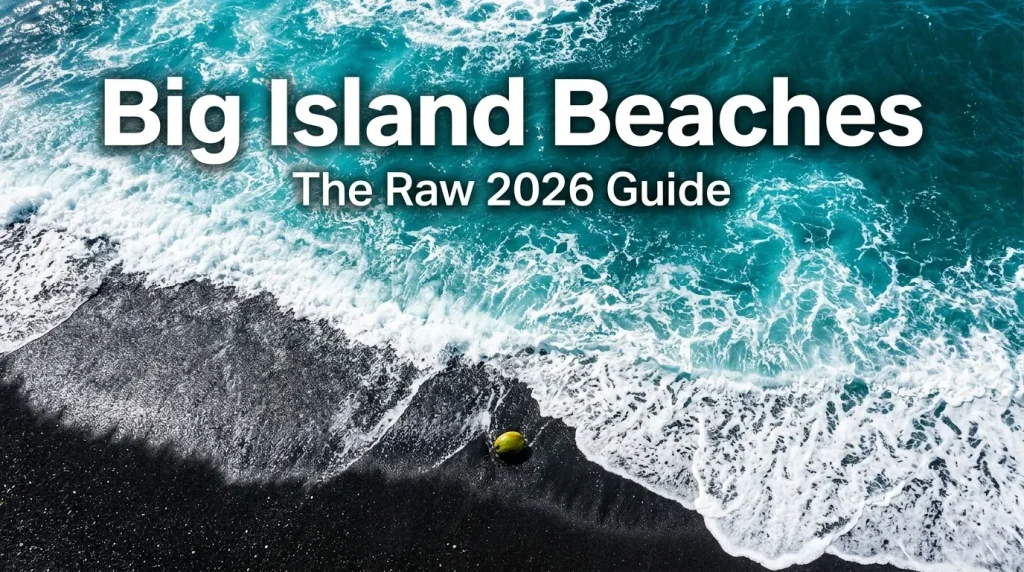
Instead, you find a raw collision of molten black rock and a violent deep blue Pacific.
What This Coastline Is
You get pocket beaches of coral rubble, black volcanic glass grit, and rare olivine gems.
The entry is often over a sharp, slippery, urchin-filled lava shelf, not soft sand.
Water shoes are not optional here. They are mandatory safety equipment.
A wave can slam you onto the rocks and turn a simple swim into a bloody emergency room visit.
The Seasonal Personality
The Big Island has no protective outer reef rings to flatten the huge ocean swells.
A summer north shore is a calm turquoise swimming pool, perfect for kids.
That exact same beach in winter is a lethal 20-foot shorebreak that kills tourists annually.
You must know the seasonal swap, or you will drive to the wrong coast and find a death trap.
Hawaii Big Island Beaches: What to Know First
Your entire Big Island beach trip hinges on one single rule.
North-facing beaches are for summer. South-facing beaches are for winter.
If you forget this, you waste gas, time, and potentially your life.
The Hawaii Department of Land and Natural Resources (DLNR) posts red warning flags that you must obey.
The Sun & Skin Reality
The sun here is a malicious equatorial laser, even on a cloudy Kona day.
The trade winds cool your skin and trick you into a severe, trip-ruining sunburn.
Use SPF 50 or higher, and reapply it every single hour after swimming.
Only use reef-safe mineral sunscreen. Chemical sunscreens are banned and will be confiscated.
Vog: The Invisible Beach Ruiner
The Kilauea volcano emits “vog,” a sulfur dioxide haze that can choke the Kona Coast.
It can turn a pristine ocean view into a gray, smoggy, respiratory nightmare.
Check the University of Hawaii Vog Measurement and Prediction Project daily.
On a heavy vog day, drive north to Kohala, which often sits above the trapped air.
Key Takeaway: Match your coast to the season, wear shoes, and check the vog forecast.
Beaches on Big Island Hawaii: A Regional Guide
The Big Island’s beaches are clustered into four distinct, drivable zones.
Your choice of hotel or rental determines your “home coast” for the week.
You must budget massive drive times. This island is the size of Connecticut.
A “quick” trip from Kona to Hilo is a full-day, exhausting, two-hour one-way mission.
Kona Town & Ali’i Drive
This is the tourist hub, a mix of rocky shore entries and small sandy coves.
Magic Sands Beach appears and disappears with the seasons, hence the name.
It’s a convenient, central home base for travelers who want walkable coffee and restaurants.
It serves the first-time visitor who prioritizes convenience over raw, empty beauty.
The Kohala Gold Coast
The stretch north of the Kona Airport is the sunniest, driest, and most resort-dense coast.
Here, you find the “classic” sandy Hawaii beaches like Hapuna, imported and manicured by mega-resorts.
It serves the luxury resort traveler and the family who wants a calm, predictable beach day.
Non-guests can access these beaches, but public parking is painfully limited and fills by 8 AM.
Hilo & The East Side
Forget swimming here. This is a wild, black-sand, crashing coastline of raw power.
It serves the nature lover, the surfer, and the photographer seeking a dramatic volcanic backdrop.
The Deep South (Ka’u)
This is the wild, empty, spiritual heart of the island, home to the green and black sand titans.
It serves the adventurer with a full day and a full tank of gas.
Best Beaches in Hawaii for Families: Big Island Edit
A family beach on the Big Island demands a very specific set of traits.
You need a lifeguard, a sandy shallow entry, and a north-facing summer location.
Do not experiment with a family. A wrong choice here is a terrifying, dangerous event.
Stick to these three named parks, and your kids will call this the best trip ever.
Spencer Beach Park (Kawaihae)
Spencer Beach Park is the single safest, best family beach on the Big Island.
A massive offshore reef breaks the power of the winter surf, creating a calm, shallow lagoon.
The sand is soft, the shade is plentiful from ironwood trees, and there are full facilities.
It perfectly serves families with toddlers and nervous parents needing a predictable, gentle Pacific entry.
Waialea Beach (Beach 69)
Waialea Beach, nicknamed “Beach 69,” is a sheltered, tree-lined gem just south of Hapuna.
The snorkeling on the fringing reef is superb and gentle, perfect for older kids.
The water is calm and shallow in the summer months, with a soft sandy bottom.
Families with elementary-school-aged children will find this a magic, safe, and shaded playground.
Hapuna Beach State Park in Summer Only
Hapuna is the island’s most famous long, white-sand beach, a true swimming paradise from May to September.
In winter, it is a deadly, closed-out shorebreak that severely injures people.
Family visitors must only come to Hapuna on a calm, flat summer day with a lifeguard on duty.
Budget travelers save money by using the large state-run parking lot and packing a full-day picnic.
Best Beaches on the Big Island of Hawaii for Swimming
A true swimming beach here is a rare and precious seasonal gift.
You want a soft entry, a sandy bottom, and no pounding shorebreak.
The answer is never fixed. It changes by the month.
Check the date on your phone, then consult this 2026 guide.
Kua Bay (Manini’owali)
Kua Bay is the goldilocks beach of the Kona Coast, a perfect crescent of white sand.
The water is an almost supernatural turquoise, set against a black lava cliff backdrop.
The swimming is glorious, but the shorebreak can snap an ankle on an incoming tide.
It serves active couples and strong swimmers looking for the island’s most postcard-perfect swimming hole.
Parking is limited, and the pavement is lava-sharp, so drive a sturdy rental car.
Go early morning or late afternoon to get a spot and avoid the blazing midday lava heat.
Mauna Kea Beach
Mauna Kea Beach, fronting the legendary hotel, is considered the archetypal soft, sandy crescent.
The public can access it, but the resort controls the gate, issuing only a fixed number of non-guest passes.
The water is often calm, clear, and shockingly beautiful against the hotel’s manicured backdrop.
A luxury seeker staying at the hotel has a five-star day. A budget traveler gets turned away by 9 AM.
Makole’a Beach (For Strong Swimmers Only)
Makole’a Beach in Kona is a local’s haven near the old Kona Lagoon Hotel site.
It’s a secluded, sandy cove with volcanic rocks protecting it from the open ocean swells.
The entry is smooth and the swimming is excellent when the Kona side is calm.
This serves the confident, adventurous local-seeker who wants to escape the guidebook crowds.
Key Takeaway: Your favorite swimming beach must face away from the current season’s swell.
Big Island Beaches for Snorkeling
The Big Island’s new, sharp lava reefs attract more sea life than old, dead sandbars.
You snorkel to see the volcanic architecture covered in living coral and turtles.
The water is cooler and clearer than the Caribbean, so rent a thin wetsuit top.
These specific spots are the 2026 gold standard for safety and underwater payoff.
Two Step (Honaunau Bay)
Two Step is the single greatest shore-entry snorkel spot on the Big Island.
A natural lava-rock staircase (“two steps”) lets you enter the crystal-clear, protected bay.
The coral gardens are healthy, and swimming with grazing green sea turtles (honu) is guaranteed here.
According to Go Hawaii, this is a “must-do” but requires arriving before 9 AM to find parking.
Kealakekua Bay (By Kayak or Boat)
The Captain Cook Monument across Kealakekua Bay is a snorkeling mecca.
You cannot legally hike down to it easily, so book a guided kayak tour or a boat charter.
The coral garden next to the monument is dense, filled with vibrant fish, and historically fascinating.
It serves the adventuring couple perfectly. Budget travelers can rent a kayak for a cheaper DIY crossing.
Waialea Bay (The Family Reef)
The fringing reef at Waialea Bay is accessible directly from the soft sand.
This is the best place for a child or a nervous beginner to see bright tropical fish.
Stay to the rocky sides of the bay where the fish congregate.
Don’t touch the coral. It’s sharp, fragile, and protected by a strict legal fine.
Hawaii Island Beaches with White Sand
True natural white sand is rare on this young volcanic island.
Most white sand is either a state park miracle or a resort’s expensive import.
You find three types: the perfect state park, the exclusive resort-access beach, and the remote treasure.
The map below navigates the truth for each profile.
| White Sand Beach | Sand Source | Swimmable? | Honest Profile Match |
|---|---|---|---|
| Hapuna State Park | Natural/Imported mix | Summer Only (dangerous in winter) | Active families, sunbathers |
| Kua Bay | Natural coral rubble | Excellent (watch shorebreak) | Couples, strong swimmers |
| Mauna Kea Beach | Resort-manicured natural | Excellent (calm) | Luxury guests, early-bird public |
| Makalawena Beach | 100% Natural, wild | Good, mild shorebreak | Fit hikers, adventure seekers |
Makalawena is the wildest, purest white sand dream on the Big Island.
It’s a 20-minute hike over a brutal, black, shadeless lava field from the Kekaha Kai State Park lot.
You walk through a lunar apocalypse and emerge into a pristine, empty, white-sand mirage.
It serves the fit, prepared adventurer who carries in water, shoes, and an umbrella.
Resort Sand: The Imported Truth
Beaches like the one at the Waikoloa Beach Marriott are artificially maintained and often semi-enclosed.
They are fake, but for a family with nervous toddlers, they are the safest, calmest option on the coast.
Budget travelers need to know these lagoons are technically public but have zero public parking.
You must eat at the resort restaurant to validate parking, which costs a premium lunch fee.
The Big Island Black Sand Beaches
Black sand is not a gimmick. It’s the Big Island’s primary geological identity.
You are standing on powdered lava, still warm from the earth’s mantle in geological time.
These beaches are often backed by coconut palms, creating a surreal visual contrast.
They are beautiful, but they get physically scorching hot in the midday sun.
Punalu’u Black Sand Beach
Punalu’u is the most famous and accessible black sand beach, located on the deep south coast.
Massive honu turtles regularly haul out onto the jet-black sand to rest, completely unbothered by humans.
The visual is stunning, a jet-black shore pounded by a cyan-blue Pacific wave.
It serves photographers, families, and nature lovers who crave a guaranteed turtle sighting.
Never touch the turtles. A massive federal fine protects them.
The water entry here is rocky, often rough, and has a powerful rip current. Swim with extreme caution at the protected north end.
Pololu Valley Beach
Pololu is a dramatic black sand beach at the end of the road on the wild northern tip.
You hike a steep 25-minute trail down a lush cliffside into a raw, powerful valley.
The beach is a massive driftwood-and-black-sand cathedral battered by massive waves.
This is a visual, spiritual experience, not a swimming beach. Do not enter the water here.
Green Sand Beach Big Island: The Truth
Papakolea Green Sand Beach is one of only four green sand beaches in the world.
The rare green crystals are olivine, a semi-precious peridot mineral from a cinder cone.
The truth is, it’s a long, hot, controversial journey to see it.
You must decide if the effort and ethical friction are worth it for you.
The Hike (And The Trucks)
The “official” path is a brutal, 5.5-mile round-trip walk along a shadeless, rutted, dusty 4×4 road.
Locals in pickup trucks offer a cash ride across the fragile cultural land, a practice in a legal gray zone.
The Hawaii DLNR strongly advises against the illegal shuttle service due to erosion and land damage.
Walking the route is physically demanding and requires at least two liters of water per person.
The Beach Itself
The beach is a steep, small, olive-tinted crescent, beautiful and surreal to see.
The shorebreak is powerful, dangerous, and not safe for casual swimming or children.
Honeymooners and photographers seeking a bucket-list sight will find it surreal and romantic.
Families with young children or anyone with mobility issues must skip this entirely.
Key Takeaway: The green sand beach is a strenuous, ethical pilgrimage, not a relaxing beach day.
Kona Coast Beaches: The Resort Row
The Kona Coast is the sun-blasted, volcanic western shore from the airport to Keauhou.
This is the island’s tourism nerve center, packed with condos, resorts, and easily accessible coves.
The vibe is convenient, social, and near all the best post-beach happy hours.
You trade total solitude for air conditioning and a cocktail on Ali’i Drive.
Magic Sands Beach (La’aloa Bay)
Magic Sands is a small, bustling city beach right on Ali’i Drive in Kailua-Kona.
The sand literally vanishes overnight during winter swells, leaving a bare rocky shelf.
When the sand is there, it’s a fun, central body-surfing and sunbathing hub.
It serves the solo traveler or young couple staying right in town who wants a quick, social dip.
Kahalu’u Beach Park
Kahalu’u is the best beginner snorkeling spot on the island, period.
A natural breakwater calms the water and attracts a massive, colorful, dense fish population.
It’s often crowded with families and tour groups, but the fish action is non-stop.
Budget travelers can rent cheap gear across the street and enter a world-class aquarium for free.
Kealakekua Bay State Historical Park
This is the epic, historically significant bay looking across to the Captain Cook Monument.
You don’t swim to the monument from here (it’s a kayak mission), but the bay views are breathtaking.
The water is a deep, regal, protected turquoise, and the historical weight is profound.
It serves the history buff and the romantic couple perfectly.
Kohala Coast Beaches: The Sunny Escape
The South Kohala Coast is the driest, sunniest, and most luxurious stretch of the island.
This is the Gold Coast, where the mega-resorts and the big sandy beaches live.
It serves the luxury traveler seeking a manicured, predictable, classic Hawaiian beach day.
If you’re staying at the Four Seasons or the Fairmont Orchid, this is your home sandbox.
Hapuna Beach State Park Revisited
Hapuna is the crown jewel of the state park system in Hawaii.
A massive, half-mile stretch of bright white sand and a consistent summer swimming pool.
It’s the best place on the island for a long walk, a game of frisbee, and a solid beach workout.
The facilities, including restrooms and a large parking lot, are the best managed on the Big Island.
Waialea Bay (The Local’s Hapuna)
Locals go to Waialea Bay when Hapuna gets too crowdy and touristy.
It’s a more intimate, shaded, and reef-protected slice of the same perfect Kohala sand.
The snorkeling here is better than at Hapuna, weaving through the calm, clear tree-lined water.
Families with curious kids will find a more engaging, explorable underwater world here.
The Resort-Access Paradox
Beaches like Mauna Kea and Puako technically have public rights of way.
In reality, the resorts strictly gatekeep the parking, leaving only a handful of non-guest spots.
You can legally walk through the Mauna Kea gate, but you cannot park there.
A luxury seeker staying on-site gets a perfect private beach. A budget traveler gets a long, hot, parking-less walk.
Hilo Side Beaches: The Wild East
The Hilo side is a different planet, deeply lush, rainy, wild, and volcanic.
You don’t come here for classic, sunny, lazy beach days on a soft towel.
You come for the raw power of the Pacific, the coconut-fringed black sand, and the waterfall drives.
It serves the nature photographer, the surfer, and the romantic couple who loves a dramatic stormy beach.
Richardson Ocean Park
Richardson Ocean Park near Hilo is a unique black sand family beach.
A natural basalt breakwater creates a calm, protected, spring-fed pool right on the ocean.
The water here is a bit cool and brackish, but it’s exceptionally safe for small children.
It serves the Hilo-based family who wants a unique, safe, volcanic swimming experience far from the tourist Kona crowds.
Carlsmith Beach Park (Four Mile)
Carlsmith is a local’s treasure of calm, cold, spring-fed lagoons set behind a coconut grove.
The water is a glassy, clear, emerald green, and sea turtles are almost always present.
You can swim from one sandy-bottomed lagoon to the next in a peaceful, natural aquatic park.
Budget travelers who fly into Hilo will find this the best free, uncrowded, all-day swimming spot on the east side.
Honoli’i Beach Park
Honoli’i is the Big Island’s most famous and consistent surf break, just north of Hilo.
It serves the adventurous surfer and the spectator wanting a true local Hawaii surf scene.
This is a fast, powerful wave for experienced surfers only, over a rocky and hazardous bottom.
Non-surfing travelers should sit on the cliff and watch the locals dominate the cold, muddy, local-favorite wave.
Secluded Beaches on the Big Island
Seclusion on the Big Island demands sweat, a car with clearance, and a good pair of shoes.
You must hike across a brutal lava field or drive a gnarly 4×4 track to earn your empty sand.
These are the beaches where you’ll find zero facilities, zero lifeguards, and total natural majesty.
They serve the true adventurer and the romantic couple seeking a private volcanic island fantasy.
Makalawena Beach (The Hiker’s Reward)
Makalawena is the ultimate secluded white sand beach on the Kona Coast.
As detailed earlier, the 20-minute lava-field hike is the filter that keeps this place empty.
You carry in everything: water, a shade umbrella, food, and a first-aid kit for lava cuts.
The reward is a pristine, dune-backed, triple-crescent of empty soft sand and brilliant turquoise water.
Kekaha Kai State Park (Mahai’ula Section)
The 1.5-mile rough lava road to Mahai’ula Beach inside Kekaha Kai State Park is a rental car destroyer.
Do not drive it in a Mustang convertible. You need a high-clearance SUV.
The beach itself is a wild, volcanic gem with a lovely stretch of sand and a critical shade tree.
A 4.5-mile roundtrip coastal trail connects Mahai’ula to Makalawena for the ultimate Big Island beach hike.
Waipi’o Valley Beach
Waipi’o Valley on the Hamakua Coast is the sacred, steep-walled “Valley of the Kings.”
Access to the black sand beach has been strictly restricted to residents and tour operators in recent years due to the dangerously degraded road.
Check the Hawaii County Public Works website for the latest 2026 access rules before driving here.
The valley is a spiritual, breathtaking masterpiece, but you may now only view it from the rim lookout.
Big Island Beaches Map: Winter vs. Summer Swap
The most valuable map you can have on your phone is a seasonal one.
You must swap coasts as the massive ocean swells shift with the time of year.
This simple swap chart is worth the entire cost of your flight.
It will save you from wasting a day driving to a dangerous, closed-out beach.
| Season | Best Coast for Swimming | Worst Coast (Avoid) | Primary Swell |
|---|---|---|---|
| Summer (May-Sep) | North-Facing (Kohala: Hapuna, Waialea) | South-Facing (Ho’okena, Miloli’i) | South Swell |
| Winter (Oct-Apr) | South-Facing (Two Step, Kealakekua) | North-Facing (Kohala: Hapuna, Pololu) | North Swell |
| Kona Wind Days | Head Far North to Spencer Beach Park | Kona Coast (Kua Bay, Magic Sands) | Choppy East Wind |
How to Read the Swap
In summer, drive 30 minutes north from Kona to the Kohala Coast for glassy water.
In winter, stay on the sheltered south-facing Kona and South Kona coves.
A winter visit to Hapuna is not a beach day. It’s a life-threatening ocean spectacle for watching only.
Check the NOAA Hawaii Surf Forecast before you leave your hotel every single day.
Big Island Beach Safety and Vog Warnings
The beauty of the Big Island hides an aggressive, unforgiving set of dangers.
The ocean, the sun, and the volcano can all hurt you in a heartbeat.
You are responsible for your own life here. Lifeguards are rare.
Every single year, a tourist dies because they turned their back on a Big Island wave.
Key safety and seasonal facts every visitor must memorize:
- Never turn your back on the ocean. A rogue wave can wash you off a lava shelf in seconds. Watch the water for at least 20 minutes before picking a spot.
- Shorebreaks break necks. A wave that pounds directly onto dry sand will pile-drive you onto the ocean floor headfirst. Do not body-surf at beaches like Hapuna on a rough day.
- Vog is poisonous air. If you have asthma, COPD, or a frail respiratory system, vog can trigger a life-threatening attack. Check the Vog Measurement and Prediction Project daily. Leave the Kona Coast for Kohala or Hilo if the AQI is bad.
- Lava rock cuts are biological weapons. A cut from the sharp black rock gets septic shockingly fast. Clean it immediately with strong antiseptic and cover it.
- The sun will blind and burn you. The equatorial UV index is extreme. Wear polarized sunglasses and a wide-brim hat at all times.
Emergency Contact: Dial 911. Ocean rescue operates out of the Hawaii County Fire Department.
Beach Access and Parking Rules in 2026
Public access is a fiercely protected right in Hawaii, but a practical nightmare.
A sign saying “Public Shoreline Access” often just means a cramped, unmarked lava path between two private mansions.
You must know the 2026 parking reality, or you will find a locked gate.
Resort-area beaches are technically public but functionally private if you have no car park.
State Parks: The Reservation System
Hapuna Beach State Park has a massive paid parking lot that fills by 10 AM in summer.
You can currently drive in without a prior reservation for day use, but verify this in 2026.
The state is piloting advanced booking for parking at the most crowded lots.
Check the Hawaii DLNR State Parks official website for the current 2026 rules before you drive out.
Resort Access: The “Public” Mirage
The law states you can access the beach below the high water line.
The Four Seasons and Mauna Kea Hotel are required to provide a few public parking stalls.
They are often full by dawn. Taking a rideshare to the resort gate and walking through is a clever budget hack.
Spending $40 on a poolside lunch to “validate” your parking is a worthwhile luxury-seeker splurge.
County Parks: The Budget Win
County-run parks like Spencer Beach Park and Kahalu’u Beach Park are the budget traveler’s best friend.
They have free or very cheap parking, restrooms, showers, and sometimes even a resident food truck.
Arrive before 8:30 AM to secure a spot in the small lot.
You get a world-class, lifeguarded beach day for the price of the gas in your tank.
Key Takeaway: A county park with free parking is the best value beach day on the island.
Frequently Asked Questions About Big Island Beaches
What is the best beach on the Big Island for swimming?
Hapuna Beach is the best swimming beach in the calm, flat summer months of May to September.
Its wide, soft, white sand and a long, gradual depth profile make it a perfect, classic beach day.
In winter, you must switch to a south-facing Kona beach like Two Step for safe, calm swimming.
Are Big Island beaches safe for young children?
Spencer Beach Park is the safest and best Big Island beach for toddlers and young kids.
A protective offshore reef eliminates waves and creates a shallow, sandy, calm lagoon.
Carlsmith Beach Park in Hilo provides a safe, cold-spring-fed, protected lagoon perfect for kids.
Can you swim at the black sand beach on the Big Island?
You can swim at Punalu’u Black Sand Beach at the small, rocky, protected boat-ramp side.
Swim with extreme caution and stay close to shore due to strong rip currents and a rocky bottom.
The other black sand beaches, like Pololu, are lethal for swimming and must be strictly avoided.
Is the hike to Green Sand Beach worth it?
The hike to Papakolea Green Sand Beach is only worth it for avid hikers and dedicated photographers.
The 5.5-mile roundtrip walk is on a brutally hot, shadeless, deeply rutted dirt road.
The beach is visually surreal, but the dangerous shorebreak means you cannot safely swim upon arrival.
Which side of the Big Island has the calmest water?
The South Kona Coast has the calmest, most protected water during the winter North Swell season.
The Kohala Coast on the north side has the calmest, most swimmable water during the summer months.
You must physically swap which side you visit based on the season and the swell direction.
Do I need a reservation for Big Island beaches?
In 2026, most state parks like Hapuna Beach currently allow drive-up entry, but parking is a battle.
Major tourist beaches are piloting a pre-booked parking reservation system to control the daily overcrowding.
Check the Hawaii DLNR State Parks official website for the current 2026 reservation rules before you drive.
Your perfect Big Island beach is out there, a black, white, or green slice of geological magic.
You simply cannot drive to a random beach sign and expect a safe, soft, tropical swimming pool.
Match the beach to the season, wear water shoes, and check the vog and swell report.
That simple 60-second check makes the difference between a dream day and a hospital visit.
Book the rental car with the good tires, pack a cooler with local poke, and leave at dawn.
The wild, raw, uncrowded Hawaii of your imagination exists, and you’ve just earned the map to find it.