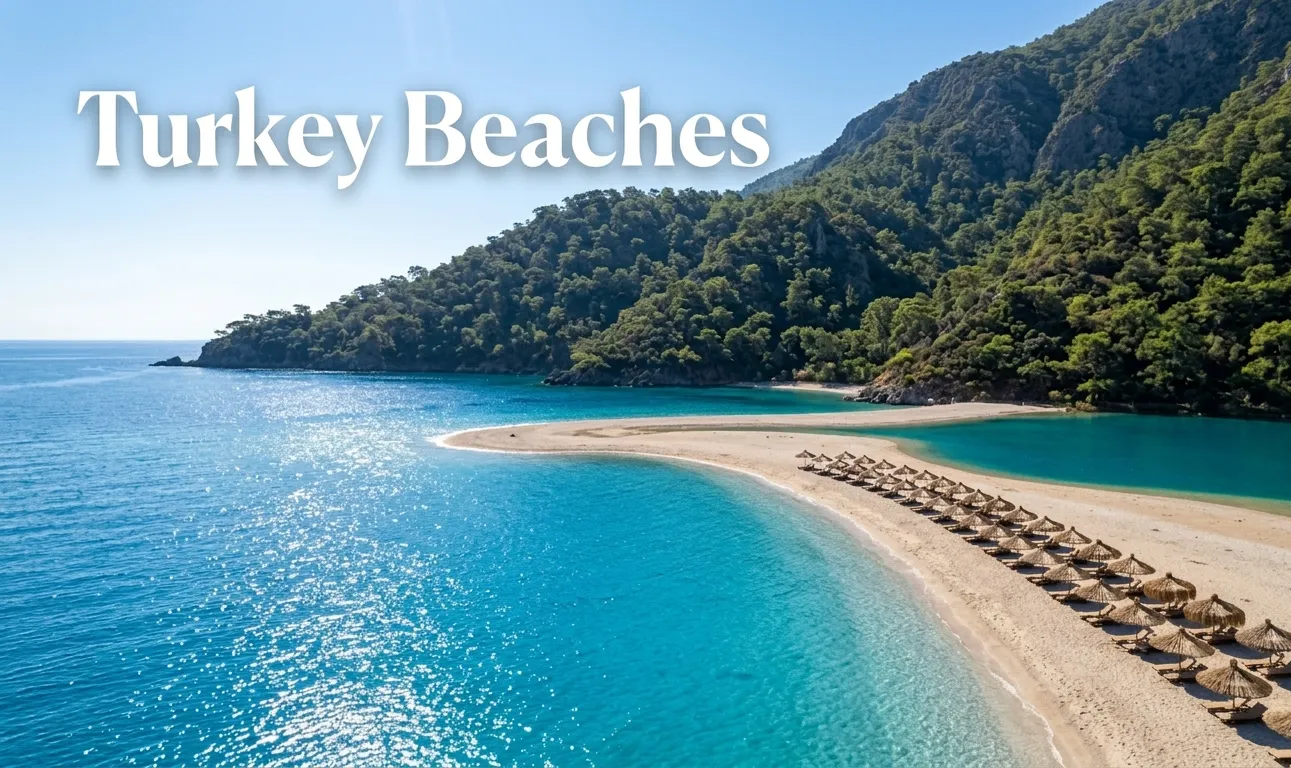
Turkey Beaches
Turkey beaches are clustered along three distinct coastlines. The Mediterranean, the Aegean, and the Black Sea each offer different experiences.
The Mediterranean coast from Antalya to Muğla has the warmest water. This is where most international tourists head .
The Aegean coast around İzmir and Bodrum has cooler water and better wind. Windsurfers and sailors prefer this coast .
The Black Sea coast is green, lush, and less developed. The water is cooler, and the vibe is more local .
The Mediterranean and Aegean coasts together form the “Turquoise Coast.” This nickname comes from the incredible water color.
Turkey averages 300 days of sunshine per year on the Mediterranean coast . You can find a beach day in almost any month .
Most beaches have Blue Flag certification. This means excellent water quality, lifeguards, and facilities .
| Coast | Water Temp Summer | Best For | Vibe |
|---|---|---|---|
| Mediterranean | 24-26°C (75-79°F) | Families, resorts | Lively |
| Aegean | 22-24°C (72-75°F) | Windsurfing, culture | Chic |
| Black Sea | 20-22°C (68-72°F) | Nature, seclusion | Quiet |
Best Beaches in Turkey
The best beaches in Turkey depend on what you want. Swimming, paragliding, turtle spotting, or seclusion all point to different shores.
Ölüdeniz Blue Lagoon is the most photographed beach in Turkey. The turquoise water and mountain backdrop are unforgettable .
Kaputaş Beach is a hidden cove between dramatic cliffs. You descend over 100 steps to reach the sand .
Patara Beach is 18 kilometres of untouched sand. It is a protected nesting ground for loggerhead sea turtles .
İztuzu Beach is known as Turtle Beach. The 4.5-kilometre spit is a haven for endangered loggerhead turtles .
Lara Beach in Antalya is a 12-kilometre sandy strip. The area is packed with bars, restaurants, and water sports .
Cleopatra Beach in Alanya has golden sand and clear water. Legend says Cleopatra herself swam here .
Marmaris Beach combines a long sandy bay with a marina. The old town is steps from the sand .
Key Takeaway: The “best” beach depends on your priorities. Read each description carefully before choosing.
Beaches in Turkey
Beaches in Turkey vary dramatically by region. Antalya, Muğla, and İzmir have the highest concentration of Blue Flag beaches .
Antalya city has two main beaches. Lara Beach is a long sandy resort strip. Konyaaltı is a pebbly promenade bay with mountain views .
Konyaaltı is free and popular with local families. The Taurus mountains rise dramatically behind the beach .
The beaches around Kemer and Beldibi are sheltered and calm. These are excellent for younger children .
Further west near Kaş, the beaches become more dramatic. Kaputaş is the most famous, but small coves are everywhere.
The Muğla region has the most geographical drama. Mountains drop into the sea, creating hundreds of sheltered coves .
Bodrum’s beaches range from windsurfing flats to boutique coves. Many of the best spots are reached by boat rather than road .
Marmaris combines a long sandy bay with a marina and old town. It is easy to split a day between beach and town .
Insider Tip:
- Rent a car to explore the D400 coastal road west of Antalya
- The drive is one of the most beautiful in Turkey
- Stop at any small cove that catches your eye
Turkey Best Beaches
Turkey best beaches are concentrated in three provinces. Antalya, Muğla, and İzmir contain most of the country’s 500+ Blue Flag beaches .
Antalya has the largest variety of beaches. The region has everything from city beaches to wild Lycian coves .
Lara Beach is the resort strip: long, sandy, and sociable. Large hotels make family logistics easy .
Konyaaltı is something different. Local families swim here for free with the Taurus Mountains behind them .
The beaches around Kaş are dramatic and less crowded. Kaputaş is the star, but small coves are everywhere .
Muğla has the most dramatic scenery. Ölüdeniz, Butterfly Valley, and İztuzu are all in this province .
Bodrum’s beaches are chic and varied. Bitez has calm shallow water perfect for families .
Alaçatı in İzmir is the windsurfing capital of Turkey. The constant Aegean wind and shallow flat water create perfect conditions .
Most Beautiful Beaches in Turkey
The most beautiful beaches in Turkey all share one feature. The water color is an incredible turquoise blue.
Ölüdeniz Blue Lagoon appears on every “most beautiful” list. The shallow turquoise inlet is separated from the open sea by a narrow sandbank .
The mountains behind Ölüdeniz rise so steeply that paragliders launch from the peak. They glide down to the beach in minutes .
Kaputaş Beach is a natural bay tucked between two cliffs. The limestone cliffs and turquoise water create a postcard scene .
You must descend over 100 steps to reach Kaputaş. The staircase keeps the beach less crowded than others .
Patara Beach is beautiful in a different way. The 18-kilometre stretch of sand has no development behind the dunes .
Butterfly Valley is only accessible by boat. The dramatic cliff-backed bay is home to over 100 butterfly species .
Iztuzu Beach is beautiful and ecologically important. The 4.5-kilometre spit is a protected turtle nesting ground .
Cleopatra Beach has golden sand and a legendary history. The Taurus Mountains provide a stunning backdrop .
Blue Flag Beaches Turkey
Blue Flag beaches in Turkey number over 500. This is one of the highest totals in the world .
The Blue Flag is an international environmental award. It is managed by the Foundation for Environmental Education .
Blue Flag beaches meet strict standards across four categories. Water quality, environmental education, management, and safety .
In practical terms, Blue Flag means the water is tested and clean. There are trained lifeguards and first aid available during peak season .
For families, Blue Flag is the most reliable indicator of a safe beach. The flag flies at the entrance to certified beaches .
Türkiye’s Blue Flag count has grown significantly over two decades. The concentration along the Antalya, Muğla, and İzmir coastlines is especially high .
Antalya holds the world record for the highest number of Blue Flag-certified beaches . Lara Beach, Konyaaltı, and many smaller coves all have certification.
The Blue Flag is re-evaluated every year. Check the Foundation for Environmental Education website for the current year’s list before you travel .
Smaller beaches may gain or lose certification annually. Do not assume last year’s flags are still flying.
Key Takeaway: Look for the Blue Flag at beach entrances. It means clean water, lifeguards, and proper facilities.
Ölüdeniz Blue Lagoon
Ölüdeniz Blue Lagoon is Turkey’s most photographed beach. The shallow turquoise water is separated from the open sea by a narrow sandbank .
The lagoon is part of a national park. The entrance fee helps protect this natural wonder .
The water is calm and shallow near the shore. Young children can play safely in the shallows .
Babadağ Mountain rises steeply behind the lagoon. Paragliders launch from the peak and glide down to the beach .
Tandem paragliding flights run daily from April through October. This is one of the world’s best paragliding spots .
The beach has sunbeds and umbrellas for rent. Food and drink vendors operate during the day .
Ölüdeniz is best for couples and adventure travelers. The sunset views are spectacular .
Families with young children should choose the nearby Belcekiz Beach. The entry into the water is more gradual there .
The lagoon can be crowded in July and August. Arrive early to secure a good spot .
Kaputaş Beach
Kaputaş Beach is a natural bay between two cliffs. The water is a brilliant turquoise color .
The beach sits on the D400 coastal road between Kaş and Kalkan. You will see the staircase from the roadside .
You must descend over 100 steps to reach the sand. The staircase is steep but safe .
The effort is rewarded with one of Turkey’s most beautiful coves. The cliffs frame the turquoise water perfectly .
Kaputaş has no facilities beyond basic changing cabins and toilets. There are no sunbeds or umbrellas for rent .
Bring your own food, water, and shade. The beach has no restaurants or snack bars .
The water is clear and cool. Snorkeling is excellent near the rocky edges .
Kaputaş is free to enter. It does not belong to any hotel, so it is open to everyone .
The beach is best for couples and adventurous travelers. Families with young children may find the stairs challenging.
Visit in the morning for the best light for photographs. The sun hits the water directly .
Patara Beach
Patara Beach is 18 kilometres long. It is the longest beach in Turkey .
The beach is backed by massive sand dunes. There is no development behind the sand, just dunes and ancient ruins .
Patara is a protected nesting ground for loggerhead sea turtles. Access is managed during nesting season from May to October .
There are no sun loungers, no beach clubs, and no development. The beach stays in the condition that makes it worth protecting .
The sea is shallow for a long distance from shore. This makes Patara safe for children .
Nearby are the ruins of the ancient city of Patara. You can combine a beach day with history .
Patara has an entrance fee. The price varies depending on whether you are swimming or also visiting the ruins .
There is almost no shade on Patara Beach. Bring a sun umbrella and plenty of water .
The beach is best for nature lovers and history buffs. Families who need facilities should choose a different beach .
You can walk for an hour without reaching the end of Patara. It feels like a different category of beach altogether .
Key Takeaway: Patara is for experiencing nature, not for luxury. Leave the high expectations at home and embrace the wild sand.
İztuzu Beach (Turtle Beach)
İztuzu Beach stretches over 4.5 kilometres. The sand spit sits where the Dalyan River meets the Mediterranean Sea .
The beach is a haven for endangered loggerhead turtles (Caretta caretta). They nest here between May and October .
Access is managed during nesting season to protect the turtles. Some sections of the beach are roped off .
The sand is snow-white and shallow. The entry into the sea is smooth, without sudden changes in depth .
There are no noisy establishments or hotels near İztuzu. The beach feels remote and peaceful .
You can reach İztuzu by boat from Dalyan or by road. The Dalyan river cruise also passes the Lycian rock tombs .
The beach has basic facilities including toilets and showers. There are no sunbed rentals on the protected sections .
İztuzu is best for nature lovers and eco-conscious travelers. Seeing a nesting turtle is an unforgettable experience .
Families with young children will find the shallow water safe. Just be careful to respect the turtle nesting zones .
Visit between May and October for the best chance to spot turtles. Early morning is the best time .
Lara Beach Antalya
Lara Beach is a 12-kilometre stretch east of Antalya city. The sand is golden and the water is clear .
The beach is known as the resort strip. Large all-inclusive hotels line the sand .
The area has plenty of bars, restaurants, and shops. Water sports are available from multiple vendors .
Lara Beach has Blue Flag certification. The water quality and safety standards are excellent .
The Duden Waterfall sits at the eastern end of Lara Beach. The waterfall drops directly into the sea .
There is a restaurant at the top of the waterfall with a revolving deck. The views for guests change smoothly as you eat .
Lara is best for families who want convenience. Everything you need is within walking distance .
The beach can be crowded in July and August. Sunbeds fill by late morning .
The water is shallow and calm near the shore. Young children can play safely .
Lara is less scenic than Ölüdeniz or Kaputaş. The convenience is the main selling point, not the natural beauty .
Cleopatra Beach Alanya
Cleopatra Beach is in Alanya on the Mediterranean coast. The sand is golden and the water is crystal clear .
Legend claims that Cleopatra used to visit this beach. She loved to swim in the turquoise bay .
The beach has the foothills of the Taurus Mountains as a backdrop. The mountains frame the view beautifully .
Cleopatra Beach is divided into sectors. Some have sun loungers, others are reserved for water sports .
The sand is said to have been brought from Egypt for Cleopatra. Today, you cannot remove sand from the beach .
The water is clean and almost transparent. The entry is gradual, making it safe for children .
The beach has full facilities including showers, toilets, and changing cabins. Sunbeds and umbrellas are available for rent .
Nearby Alanya Castle sits on a peninsula overlooking the beach. You can visit the castle in the morning and swim in the afternoon .
Cleopatra Beach is best for families and history lovers. The combination of beach and ancient sights is unique .
The beach can be windy in the afternoons. Morning visits offer calmer conditions .
Marmaris Beach
Marmaris Beach combines a long sandy bay with a marina. The old town is just steps from the sand .
The beach is urban but fairly clean. Everything you need is nearby .
Admission is free, but sun loungers cost extra. The water is calm and clear .
Marmaris has a lively nightlife scene. Bar Street has bars, clubs, and late-night parties .
The beach is best for groups and young adults. Families may prefer quieter nearby beaches like Icmeler .
The water is slightly cooler than Antalya’s beaches. This can be refreshing in July and August .
The marina is full of yachts and gulets (traditional Turkish boats). You can book boat tours to nearby coves and islands .
Marmaris is well-connected by road and sea. Ferries run to Rhodes, Greece during summer months .
The beach is best for travelers who want more than just sand. Dining, shopping, and nightlife are all within walking distance .
When to Visit Turkey Beaches
When to visit Turkey beaches determines water temperature and crowds. June through September is the best window .
Water temperatures on the Mediterranean coast reach 24-26°C (75-79°F) in July and August. This is the warmest and most comfortable swimming .
July and August have the largest crowds. Beaches fill by late morning, and sunbeds are scarce .
September has warm water with smaller crowds. Water stays above 24°C (75°F) through mid-September .
May and June are shoulder months. Water temperatures are 21-23°C (70-73°F), comfortable for most but cool for some .
October is swimmable for the first half of the month. Water stays around 23°C (73°F) early October .
The Mediterranean coast has 300 days of sunshine per year . You can find sunny days even in winter .
| Month | Air Temp | Water Temp | Crowds | Verdict |
|---|---|---|---|---|
| May | 21°C (70°F) | 19-21°C (66-70°F) | Low | Good for quiet |
| Jun | 24°C (75°F) | 22-23°C (72-73°F) | Moderate | Best value |
| Jul-Aug | 27-32°C (80-90°F) | 24-26°C (75-79°F) | Peak | Warmest water |
| Sep | 25°C (77°F) | 24°C (75°F) | Moderate | Best overall |
| Oct | 20°C (68°F) | 21-22°C (70-72°F) | Low | Good for some |
Key Takeaway: September is the best month for Turkey beaches. Warm water, smaller crowds, and lower accommodation prices.
Turkey Free Public Beaches 2026
Turkey free public beaches are expanding in 2026. The Culture and Tourism Ministry operates 20 free public beaches across the country .
Three new public beaches are currently under construction. These are in Bitlis (Adilcevaz), Sinop (İnceburun), and Samsun (Yakakent) .
By the end of 2026, the public beach network will reach 23 locations. Entry and basic services are provided free of charge .
Facilities include toilets, showers, and changing cabins. Children’s playgrounds are available at most locations .
Baby care rooms, prayer rooms, and sports areas are also provided. Special emphasis is placed on accessibility for persons with disabilities .
All facilities are designed in accordance with accessibility standards. Food, beverage services, and parking are also available .
These beaches are operated exclusively by the ministry. They are designed both for local communities and tourists .
The initiative launched in 2019. It aims to deliver high-quality public services in coastal areas .
Most free public beaches are on the Mediterranean and Aegean coasts. The new locations will extend coverage to the Black Sea and eastern regions .
Check the ministry’s website for exact locations before traveling. Opening dates for the three new beaches will be announced upon completion .
Safety and Seasonal Warnings for Turkey Beaches
The Turkish sun is intense from June through August. High-SPF sunscreen, hats, and hydration are essential.
Sea urchins hide in rocky areas at beaches like Kaputaş. Wear water shoes when entering from rocks.
Some beaches have strong currents, especially after storms. Swim only in designated areas with lifeguards where available.
Blue Flag beaches have trained lifeguards during peak season . Unpatrolled beaches require extra caution.
Respect local customs away from the beach. Cover shoulders and knees when walking through towns and villages.
Tipping (bahşiş) is customary in Turkey. Keep small denominations of Turkish Lira for tips.
Emergency numbers in Turkey: Police 155, Ambulance 112, Fire 110. The tourist police also operate in major resort areas.
Drink bottled water at beaches. Tap water is generally not recommended for drinking.
Check travel advice from your home country before booking. Regulations can change.
Frequently Asked Questions About Turkey Beaches
What is the most beautiful beach in Turkey?
Ölüdeniz Blue Lagoon is widely considered the most beautiful beach in Turkey. The turquoise water, white sand, and dramatic mountain backdrop are unforgettable . Kaputaş Beach is a close second with its cliff-framed turquoise cove .
Does Turkey have Blue Flag beaches?
Yes, Turkey has over 500 Blue Flag beaches, one of the highest totals in the world . Blue Flag means excellent water quality, lifeguards, and facilities. The Antalya region holds the world record for the highest number of Blue Flag-certified beaches .
Are there free beaches in Turkey?
Yes, the Turkish government operates 20 free public beaches, expanding to 23 by the end of 2026 . These beaches offer free entry, toilets, showers, changing cabins, playgrounds, baby care rooms, prayer rooms, and disability access. Konyaaltı Beach in Antalya is also free and popular with local families .
Which part of Turkey has the best beaches?
The Mediterranean coast (Antalya and Muğla provinces) has the best beaches for swimming with the warmest water and most Blue Flag certifications . The Aegean coast (İzmir and Bodrum) has better wind for water sports. The Black Sea coast is greener, cooler, and less developed.
What is the best time to visit Turkey for beach weather?
September is the best month for Turkey beaches. Water stays warm at 24°C (75°F), crowds drop significantly after summer, and accommodation prices are lower. June offers good weather with moderate crowds. July and August have the warmest water but peak crowds and highest prices .
Can you swim in Turkey in October?
Yes, you can swim in Turkey in October, especially during the first half of the month. Water temperatures stay around 22-23°C (72-73°F) on the Mediterranean coast . The weather remains warm at 20-26°C (68-79°F) with plenty of sunshine. By late October, water starts cooling rapidly.
Turkey’s beaches are among the best in the Mediterranean. Over 500 Blue Flag certifications prove the quality .
Choose the Mediterranean coast for warm water and family resorts. Choose the Aegean for windsurfing and chic towns.
Ölüdeniz offers the most beautiful scenery. Kaputaş offers a hidden cove adventure. Patara offers wild, untouched sand.
Iztuzu offers turtle encounters and eco-tourism. Lara Beach offers convenience and all-inclusive ease.
Free public beaches are expanding in 2026. The ministry will operate 23 locations by the end of the year .
September offers the best balance of warm water and smaller crowds. July and August are peak season for a reason.
Pack reef-safe sunscreen and water shoes. Respect the sea turtles and the coral.
Blue Flag status is re-evaluated annually. Check the current year’s list before you travel .
The right beach depends on your travel style. Families go to Lara or Cleopatra. Couples go to Ölüdeniz or Kaputaş.
Adventurers go paragliding at Babadağ. Nature lovers go to Patara or Iztuzu.
Turkey is not just Istanbul and Cappadocia. It is also a world-class beach destination.
Choose your coast carefully. Enjoy the Turquoise Coast.