Charleston Beaches 2026: A Guide to the Best Sand & Surf
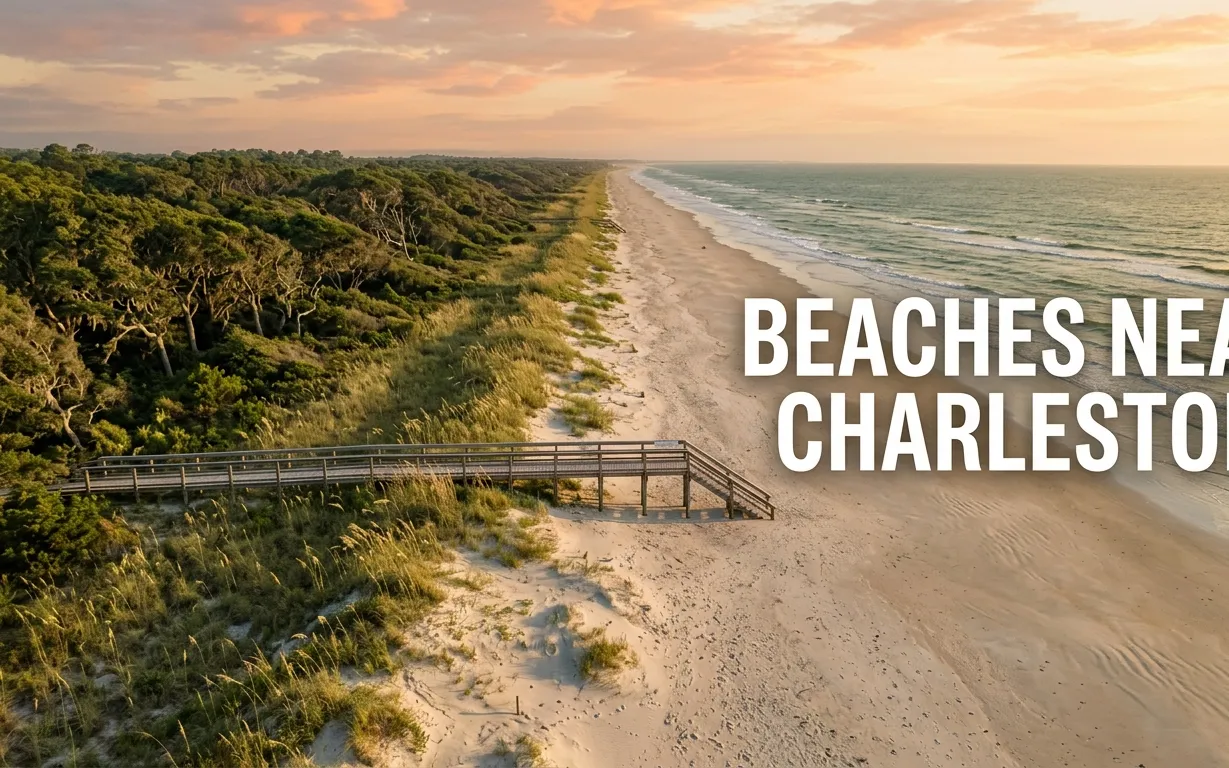
The beaches near Charleston are barrier islands, not a contiguous urban coastline.
You must drive roughly 20 to 30 minutes east of the historic district to reach them.
According to the Charleston County Park and Recreation Commission, the local
beach parks see roughly 1.5 million visitors during the summer season.
The 2026 parking passes and tide schedules are already live.
This guide cuts through the Lowcountry marketing haze to tell you exactly which
beach fits your personality. You will learn where to park without getting a ticket,
and why the water looks the way it does.
Does Charleston Have Beaches?
Yes, Charleston has real, swimmable barrier island beaches, but none are downtown.
The sand lies on the far side of the Cooper River and the vast salt marsh estuary.
You cross the Arthur Ravenel Jr. Bridge to reach the islands of Mount Pleasant,
Sullivan’s Island, and Isle of Palms. The alternative route takes you south through
West Ashley to Folly Beach.
The water here is not the neon turquoise of a resort advertisement.
Expect a soft, brackish green-brown tint colored by nutrient-rich marsh outflow
and fine riverine sediment, not pollution.
Charleston Area Beaches Overview
The Charleston area beaches split into three distinct geographic and cultural
zones in 2026. The “East Islands” include Sullivan’s Island and Isle of Palms.
The “South Island” is the funky, shaggy end known as Folly Beach.
The “Wild Luxury Islands” encompass the gated enclaves of Kiawah, Seabrook, and
the state-owned Boneyard Beach at Capers.
You cannot easily “hop” between these by foot or bike as they are separated by
deep, fast-moving tidal inlets like Breach Inlet. Choose your island before
you cross the bridge because correcting a wrong choice costs an hour in traffic.
| Beach | Drive from Downtown | Parking Fee | Vibe |
|---|---|---|---|
| Sullivan’s Island | 20 min | $0 (Street) | Aristocratic Quiet |
| Folly Beach | 25 min | $15-$20 | Party/Fishing Town |
| Isle of Palms | 30 min | $15-$20 | Family Resort |
| Kiawah (Beachwalker) | 50 min | $10 (CCPRC) | Secluded Luxury |
Key Takeaway: Charleston’s barrier islands are isolated ecosystems, and the bridge
you pick in the morning dictates your entire day’s experience.
Best Beaches in Charleston, SC
Sullivan’s Island is the best beach in Charleston for couples and adults
seeking a quiet, architectural stroll. The beachfront is lined with massive,
historic non-commercial homes rather than high-rise condos or neon arcades.
The sand here is a fine, tightly packed beige that turns hard as concrete at low
tide, making it perfect for a long, meditative barefoot walk. The surf is
typically gentle, but the shore can drop off steeply at high tide.
Insider Tip:
- The beach nearly disappears during the monthly spring king tide. Check a tide
chart to ensure dry sand exists before you lug a cooler out. - There are zero public restrooms on the island. Plan your coffee intake accordingly.
- The “municipal” parking is all residential street parking, enforced by aggressive
ticketing for out-of-town plates if your tires touch the grass.
Folly Beach
Folly Beach is the unpolished, eclectic social hub of the Charleston coast
in 2026. Center Street is a ragtag collection of surf shops, taco stands, and
the legendary Taco Boy patio that defines the town’s laid-back soul.
The Folly Beach Fishing Pier extends over a thousand feet into the Atlantic.
You can walk the pier for a small fee, fish without a license, or just watch the
surfers ride the waves crashing against the nearby “Washout” sandbar.
This is the best Charleston beach for solo travelers and friend groups who want
a drink after the sun sets. It is not the best beach for families seeking a quiet,
pristine, “no shoes, no shirt” dinner at a five-star restaurant.
Honest Limitation: The traffic merges into a single-lane road from the causeway
to Center Street. On a Saturday in July, leaving Folly at 4:00 PM will trap you
in a 45-minute parking lot of concrete and heat before you even hit the bridge.
Key Takeaway: Folly Beach is for the young and the young-at-heart who value a
bloody mary and a shrimp taco more than they value absolute silence and wide sand.
Sullivan’s Island Beach
Sullivan’s Island Beach enforces a “front-porch” culture rather than a commercial
boardwalk vibe. The strict zoning ordinance bans the massive beach clubs and high-
rise hotels that dominate other East Coast tourist traps.
The lighthouse at the north end marks the dangerous currents of Breach Inlet.
Never swim in the inlet itself, as the current rips out to sea at lethal speeds
of over four knots, sucking water between Sullivan’s and Isle of Palms.
The sand here is littered with smooth, beautiful black fossilized sharks’ teeth
after a heavy storm. Walk the tide line near Station 22 for the best finds, though
you will be competing with some very serious local amateur paleontologists.
Romantic travelers love this island for its quiet, clean lines and pristine dune
walkovers. Families with toddlers often struggle here due to the total lack of
public restrooms and the sometimes steep, eroded drop-offs at the waterline.
Key Takeaway: Sullivan’s delivers a rare, high-end, porch-and-sand vibe that feels
like a private club, but it physically punishes you if you fail to use the bathroom
before you arrive.
Isle of Palms Beach
Isle of Palms (IOP) is the broad-shouldered, “big sand” family resort of
Charleston in 2026. The newly renourished front beach offers a massive, flat swath
of dry sand stretching hundreds of yards back to the dune line.
The Windjammer beach club anchors the social scene with live music and a
front-row view of the volleyball courts. Couples and honeymooners should book a
room at Wild Dunes Resort on the far north end for a quieter, gated community
experience away from the main public hub.
Charleston County Park (IOP) manages the central access with plentiful paid
parking, clean modern changing rooms, and snack bars. Budget travelers will
cringe at the $15 to $20 daily parking fee and the strictly enforced “no external
alcohol” policy.
The surf is mild, with a shallow sandbar that stretches for miles.
This is the safest swimming beach in the city for young children who want to wade
far out without hitting a sudden drop.
Key Takeaway: Isle of Palms is the path of least resistance, offering the most
“Jersey Shore” or “Ocean City” familiarity, but dialed down to a Southern decibel.
Kiawah Island and Seabrook Island
Beachwalker County Park on Kiawah Island offers the most breathtaking,
wild natural beach accessible to a non-resident day tripper. The $10 per vehicle
parking fee unlocks a wide, pristine beach with a stunning river inlet view.
You cannot access the private Kiawah Island Golf Resort beaches or Seabrook Island amenities without a guest pass or a rental booking. Gate guards are strict,
and there is no “just a quick look” bluffing.
Kiawah’s public section (Beachwalker) is a critical habitat for piping plovers and
nesting loggerheads. The dunes are biologically alive, wind-sculpted, and genuinely
untrampled compared to the packed urban sand of Folly.
Luxury seekers should book the Sanctuary Hotel for an elite experience
or rent a Seabrook home for the private, boat-friendly dock access. Budget travelers
should just pay the ten-dollar park fee and enjoy the same sand.
Key Takeaway: Beachwalker Park is the ultimate Charleston beach hack, giving you a
five-star wilderness sandbar for the price of a sandwich and a gas-station iced tea.
Capers Island and Morris Island
Capers Island State Heritage Preserve is the ultimate “Boneyard Beach” escape
in 2026. This uninhabited barrier island is only accessible by a private boat or
kayak charter, and it features a forest of sun-bleached dead trees standing in the surf.
The Morris Island Lighthouse stands out in the ocean a quarter mile off the
shore of a similarly desolate and wild beach. You reach it by hiking the narrow,
eroding shoreline from the very north tip of Folly Beach, careful not to trespass
on the sensitive dune grass.
Boats for Capers must beach strategically to avoid the rising tide.
Getting stranded on Capers is a real danger because the marsh side floods quickly,
so pay for a professional guide through a local outfitter like Coastal Expeditions.
These islands are for adventurous profile travelers and photographers only.
There is zero shade, zero cell service, and the biting horseflies can be brutal
in August if the wind drops.
Key Takeaway: The “Boneyard” beaches are a Lowcountry photographer’s dream, but
you are a fool to try Capers without a VHF radio and a rigid tidal schedule.
Best Family Beaches Near Charleston
Isle of Palms County Park is the best Charleston beach for families in 2026
because of the lifeguards, the snack bar, and the soft, shallow sandbar.
The restroom facilities here are cleaner and more modern than any other public access.
For a more natural, adventurous family day, Beachwalker Park on Kiawah offers
the calm, shallow channel of the Kiawah River where it kisses the sea.
Toddlers can safely splash in this wind-protected lagoon-like water while dolphins
fish in the channel just ten yards away.
Avoid the “Family” label on Folly Beach if you have stroller-age kids.
The steep sand drop, the rowdier bar-adjacent crowds, and the strong currents near
the pier make it a chore for parents managing gear and small children.
Breach Inlet is a deadly temptation for families with curious kids.
Do not let children wade in the flat, calm-looking water here, as the undertow will
pull them off their feet and into the shipping channel instantly.
Key Takeaway: For a safe family trip, stick to the managed County Parks at IOP and
Kiawah, and avoid the wild inlets no matter how calm they look.
Dog-Friendly Beaches Near Charleston
Sullivan’s Island offers the most lenient off-leash dog rules in the Charleston
area during the 2026 off-season (November through February). Dogs can run free
during specific morning and evening hours if under strict voice control.
Isle of Palms requires a city-issued dog permit for walking your dog on the
sand during the peak summer season from 10:00 AM to 6:00 PM. You will be fined
immediately if you skip this bureaucratic step, even if your dog is leashed.
Folly Beach completely bans dogs on the sand from May 1st through September 30th.
No exceptions exist for non-residents, and the police enforce the rule strictly
to protect the nesting loggerhead turtles.
Capers Island allows dogs on the primitive beaches because it is a state
preserve, but the sharp oyster shells in the landing zone can slice a paw open.
Bring protective dog booties or be prepared to carry a fifty-pound Lab through mud.
Key Takeaway: For dog owners, Sullivan’s Island is the holy grail of Lowcountry
off-leash freedom, but only if you visit outside of the hot, restricted summer window.
Free Parking and Budget Hacks
Parking on Sullivan’s Island residential streets is technically free in 2026,
but it is a cutthroat game of musical chairs. You must arrive before 9:00 AM on
a weekend and ensure all four wheels are off the pavement’s edge or risk a fine.
The Mount Pleasant Waterfront Park pier area offers a free parking base.
You can park here for free, enjoy the pier, and then drive to Sullivan’s for the
beach while avoiding the worst of the island’s aggressive street-side enforcement.
Folly Beach charges $15 to $20 for all county lots near the pier on weekends.
If you are a budget traveler with a bike rack, park at the far-flung Folly River
Park boat landing for free and pedal the two miles into town along the back streets.
Charleston County Parks Gold Pass is a hidden value if you plan to visit the
managed beaches (IOP, Kiawah, Folly County Park) more than four times in a week.
The annual pass covers your entry fees and pays for itself fast.
Key Takeaway: The only true “free sand” is a Sullivan’s side street at dawn, but
miscounting your tire alignment by six inches is a guaranteed souvenir parking ticket.
Charleston Beach Water Quality and Safety
The South Carolina Department of Health and Environmental Control (SCDHEC)
tests the beach water weekly during the summer. Avoid swimming for 24 hours after
a torrential thunderstorm because stormwater runoff spikes bacteria counts near
the pier outfall pipes at Folly and IOP.
Rip currents are most common near the groins (rock jetty structures) at the ends
of the islands. If you swim near the rocks at the Folly Washout or the Breach
Inlet jetty, you are in the highest risk zone for a quick, silent drowning.
Jellyfish arrive with the 80-degree water in late June.
Cannonball jellyfish (flat, brown-rimmed) are harmless, but sea nettles (translucent
with tentacles) sting fiercely and drift into the shallows on an incoming tide.
Lightning is the greatest natural killer on a Charleston summer afternoon.
The moment you see a thunderhead building over the Ravenel Bridge, pack up and
go sit in your car for the mandatory 30-minute count from the last thunderclap.
Best Time to Visit Charleston Beaches
October is the single best month for a 2026 Charleston beach trip because the water
holds its 78-degree warmth while the air loses its suffocating summer humidity.
The Spring Break window from early March through mid-April brings perfect 75-degree
sunshine but also the worst Folly Beach rowdiness and a massive pollen bloom.
If you have allergies, the pine pollen “yellow blizzard” will coat your towel.
Avoid the “Dog Days” of late July and August if you are not from the South.
The heat index pushes 105 degrees with 90% humidity, and the biting no-see-ums
(gnats) swarm the dune line at sunset.
Weekdays in September offer the lowest crowds and the calmest water.
The summer crowds vanish when the schools go back, leaving the broad sandbars
empty while the hurricane risk still looms offshore, so check the weather updates.
How to Plan a Charleston Beach Day Trip
You must check the tide chart for the specific island on the exact date of your trip.
A low-tide Sullivan’s Island is a wide, concrete-hard dream; a high-tide Sullivan’s
Island is a sliver of wet sand crashing against the dune scarp with no room to sit.
Pack a cooler with water, as the salt air dehydrates you fast.
Leave no glass on the beach because Charleston City and IOP enforce a zero-glass
policy with heavy fines that protect bare feet from shattered beer bottles.
Sunset Strategy: The sun sets behind the marsh, not over the ocean in Charleston.
To get the gold reflection on the water, you must swim in the morning light.
To get the long shadows and cool breeze, walk the beach in the evening twilight.
Frequently Asked Questions About Beaches Near Charleston
Does Charleston SC actually have beaches?
Yes, Charleston has real barrier island beaches located about 20 to 30 minutes
east of the downtown historic district by car.
The sandy shore is on the other side of the harbor and marsh estuary.
You will not see the ocean from downtown hotels, but it is a short, direct drive.
What is the best Charleston beach for a family with small children?
Isle of Palms County Park is the best Charleston beach for families with small
children because of its gently sloping sandbar and modern restroom facilities.
The “Front Beach” area near the Pavilion has lifeguards and a snack bar.
The shallow water stays waist-deep for a long distance at low tide.
Can you drink alcohol on Charleston beaches?
No, alcohol consumption is strictly illegal on all public Charleston County
beaches and is aggressively enforced during the 2026 peak season.
Police patrol the sand on ATVs and issue tickets for open containers.
You can drink inside licensed bars like the Windjammer deck, but not on the dry sand.
Is Folly Beach or Sullivan’s Island better for a day trip?
Sullivan’s Island is better for a quiet, romantic, and architectural day trip
with a focus on long walks and low-key food at Poe’s Tavern.
Folly Beach is better for a lively, social day trip with surfing, fishing on
the pier, and messy tacos at Taco Boy.
Your choice depends entirely on whether you want peace (Sullivan’s) or a party
(Folly).
Do you have to pay to park at Charleston beaches?
Yes, Folly Beach and Isle of Palms County Parks charge daily parking fees of
$15 to $20 during the summer and require the Flowbird mobile payment app.
Sullivan’s Island does not have county parking, but the street parking is highly
restricted and strictly enforced with ticketing for minor violations.
Kiawah’s Beachwalker Park charges a lower $10 per vehicle fee for the public lot.
Where is the clearest water near Charleston?
The clearest water near Charleston is at the Kiawah River inlet at Beachwalker
Park, where the calm channel filters out sediment better than the open ocean surf.
The water here typically has a pale green tint rather than the murky brown of
Folly Beach.
Visibility is best at the slack tide when the sediment is not being violently
stirred up by the current.
Find Your Charleston Sand in 2026
The best beach near Charleston is the one that matches your current speed limit.
Choose Folly for a taco and a buzz, Sullivan’s for an architectural power walk,
and Kiawah for a wild, windshield-free view of the Atlantic that feels a world away.
Book your County Parks Gold Pass online before you arrive to lock in 2025’s rates
for the 2026 season and skip the pay-by-plate line at the busiest entry gates.
Verify the SCDHEC water quality report and the local tide table on the morning of
your beach day. Charleston sand is dynamic, and a high-tide mistake can erase your
toweling spot entirely.