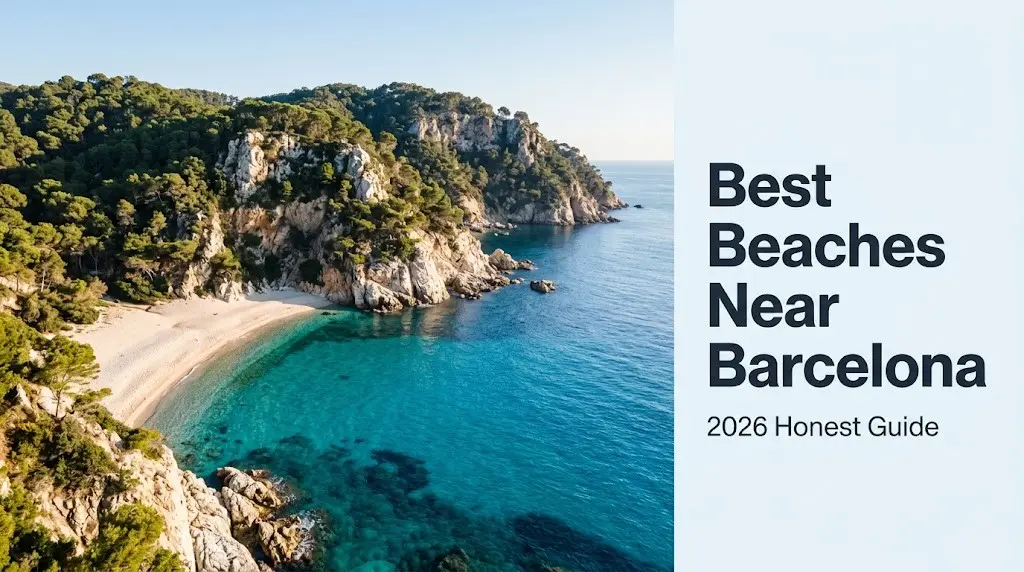
Best Beaches Near Barcelona in 2026: 16 Honest Picks
The best beaches near Barcelona span two very different coastlines, and choosing the wrong one costs you a full vacation day.
Turisme de Catalunya identifies over 300 kilometers of Catalan coastline within day-trip range of the city, ranging from flat urban sand to dramatic rocky coves.
This guide covers 16 specific beaches and beach areas. It tells you exactly which suit your travel style, how to reach each one, and when to avoid them.
Best Beaches Near Barcelona: What the Coast Actually Offers
The coast near Barcelona divides into three distinct zones, each delivering a different experience.
South of the city runs the Costa Daurada: long, flat, sandy beaches with calm water and easy train access. North of the city, the Costa del Maresme offers a string of town beaches backed by rail lines. Further north, the Costa Brava delivers rocky pine-backed coves with significantly clearer water, but requires more travel time.
Barcelona’s own urban beaches stretch 4.5 kilometers along the city’s eastern waterfront. They are convenient but busy.
The sand quality near Barcelona is generally fine to medium-grain. Water clarity is good on the urban beaches and excellent on the Costa Brava coves.
Wave conditions across almost all these beaches are calm by Atlantic standards. The Mediterranean is a nearly enclosed sea with modest wave action, making most beaches here suitable for calm-water swimming.
Turisme de Catalunya notes that the Catalan coast holds more Blue Flag certified beaches than almost any other Spanish coastal region, a certification updated annually by the Foundation for Environmental Education.
| Zone | Sand Type | Water Clarity | Best For | Train Access |
|---|---|---|---|---|
| Barcelona Urban (Barceloneta zone) | Fine golden sand | Good | Convenience, nightlife adjacent | Excellent (Metro L4) |
| Costa del Maresme (north) | Fine to medium sand | Good to very good | Easy day trips, local atmosphere | Excellent (R1 line) |
| Costa Daurada (south) | Fine sand | Good | Long flat beaches, families | Good (R2 Sud line) |
| Costa Brava (north, further) | Rocky coves, pebble or fine sand | Excellent to outstanding | Snorkeling, scenery, quiet | Car or bus required |
| Garraf (south) | Pebble and coarse sand | Very good | Quiet, scenic, uncrowded | Good (R2 Sud) |
Insider Tip:
- The best overall water quality within easy reach of Barcelona is found at the Garraf natural park coves and the Costa Brava, not at Barceloneta.
- Visitors expecting “Mediterranean blue” water at Barceloneta itself often find it pleasant but not dramatically turquoise. The Costa Brava genuinely delivers that color.
- Couples and honeymooners specifically benefit from the extra travel time to reach the Costa Brava. The atmosphere difference is significant.
Beaches in Barcelona: The City’s Own Shoreline Explained
Barcelona’s city beaches run from Barceloneta in the southwest to Mar Bella in the northeast, covering roughly 4.5 kilometers of continuous sandy waterfront.
Platja de la Barceloneta anchors the southwest end. Moving northeast, you pass Nova Icària, Bogatell, La Mar Bella, and La Nova Mar Bella in sequence.
Each beach along this strip has a different crowd character. Barceloneta draws tourists and weekend Barcelona residents. Nova Icària draws a mixed local and tourist crowd. Bogatell skews local. Mar Bella is partly nudist and popular with the LGBTQ+ community.
All city beaches share the same sand quality: fine, golden, and well-maintained by the Barcelona city authority. Water quality across the urban strip is monitored regularly and generally rated good.
Facilities are consistent across all city beaches: shower points, lifeguard posts, accessible pathways, and multiple chiringuitos (beach bars) operating from approximately April through October.
The honest limitation of every city beach is the summer crowd density. In July and August, the ratio of sand to people drops dramatically at Barceloneta and Nova Icária.
Bogatell and Mar Bella receive meaningfully fewer tourists because they are further from the Gothic Quarter and less represented in tourist guides. The 15-minute walk from Barceloneta to Bogatell filters out a significant portion of the tourist crowd.
For families, Nova Icária has gentle entry and calm water. The calm conditions are consistent across all city beaches due to the breakwater structure of Port Olímpic.
For budget travelers, all city beaches are free to access. Sunbed and umbrella rental typically runs in the range of 10 to 25 euros per day, though confirm current rates before visiting.
Best Beaches in Barcelona for Swimming: Water Quality and Conditions
The best beaches near Barcelona for swimming are Bogatell Beach for city convenience and Aiguablava for overall water quality.
For genuine open-water swimming, the city beaches offer safe, calm conditions almost year-round. The breakwater infrastructure around Port Olímpic dampens wave action considerably.
Water temperatures in the Barcelona area typically range from 18 to 20°C (64 to 68°F) in May and June. By July and August, temperatures reach 24 to 26°C (75 to 79°F). September remains very swimmable at 23 to 25°C (73 to 77°F).
Water visibility at city beaches is typically 3 to 6 meters on a calm day. At Garraf and Costa Brava locations, visibility regularly reaches 10 to 20 meters in good conditions.
AEMET (the Spanish Meteorological Agency) data shows that the Catalan coast receives an average of over 2,500 hours of sunshine annually. This is relevant because UV intensity from late May through August is high enough to require SPF 50 protection.
Rip currents are not a significant concern on most Barcelona-area beaches due to the sheltered Mediterranean conditions. The main swimming safety issue is jellyfish, addressed in the seasonal section below.
Snorkeling swimmers should be aware that city beaches have limited marine life due to heavy boat traffic and reduced seagrass coverage. Aiguablava and the coves around Calella de Palafrugell on the Costa Brava offer substantially better snorkeling, with posidonia seagrass meadows and rocky reef structures.
For families with children, Bogatell and Nova Icária offer gently sloping sandy entries with shallow water for several meters. These are the most consistently safe swimming environments for young children on the Barcelona urban waterfront.
Key Takeaway: Water quality is good at all Barcelona city beaches, but snorkelers and clarity-seekers should head to the Costa Brava or Garraf rather than the urban waterfront.
Barceloneta Beach: Europe’s Most Famous Urban Beach, Honestly Assessed
Barceloneta Beach (Platja de la Barceloneta) is the most visited beach in Spain and one of the most visited in Europe. That tells you everything about its character.
It is a 1.1-kilometer stretch of fine golden sand facing southeast. The water is generally clean by urban beach standards. The setting, with the Gothic Quarter and Barceloneta neighborhood behind it, is genuinely distinctive.
The honest limitation is crowd density from mid-June through early September. On a July Saturday, the beach can hold upward of 400,000 visitors. Personal space at the waterline becomes extremely limited by midday.
Facilities are comprehensive: multiple chiringuitos, beach volleyball courts, lifeguard posts at regular intervals, accessible pathways, outdoor showers, and adjacent public bathrooms. The Passeig Marítim promenade runs directly behind the beach.
For couples, Barceloneta works well in May, early June, and September. The sunset view from the waterline with the city behind you is genuinely pleasant when crowds are manageable.
For families, the beach entry is gentle and the water is safe. But navigating a stroller or keeping track of children in peak summer crowds requires significant effort.
For honeymooners, Barceloneta is not the right choice. The atmosphere is social and lively, not intimate. Even in shoulder season, it reads as a city beach rather than a romantic one.
Insider Tip:
- Arrive before 10am if you want a spot on the sand with personal space in summer.
- The northeastern end of Barceloneta, closer to Port Olímpic, is slightly less packed than the central section.
- The beach itself is free. Sunbed rental, umbrella hire, and chiringuito food and drink are the primary costs.
Castelldefels Beach: The Best Easy Escape South of the City
Castelldefels Beach is the most practical long sandy beach within easy reach of Barcelona, located approximately 20 kilometers south of the city center.
The beach runs for around 5 kilometers in a broad, flat arc facing southwest. Sand is fine and golden. Water entry is gentle with a gradual slope, and the Mediterranean conditions here are consistently calm.
The Rodalies R2 Sud commuter train from Barcelona Sants station reaches Castelldefels in approximately 35 to 40 minutes. Trains run frequently throughout the day. The train station is a 10-minute walk from the beach.
Water clarity at Castelldefels is good but not exceptional. Visibility typically runs 4 to 8 meters on calm days. The bottom is sandy with limited marine life, making it better for swimming than snorkeling.
The beach has a well-developed infrastructure: multiple chiringuitos, pedal boat rentals, volleyball courts, and accessible beach pathways. Parking is available for drivers but fills quickly on summer weekends.
For families, Castelldefels is one of the best choices near Barcelona. The gentle slope, calm water, wide beach, and good facilities combine well. The shallow entry is safe for young children, and the beach width means more room even during busy periods.
For budget travelers, Castelldefels delivers good value. Train access is inexpensive, and while sunbed rental adds cost, bringing your own equipment is easy given the train access.
The honest limitation: Castelldefels beach is popular with Barcelona residents on weekends. Saturday and Sunday afternoons from June through August are busy. Weekdays in the same period are significantly more manageable.
According to Turisme de Catalunya, Castelldefels holds a Blue Flag beach certification, confirming consistent water quality monitoring and beach management standards. Verify current certification status before your visit.
Sitges Beach: The Most Complete Beach Town Near Barcelona
Sitges is the most fully realized beach destination within an hour of Barcelona. It combines a genuine beach town atmosphere, historic architecture, a gay-friendly social scene, and a string of beaches with good facilities.
The main beach, Platja de la Ribera, runs in front of the old town. Sand is fine and the water is generally clean. The backdrop of whitewashed houses and the Sant Bartomeu i Santa Tecla church behind the beach gives Sitges its distinctive visual character.
The Rodalies R2 Sud train from Barcelona Passeig de Gràcia reaches Sitges in approximately 35 to 40 minutes. It’s one of the most pleasant short rail journeys in Catalonia. Trains run regularly, including in the evening, making it practical as a day trip.
Sitges has multiple distinct beaches spread along its coastline. Platja de la Bassa Rodona is the historically nudist beach and the recognized LGBTQ+ social center. Platja de les Anques and Platja dels Balmins at the southern end of town are quieter.
For couples, Sitges is the single best beach town near Barcelona. The combination of a genuinely attractive town, multiple dining options, and beach access without the Barcelona tourist density makes for a well-rounded day.
For honeymooners, Sitges provides a more complete romantic atmosphere than any city beach. Boutique hotels in the old town, evening dining near the seafront, and the generally pleasant town atmosphere work well for a short romantic stay.
The honest limitation: Sitges gets very busy in July and August, particularly during the Sitges Carnival period and the Sitges Film Festival (October). During peak summer, the beaches are crowded and hotel rates rise considerably. Shoulder season visits are meaningfully better.
Key Takeaway: Sitges is the most well-rounded beach destination near Barcelona for couples and independent travelers who want more than just sand and water.
Garraf Beach: The Quieter Alternative Most Visitors Skip
Garraf Beach sits within the boundaries of the Parc Natural del Garraf, approximately 30 kilometers south of Barcelona. Most visitors pass through on the train to Sitges without stopping.
The beach is smaller than Castelldefels and has a more rugged character. The coastline here is partly rocky with some sandy cove sections. A small fishing village backs the beach, giving it a local character that the larger beaches completely lack.
Water clarity at Garraf is notably better than at the city beaches or Castelldefels. The protected natural park status limits development and reduces the boat traffic that reduces visibility elsewhere.
The R2 Sud Rodalies train stops at Garraf station. The journey from Barcelona Sants takes approximately 40 to 45 minutes. The beach is a short walk from the station.
Facilities are more limited than at Castelldefels or Sitges: one chiringuito, limited sunbed rental, basic shower access. Bring your own supplies for a more comfortable visit.
For couples seeking a quieter alternative with better scenery and cleaner water than the standard city day trips, Garraf delivers. The natural park setting provides a more genuinely scenic backdrop than any of the flat sandy beaches to the south.
For families with young children, the rocky sections and limited facilities make Garraf less practical than Castelldefels. Older children who enjoy exploring rock pools and natural environments will find it more interesting.
The honest limitation: The beach is genuinely small. On a summer weekend, it can fill to a point where the “quiet alternative” quality disappears. Weekday visits outside of July and August are when Garraf is at its best.
Insider Tip:
- The Garraf fishing village has a small collection of seafood restaurants that serve genuinely local cooking, not tourist menu fare.
- The rocky sections north of the main beach are accessible by foot and offer better snorkeling spots than the sandy section.
- Solo travelers and nature-oriented visitors get the most from Garraf. It does not suit travelers primarily seeking beach facilities or nightlife adjacency.
Costa Brava Beaches Near Barcelona: When the Drive Is Worth It
The Costa Brava is a completely different category of beach experience from anything within the city or on the southern coast. The extra travel time is justified for travelers prioritizing water clarity, dramatic scenery, and natural cove settings.
The Costa Brava begins roughly 60 kilometers north of Barcelona at Blanes and stretches northeast toward the French border. The coastline alternates between pine-covered headlands, ancient fishing towns, and coves with water clarity that is genuinely exceptional by Mediterranean standards.
Reaching the Costa Brava from Barcelona typically requires a rental car or private transfer. The Rodalies R1 line reaches coastal towns like Sant Pol de Mar and Calella, but the more dramatic Costa Brava coves north of Blanes require a car.
Budget a minimum of 60 to 90 minutes driving time from central Barcelona to reach the best-known coves near Begur or Calella de Palafrugell. Traffic on summer weekends can extend this considerably.
For snorkelers, the Costa Brava is the clear destination choice near Barcelona. Protected posidonia seagrass meadows, rocky reef structure, and excellent visibility (regularly 10 to 20 meters in calm conditions) make it the only area near Barcelona where snorkeling is genuinely rewarding.
For luxury travelers, the Costa Brava has a selection of high-end boutique hotels and small resort properties, particularly around Begur, Aiguablava, and the Empordà region. These properties tend to be genuinely atmospheric rather than simply expensive, set in restored masías (Catalan farmhouses) or clifftop positions with sea views.
The honest limitation: The Costa Brava’s best coves are no longer secret. Parking at popular spots like Aiguablava, Sa Tuna, and Calella de Palafrugell is extremely limited in July and August. Arrive before 9am or arrive by late afternoon to find parking. Some coves have implemented pre-booking systems for vehicle access; check with the relevant municipal authority before visiting.
Tossa de Mar Beach: The Costa Brava’s Most Accessible Jewel
Tossa de Mar is the most practically accessible Costa Brava beach destination from Barcelona, combining a medieval walled old town, a main sandy beach, and multiple coves within walking distance.
The main beach, Platja Gran de Tossa de Mar, sits in a bay flanked by the 12th-century Vila Vella (old fortified town). The combination of medieval walls rising above a sandy beach is legitimately distinctive. The setting is among the most visually arresting of any beach near Barcelona.
Travel time from Barcelona by car is approximately 1 hour 15 minutes to 1 hour 45 minutes depending on traffic. A direct bus service (Moventis/Sarfa) operates from Barcelona Nord bus station in summer, taking approximately 1.5 hours. Confirm current routes and timetables directly with the operator before traveling.
Water clarity at Platja Gran is good to very good, with typical visibility around 6 to 12 meters on calm days. The sand is coarse and golden. The bay faces south-southwest, giving good afternoon sun.
For couples, Tossa de Mar delivers a more complete experience than any beach within 40 kilometers of Barcelona. The old town, multiple small restaurants, and genuinely scenic setting make it suitable for a full day trip with meals and exploration included.
The honest limitation: Tossa de Mar is well-known and draws significant crowds in July and August. The main beach gets busy by late morning in peak summer. The smaller coves north and south of the main beach, including Cala Llevadó and Platja de la Mar Menuda, offer quieter alternatives within walking distance.
For families, the main beach entry is sandy and gentle. The protected bay reduces wave action. The old town provides shade and sightseeing options when children need a break from the beach.
Key Takeaway: Tossa de Mar is the single best full-day beach destination within a 90-minute radius of Barcelona, combining water quality, scenery, and a genuine sense of place.
Aiguablava Beach: The Best Water in the Barcelona Region
Aiguablava is the single Costa Brava cove with the most consistently clear and turquoise water within a day’s travel of Barcelona.
The name translates literally to “blue water” in Catalan, and it earns the description. The small cove faces southeast in a sheltered position between pine-covered cliffs. Water color shifts from pale turquoise at the shoreline to deep cobalt in the center of the bay.
The drive from Barcelona takes approximately 1 hour 45 minutes to 2 hours, reaching the coastal town of Begur and then descending to the cove. No train service reaches Aiguablava; a rental car is required.
The beach itself is small: approximately 150 meters of fine white sand. Parking is very limited. In July and August, both the parking area and the beach fill by 9am on clear-weather days.
The Parador de Aiguablava hotel sits directly above the cove. It is a state-run Spanish Parador property with a terrace restaurant overlooking the bay. Lunch or dinner with this view is worth the cost regardless of whether you are staying there. Room rates at Paradores vary by season; check the official Paradors of Spain website for current rates.
For honeymooners, Aiguablava is the best answer within a day trip of Barcelona. The small scale, extraordinary water color, and relatively low development make it genuinely intimate. Staying at a Begur boutique hotel and walking down to Aiguablava for a morning swim before the crowds arrive is the way to experience it properly.
The honest limitation: Aiguablava is not a full-day destination with nightlife or a lively town atmosphere. It is a natural cove for those who want calm water and scenery. Travelers wanting restaurant variety, beach bars, or social atmosphere should pair it with nearby Begur or Calella de Palafrugell.
Sant Pol de Mar and El Masnou: The Overlooked Maresme Coast
The Costa del Maresme north of Barcelona is one of the most overlooked coastal zones near the city, largely because it lacks the dramatic scenery of the Costa Brava or the resort identity of Sitges.
Sant Pol de Mar, approximately 55 kilometers north of Barcelona, is the best beach town on the Maresme for day trippers. The beach is long, sandy, and backed by a small town with a genuine local character. The water is good quality, and the beach is significantly less crowded than anything south of Barcelona in summer.
The Rodalies R1 line from Barcelona Sants reaches Sant Pol de Mar in approximately 1 hour to 1 hour 15 minutes. Trains run regularly, making it genuinely practical without a car.
El Masnou, much closer to Barcelona at approximately 20 kilometers north, offers a long sandy beach that is almost entirely patronized by local residents rather than tourists. It lacks the town atmosphere of Sant Pol but is an easier option for a quick beach session without the Barceloneta crowds.
The R1 Rodalies line from Barcelona Sants reaches El Masnou in approximately 20 to 25 minutes. It’s among the quickest beach escapes from the city center.
For budget travelers, El Masnou and Sant Pol de Mar are excellent choices. Train fares on the Rodalies network are very affordable. The beaches are free to access, and the local atmosphere means food and drink prices are lower than at tourist-heavy destinations.
The honest limitation of the Maresme coast: the beaches run parallel to the main railway line, and trains pass regularly behind the beachfront. The sound of passing trains is audible from the beach at all locations on this coast. For some visitors, it is not noticeable. For others, it disrupts the relaxation.
Insider Tip:
- Canet de Mar on the Maresme coast has a beach adjacent to a Modernista building designed by Lluís Domènech i Montaner, making it the only beach near Barcelona where architecture is part of the scenery.
- For solo travelers, the Maresme towns have a genuinely local bar and restaurant scene, far less oriented toward tourists than Barceloneta or Sitges.
Key Takeaway: El Masnou delivers a genuine beach escape from Barcelona in under 30 minutes by train, almost entirely free of tourist crowds, and is consistently underused by visitors to the city.
Beaches Near Barcelona by Train: The Practical Guide
Most of the best beaches near Barcelona are reachable by train without a car, which is a genuine advantage over many European city beach situations.
The Rodalies de Catalunya commuter rail network (operated by RENFE) serves the majority of the coastal towns within comfortable day-trip distance. Two lines are most relevant: the R2 Sud (south to Castelldefels, Garraf, and Sitges) and the R1 (north to Badalona, El Masnou, Calella, and Sant Pol de Mar).
To reach beaches by train from Barcelona:
- Purchase tickets at any Rodalies station using the ticket machines or the Rodalies app. Fares vary by zone; most beach destinations fall in zones 3 to 5.
- For Castelldefels and Garraf, depart from Barcelona Sants or Barcelona Passeig de Gràcia on the R2 Sud line.
- For Sitges, use the R2 Sud line from Passeig de Gràcia. Journey time is approximately 35 to 40 minutes.
- For El Masnou and Sant Pol de Mar, use the R1 line from Barcelona Sants or Arc de Triomf.
- For Tossa de Mar, take the bus from Barcelona Nord bus station (Moventis/Sarfa service, summer season). Confirm current routes before traveling.
- For Aiguablava and the best Costa Brava coves, a rental car is required. No practical public transport reaches these locations directly.
According to Rodalies de Catalunya’s official service information, trains on the R2 Sud line to Sitges run every 20 to 30 minutes during peak hours in summer. Verify the current timetable on the Rodalies website or app before travel, as schedules change seasonally.
For budget travelers, the train is the most cost-effective way to reach beaches. A return journey to Sitges or Castelldefels typically costs a few euros per person, substantially cheaper than car rental plus parking.
For families, train travel to beaches is practical as long as you travel outside of peak commuter hours on summer weekends. Midmorning departures avoid the worst crowding.
Beaches Near Barcelona for Families: Where Kids Actually Thrive
The best beaches near Barcelona for families with young children are Castelldefels Beach and Nova Icária Beach in the city. Both offer gently sloping sandy entry, calm water, and comprehensive facilities.
What makes a beach genuinely good for young families goes beyond “calm water.” Shade access, shallow entry for toddlers, proximity to bathrooms and food, and enough beach width to spread out without encroaching on neighbors all matter.
Castelldefels wins on width and facilities for families traveling from outside the city. The beach is wide enough that a family can set up with space around them even in moderate summer crowds. The R2 Sud train makes the journey practical without a car.
Nova Icária Beach in Barcelona (adjacent to Port Olímpic) wins on convenience for families staying in the city. It is less packed than Barceloneta while offering the same calm water and good facilities.
Key beaches for families:
- Castelldefels Beach: Best overall. Wide, calm, sandy entry, good facilities, easy train access.
- Nova Icária Beach: Best for families staying in central Barcelona. Less crowded than Barceloneta, gentle entry.
- Sitges (Platja de la Ribera): Good for families who want a town atmosphere alongside the beach. Older children appreciate the town exploration.
- Sant Pol de Mar: Best for families wanting a local atmosphere without tourist crowds. Good sand, calm water, genuine town center nearby.
- Tossa de Mar: Best for families with older children who can appreciate the medieval old town. Beach conditions are excellent; the setting adds educational interest.
For honeymooners and couples traveling without children, all five of these beaches are also genuinely pleasant. The distinction matters most in peak July and August, when family beach behavior (inflatable toys, children in the water, noise levels) can affect the experience of other beach users.
The honest limitation for families: No beach near Barcelona offers dedicated children’s water park facilities or the kind of organized kids’ club activities found at resort properties. Families expecting resort-style kids’ programming should book a beach hotel directly rather than planning day trips.
Quiet and Romantic Beaches Near Barcelona: For Couples and Honeymooners
The quietest and most romantic beaches near Barcelona require a car and a willingness to travel 90 minutes from the city. They are worth it.
Aiguablava, Calella de Palafrugell, and Llafranc on the Costa Brava are the three coves that genuinely deliver a romantic, uncrowded beach experience within a day’s travel of Barcelona.
Calella de Palafrugell is a small fishing village backed by a series of connected coves. The combination of white-painted fishermen’s houses, clear turquoise water, and the absence of large resort development gives it a character that is genuinely romantic in the specific way that comes from beautiful surroundings and small scale.
Llafranc, immediately north of Calella de Palafrugell along a coastal path, has a small sandy beach with a sheltered bay and a handful of good restaurants. The walking path between the two coves (20 minutes each way) is one of the most pleasant short coastal walks on the Catalan coast.
For honeymooners, the recommended approach for the Costa Brava is to stay in Begur (a hilltop town 10 minutes inland from multiple coves) at one of the boutique hotels, rather than making a day trip from Barcelona. One or two nights based in Begur with beach days at Aiguablava, Sa Tuna, and Calella de Palafrugell creates a far more complete honeymoon-caliber experience than a rushed day trip.
Within easier reach, Garraf is the most romantic beach within 45 minutes of the city. The natural park setting, fishing village backdrop, and better-than-average water clarity give it an atmosphere that none of the flat sandy beaches further south can match.
For couples visiting in shoulder season (May, early June, or September through early October), even Sitges offers a genuinely romantic experience: the old town, evening seafront dining, and manageable crowds combine well for a couple’s beach day or weekend.
Best Time to Visit Barcelona Beaches: Month-by-Month Truth
The best months for beaches near Barcelona are June, September, and early October, not July and August as most visitors assume.
| Month | Water Temp | Crowds | UV Risk | Jellyfish Risk | Verdict |
|---|---|---|---|---|---|
| March-April | 14-16°C (57-61°F) | Very low | Low | Low | Cold for swimming; pleasant for walks |
| May | 17-19°C (63-66°F) | Low | Moderate | Low | Excellent for hiking coastal paths; water still cool |
| June | 20-22°C (68-72°F) | Moderate | High | Low-moderate | Best month overall. Warm water, manageable crowds |
| July | 24-26°C (75-79°F) | Very high | Very high | Moderate-high | Hot and very crowded. Jellyfish risk rises |
| August | 25-27°C (77-81°F) | Extremely high | Very high | High | Peak crowds, peak jellyfish risk, peak prices |
| September | 24-25°C (75-77°F) | Moderate | High | Moderate | Near-ideal. Water warmest of year, crowds drop sharply after first week |
| October | 20-22°C (68-72°F) | Low | Moderate | Low | Warm enough for swimming; most facilities still open early in month |
| November-February | 13-16°C (55-61°F) | Very low | Low | Very low | Too cold for most swimmers; chiringuitos closed |
AEMET data confirms that September is statistically the sunniest month on the Catalan coast after July, with average daily sunshine hours comparable to August but significantly lower crowd density.
The jellyfish situation deserves specific attention. Pelagia noctiluca (the mauve stinger jellyfish) appears periodically on the Catalan coast from June onward, with peak risk in July and August. Jellyfish alerts are posted at beach lifeguard stations when swarms are active. Check the beach’s lifeguard flag status before entering the water: yellow flag means caution, red flag means no swimming, purple flag means jellyfish or other marine life present.
For families, June and the first half of September are the optimal months. School vacation patterns mean that European families fill beaches in the second half of June through August.
For honeymooners, late September into early October offers the best combination of warm water, low crowds, and genuinely pleasant evening temperatures for outdoor dining.
Key Takeaway: September is the single best month for beaches near Barcelona: water remains at its warmest, crowds drop sharply after the first week, and prices fall at Sitges and Costa Brava hotels.
What Most Visitors Get Wrong About Barcelona Beaches
The most common mistake visitors make is spending their limited beach time at Barceloneta Beach in July or August, then concluding that Barcelona’s beaches are disappointing.
Barceloneta in peak summer is not a representative Barcelona beach experience. It is one of the most densely crowded urban beaches in Europe. The beach itself is pleasant. The crowd density is not.
Here is what experienced visitors do instead:
- They visit Barceloneta early (before 9am) for a morning swim before the crowds establish, then leave by 11am.
- They use Barceloneta for evening walks along the Passeig Marítim, not for midday beach sessions in July.
- They catch the R2 Sud train to Sitges or Castelldefels for a full beach day, returning to Barcelona in the evening.
- They book a separate day trip to the Costa Brava (Tossa de Mar or Aiguablava) when they want genuinely clear water and a scenic cove setting.
- They visit in June or September rather than July and August when the schedule allows for it.
The second most common mistake is assuming all Barcelona beaches are identical in water quality. They are not. Garraf and the Costa Brava coves have measurably better water clarity than the urban beaches. The difference is visible to the naked eye.
The third mistake is not checking jellyfish alerts before entering the water in summer. The purple flag system at Barcelona beaches is the official advisory. Ignoring it means a potentially painful encounter with Pelagia noctiluca.
For first-time visitors to Barcelona, the practical sequence is: use city beaches (Bogatell or Mar Bella, not Barceloneta) for in-city beach sessions, and plan at least one dedicated day trip to Sitges, Castelldefels, or the Costa Brava for a beach experience that reflects the actual quality of the Catalan coast.
Safety and Seasonal Warnings for Barcelona-Area Beaches
UV intensity on the Catalan coast from May through August is among the highest in Western Europe, and most visitors underestimate the burn risk during what feel like pleasant beach days.
Key safety and seasonal facts every visitor should know:
- UV index on Barcelona beaches regularly reaches 9 to 11 (extreme) in June, July, and August. Use SPF 50 sunscreen, reapply after every two hours and after swimming, and limit direct sun exposure between 12pm and 4pm.
- The purple flag warning (bandera morada) indicates jellyfish or other marine life. Do not enter the water when this flag is flying. Check flag status at the lifeguard post before swimming.
- Red flag (bandera roja) means swimming is prohibited. This applies to all swimmers regardless of ability. Rare on Barcelona-area beaches but occurs during storms.
- Boat traffic is present near the waterline at Barceloneta and Nova Icária. Designated swimming zones are marked with buoys. Swim within the marked area only.
- Posidonia seagrass is a legally protected marine ecosystem in the EU. Do not pull or damage it at Costa Brava coves. It is not “weeds.” It is a protected habitat indicator of water quality.
- Car parking at Costa Brava coves in July and August is extremely competitive. Attempting to drive to Aiguablava or Calella de Palafrugell after 9am on a summer weekend may result in not finding parking. Some municipalities are trialing pre-booked access systems; check with the local ajuntament (municipal authority) before traveling.
- Dehydration risk is real during summer beach days. Carry at least 1.5 liters of water per person. Chiringuito drinks are costly as a primary hydration source.
In case of a water emergency on Barcelona city beaches, Cruz Roja España (Spanish Red Cross) provides the beach lifeguard service. The maritime rescue authority is SASEMAR (Sociedad de Salvamento y Seguridad Marítima). Emergency number in Spain is 112.
Frequently Asked Questions About Beaches Near Barcelona
What is the best beach near Barcelona for families with young children?
Castelldefels Beach is the best beach near Barcelona for families with young children, due to its wide sandy entry, consistently calm water, good facilities, and easy train access from the city.
The beach is wide enough to set up comfortably even on busy summer days, and the gentle slope makes the water entry safe for toddlers.
The R2 Sud train from Barcelona Sants reaches Castelldefels in about 35 to 40 minutes, making it practical without a rental car.
How do I get to Sitges beach from Barcelona without a car?
The Rodalies R2 Sud commuter train from Barcelona Passeig de Gràcia or Barcelona Sants reaches Sitges in approximately 35 to 40 minutes.
Trains run frequently, and the journey is straightforward with direct service and no changes required.
Confirm current timetables on the Rodalies de Catalunya website or app before traveling, as schedules are updated seasonally.
Is Barceloneta beach worth visiting or is it too crowded?
Barceloneta Beach is worth visiting in May, early June, and September, when crowds are manageable and the urban beach setting is genuinely pleasant.
In July and August, the crowd density reaches a level that makes it difficult to enjoy for more than a quick morning swim.
If you want a full beach day in peak summer, Castelldefels or Sitges deliver a significantly better experience with only 35 to 40 extra minutes of travel.
Which beaches near Barcelona have the clearest water?
The clearest water near Barcelona is found at Aiguablava and the coves around Calella de Palafrugell on the Costa Brava, where visibility typically reaches 10 to 20 meters on calm days.
Within easier reach, Garraf Beach (within the Parc Natural del Garraf) has noticeably better clarity than the city beaches due to lower boat traffic and the protected natural park environment.
All Costa Brava coves north of Blanes have substantially better water quality than anything on the Barcelona urban waterfront.
When is the best time to visit beaches near Barcelona to avoid crowds?
The best time to visit beaches near Barcelona with manageable crowds is June and the first two weeks of September.
Water temperatures in both periods are comfortably warm for swimming (20 to 22°C in June, 24 to 25°C in early September), while the peak European tourist and school holiday crowds are absent.
Late September and early October remain swimmable and are genuinely quiet at Sitges and Costa Brava locations.
Are there any quiet beaches near Barcelona within an hour of the city?
Garraf Beach is the quietest genuinely good beach within about 45 minutes by train from Barcelona, sitting inside the Parc Natural del Garraf with limited development and a local fishing village atmosphere.
On the Maresme coast north of the city, El Masnou and Sant Pol de Mar are quiet on weekdays throughout summer, as they attract local residents rather than tourists.
None of these beaches will be completely empty on a summer weekend, but all three are meaningfully quieter than Barceloneta, Castelldefels, or Sitges.
Making the Most of Your 2026 Beach Time Near Barcelona
The beaches near Barcelona reward planning. The right choice for a couple in September looks nothing like the right choice for a family in July, and the beach that photographs well at noon can be genuinely unpleasant to visit at that hour in August.
Start with your travel dates and your profile. If you have kids under ten, go to Castelldefels on a weekday. If you are a couple with a car and flexibility, drive to Aiguablava for the water and spend a night in Begur. If you want a beach town experience accessible by train, Sitges delivers more than any alternative within this distance.
Resort rates, train fares, beach facility hours, parking pre-booking requirements, and Blue Flag certifications all change from year to year. Verify all logistics directly with Rodalies de Catalunya, local municipalities, and individual properties before your 2026 trip.
That single step, confirming rather than assuming, is the difference between arriving at a cove with no parking and no alternative, and starting your beach day exactly as planned.