Best Beaches in Portugal: The Honest 2026 Travel Guide
The best beaches in Portugal are genuinely among Europe’s finest, but the right beach depends entirely on your travel profile, your tolerance for crowds, and your timing.
Turismo de Portugal reports over 900 kilometers of Atlantic coastline on the mainland alone, plus distinct island coastlines on Madeira and the Azores.
This guide covers 16 specific beach topics: which beaches actually deliver, which are overrated in August, and exactly which suit families, couples, surfers, and travelers who want something quieter than the famous cliff coves.
Best Beaches in Portugal: The Essential Overview
Portugal’s best beaches divide into four distinct categories, and knowing which category fits your trip saves serious time.
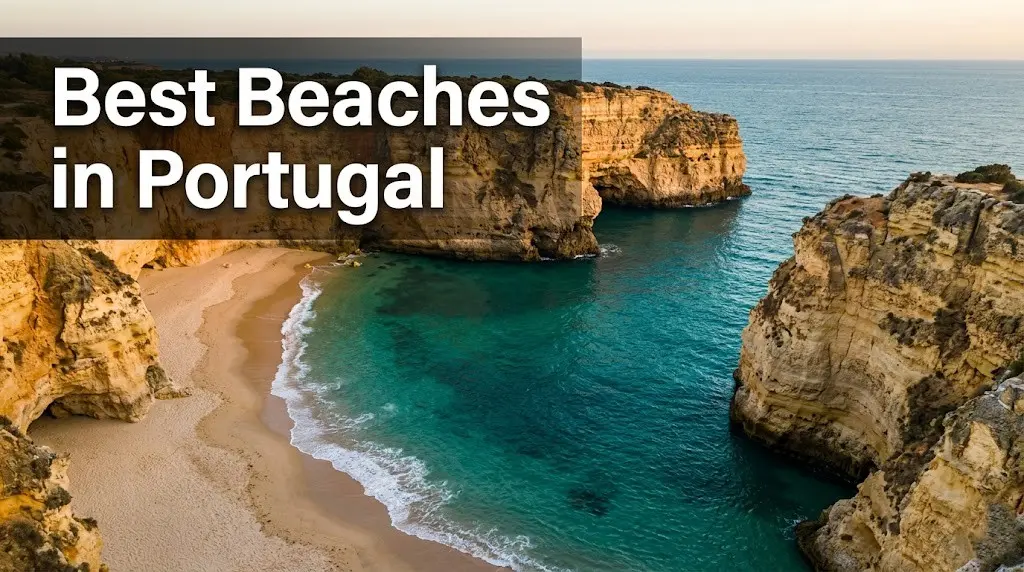
The Algarve covers the southern coast and holds Portugal’s most photographed beaches: golden limestone cliffs, sea caves, and translucent green water in sheltered coves.
The Costa Vicentina runs up the southwest Atlantic flank and delivers wild, dune-backed surf beaches with almost no development and genuine remoteness.
The Lisbon Coast and Arrábida offer dramatic contrast: the Serra da Arrábida cliffs frame some of the clearest, calmest water on the entire mainland.
Comporta and the Alentejo coast sit north of the Algarve and draw travelers who want long, empty sand without the cliff-cove crowds.
| Region | Beach Character | Best For | Crowd Level | Water Character |
|---|---|---|---|---|
| Algarve (south coast) | Limestone cliff coves, golden sand | Couples, scenic photography | High in July–August | Calm, clear, 19–22°C summer |
| Costa Vicentina | Wild Atlantic dunes, surf | Surfers, nature lovers | Low year-round | Rough, 17–20°C summer |
| Arrábida | Forested cliffs, turquoise coves | Couples, snorkelers | Moderate | Calm, clearest on mainland |
| Comporta/Alentejo | Long empty sand, pine backing | Budget travelers, escapists | Low to moderate | Atlantic, 18–21°C summer |
| Lisbon Coast | Accessible urban beaches | Day-trippers, families | High in summer | Atlantic, cooler than Algarve |
| Madeira | Volcanic black sand, pebble | Unique experience seekers | Low | 22–24°C, calm in south |
| Azores | Remote volcanic coastline | Adventure, diving | Very low | 20–23°C summer |
Insider Tip:
- The Algarve’s south-facing coves are noticeably calmer and warmer than the west-facing beaches near Sagres.
- Comporta sees significantly lower visitor numbers than the Algarve despite being a 90-minute drive from Lisbon.
- For families with children under 10, the Algarve’s southern coves and Arrábida both offer calmer water entry than any Costa Vicentina beach.
What to Expect from Portugal Beaches Before You Go
Portugal’s beaches are not tropical. The Atlantic Ocean runs colder than the Mediterranean, and that distinction matters for how you plan.
Water temperatures on the southern Algarve coast typically reach 20 to 23 degrees Celsius in July and August. On the west-facing Costa Vicentina, temperatures run closer to 17 to 19 degrees Celsius even in peak summer.
According to the Instituto Português do Mar e da Atmosfera, the Algarve’s southern coast is the warmest stretch of Portugal’s mainland coastline during summer months.
Most beach facilities — showers, sunbed rentals, beach bars, and lifeguard services — operate from mid-June through mid-September. Outside that window, services at even popular beaches are reduced or absent.
Blue Flag certification is widely held across Portugal’s beaches. The Foundation for Environmental Education awards this designation based on water quality, safety, and environmental management standards.
Beach access is almost universally free. What costs money is parking, sun lounger rental, and beach restaurant pricing, which rises steeply in July and August.
Travelers on a budget: Pack your own shade, food, and drinks. Sunbed rentals at prime Algarve beaches can run 15 to 25 euros per set per day in peak season. Bring what you need and the beach itself costs nothing.
Honeymooners and couples should note that Portugal’s cliff coves photograph dramatically well, but the “deserted cove” you see on Instagram in those shots was taken in May or October. In August, those same coves hold hundreds of visitors by mid-morning.
Best Beaches in the Algarve
The best beaches in the Algarve include Praia da Marinha, Praia do Camilo, Praia da Falésia, Meia Praia, and Praia dos Três Irmãos, each offering distinct conditions and traveler suitability.
Praia da Marinha, near Lagoa, is the Algarve’s most consistently recommended beach for a reason. Its amber limestone rock formations, sea caves, and rock pools frame calm, clear water in a sheltered cove.
Access requires a short cliff walk of roughly 5 to 10 minutes with steep steps. The car park near Praia da Marinha fills by 9am in August. Arrive before 8:30am or visit in May, June, September, or October.
Praia do Camilo, near Lagos, is smaller and less crowded than Marinha, with a dramatic wooden staircase descent through the cliffs. The water sits in a protected cove with gentle entry.
Praia da Falésia, near Albufeira, stretches approximately 6 kilometers of red and ochre cliff-backed sand. It absorbs crowds far better than the small coves because of its length.
Meia Praia, near Lagos, is one of the Algarve’s longest beaches at roughly 4 kilometers. It offers calm, shallow water and is the region’s best family beach for water entry ease.
| Beach | Location | Best For | Crowd Level (August) | Water Entry | Insider Note |
|---|---|---|---|---|---|
| Praia da Marinha | Lagoa | Couples, photography | Very high | Steps, then calm cove | Car park full by 9am |
| Praia do Camilo | Lagos | Couples, scenic walk | High | Staircase descent, gentle | Smaller so feels crowded fast |
| Praia da Falésia | Albufeira | All profiles | Moderate (length helps) | Easy, gently sloping | Best for a full beach day |
| Meia Praia | Lagos | Families | Moderate | Very easy, shallow | Water-sports rentals available |
| Praia dos Três Irmãos | Portimão | Mixed | High | Easy | Rock formations at low tide |
According to the Algarve Tourism Board (Região de Turismo do Algarve), the Algarve coast holds more than 150 individual beaches across its 155-kilometer south-facing shoreline.
Key Takeaway: Praia da Marinha earns its reputation but demands an early arrival in summer. Praia da Falésia handles crowds better than any small Algarve cove.
Most Beautiful Beaches in Portugal
The most beautiful beaches in Portugal, by consistent ranking among travel publications and independent traveler accounts, are Praia da Marinha, Praia do Camilo, Praia de Odeceixe, Sesimbra, and Comporta.
Each earns its reputation for different reasons. Marinha and Camilo deliver the iconic Algarve cliff scenery. Odeceixe is where a river meets the Atlantic at a wild, dune-flanked stretch of sand.
Sesimbra, south of Lisbon in the Setúbal district, is the mainland’s most underrated beautiful beach. Its calm, clear water sits in a protected bay backed by a Moorish castle ridge.
Comporta is a different kind of beautiful: 30 kilometers of uninterrupted fine white sand, backed by umbrella pine trees, without a hotel or restaurant in direct sightline from the waterline.
Snorkeling visibility is best at Sesimbra and in the Arrábida Natural Park coves, where calm Atlantic water in a protected park setting maintains exceptional clarity in calm summer conditions.
Couples and honeymooners should note that Comporta’s visual beauty is understated rather than dramatic. If the photograph is the goal, the Algarve’s cliff coves are more immediately striking. If the experience of isolation and space is the goal, Comporta is unmatched on the mainland.
Insider Tip:
- Praia de Odeceixe has an unusual orientation: the river side is calmer and warmer, the ocean side has more wave action. Families instinctively use the river side without knowing why it feels safer.
- Sesimbra’s western end, near the fishing harbor, stays far less crowded than the central beach area even in summer.
- Comporta beach has almost no shade. Bring your own umbrella or rent one from the handful of operators near the access points.
South of Portugal Beaches Beyond the Algarve
The south of Portugal beaches extend beyond the Algarve to include the Alentejo coast, Comporta, and Vicentina Coast beaches that receive a fraction of the Algarve’s visitors.
Comporta sits approximately 90 minutes south of Lisbon and about 2 hours north of Faro. It draws a low-key, design-conscious European crowd who want long beach walks without tourist infrastructure.
The beach is accessed via sand tracks through pine forest. No hotels sit directly on the beach. The village of Comporta itself has a handful of excellent restaurants.
Praia da Zambujeira do Mar, inside the Parque Natural do Sudoeste Alentejano e Costa Vicentina, is one of the most visually arresting beaches in all of Portugal. A steep access path leads to a wide, cliff-framed beach with almost no facilities.
Water here is Atlantic-rough and cold by Algarve standards. Water temperatures run around 17 to 19 degrees Celsius even in August. This is not a swimming beach for young children.
Budget and value travelers find the Alentejo coast significantly more affordable than the Algarve. Accommodation in the town of Comporta and surrounding villages runs notably cheaper per night than equivalent options in Lagos or Albufeira.
Praia da Carriagem and Praia do Brejo Largo are two additional Alentejo options that require 4WD or a healthy walk to access, which naturally keeps crowds minimal year-round.
Key Takeaway: Comporta and the Alentejo coast deliver genuine beach solitude within reach of Lisbon. They suit independent travelers far more than tour-package visitors.
Best Beaches Near Lisbon
The best beaches near Lisbon include Cascais, Praia de Guincho, Sesimbra, Praia do Meco, and the Arrábida Natural Park beaches, all within 45 to 90 minutes of the city.
Cascais is the most accessible, with direct train service from Lisbon’s Cais do Sodré station in about 40 minutes. Its main beach, Praia de Cascais, is a wide urban beach with excellent facilities but significant summer crowds.
For families arriving by public transport, Cascais is the practical choice. The calm bay and shallow water entry are child-friendly. The town has good restaurant options within walking distance.
Praia de Guincho, 8 kilometers north of Cascais, is a completely different experience: a wide, wind-exposed Atlantic beach backed by dunes and the Serra de Sintra. It is one of Portugal’s premier windsurfing and kitesurfing locations.
Guincho is not a swimming beach for most visitors. The waves and rip current risk are real. Do not swim at Praia de Guincho without checking current sea conditions, and keep children out of the water here.
The Arrábida Natural Park beaches, including Portinho da Arrábida and Galapinhos, sit about 50 kilometers south of Lisbon and require a car. Access to Arrábida park beaches is limited by daily vehicle quotas in summer. Book the access permit online before your visit — walk-up entry is frequently unavailable at peak times.
| Beach | Distance from Lisbon | Transport | Best For | Crowd Level | Warning |
|---|---|---|---|---|---|
| Praia de Cascais | 40 km | Train available | Families, day-trippers | Very high in summer | Urban beach feel |
| Praia de Guincho | 50 km | Car needed | Windsurfers, walkers | Moderate | Strong currents, not for swimmers |
| Portinho da Arrábida | 50 km | Car needed | Couples, snorkelers | High (quota limited) | Pre-book park entry |
| Sesimbra | 40 km | Car or bus | All profiles | Moderate | Parking fills fast |
| Praia do Meco | 45 km | Car needed | Adults, naturists | Low to moderate | Known nudist section |
Silver Coast and Costa Vicentina Beaches
The Silver Coast (Costa de Prata) and Costa Vicentina deliver Portugal’s wildest, most undeveloped Atlantic beach experiences. These are not beaches for calm swimming. They are beaches for perspective.
The Silver Coast stretches from Lisbon north through Peniche, Nazaré, and São Martinho do Porto. Nazaré is internationally known for its massive winter surf waves, generated by the Nazaré Canyon.
In summer, Nazaré’s beach becomes a wide, calm(er) family beach with full facilities. The canyon’s effect is far less dramatic in June through September. Its reputation is built on November through February swells.
São Martinho do Porto is the Silver Coast’s most family-friendly option: a crescent bay with almost enclosed calm water that behaves more like a lagoon than an Atlantic beach. Water entry is gentle enough for very young children.
Peniche is one of Portugal’s most important surf destinations, with Supertubos wave ranking among Europe’s most consistently powerful beach breaks. This is a surfers’ beach, not a casual family swim beach.
Costa Vicentina runs south from Odeceixe through Aljezur to Sagres. Praia da Bordeira, near Carrapateira, is one of Europe’s most visually impressive wild beaches: enormous dune system, a river lagoon, and an Atlantic beach stretch that can hold thousands of people and still feel empty.
According to Turismo de Portugal, the Parque Natural do Sudoeste Alentejano e Costa Vicentina is one of Europe’s largest protected coastal natural parks, covering approximately 110,000 hectares.
Surfers should note that Costa Vicentina beaches have cold Atlantic water and consistent swells year-round. Wetsuits are standard even in July. Water temperatures here run 2 to 3 degrees Celsius cooler than the southern Algarve.
Key Takeaway: São Martinho do Porto is the Silver Coast’s only beach genuinely suitable for young families. Nazaré and Peniche serve surfers and surf-culture travelers, not casual swimmers.
Best Beaches in Portugal for Families
The best beaches in Portugal for families with young children are Meia Praia (Lagos), São Martinho do Porto, Praia de Armação de Pêra, Praia do Barril (Tavira), and Manta Rota.
These five share the criteria that genuinely matter for families: shallow, gentle water entry, low wave action, lifeguard presence in season, and toilets and showers on site.
Meia Praia near Lagos is approximately 4 kilometers long, gently sloping, and protected enough from Atlantic swell by the Lagos bay headlands that wave action stays consistently mild. Water-sports rental is available on the beach.
Praia do Barril in the Ria Formosa Natural Park near Tavira requires a short miniature train ride (or a 15-minute walk on a boardwalk path) from the car park to the beach. That natural barrier keeps car-culture overcrowding off the beach itself.
The sand at Praia do Barril is fine and white. Water is calm, shallow, and notably clear in the protected park setting. Facilities include showers, a restaurant, and lifeguards in season.
Praia de Armação de Pêra is one of the Algarve’s longest urban beaches. It is wide enough to absorb large crowds without feeling chaotic. The town immediately behind has every practical facility a family needs.
Parents of very young children: avoid west-facing beaches including Praia da Bordeira, Praia de Odeceixe’s ocean side, and Praia de Guincho entirely. Atlantic swell and rip current risk are real at all three.
Budget family travelers should note that Praia do Barril’s miniature train costs a small fee per person. Parking at nearby Pedras d’El Rei is inexpensive but limited. Arriving before 10am in August is essential for parking.
Best Beaches in Portugal for Couples
The best beaches in Portugal for couples are Praia da Marinha, Praia do Camilo, Portinho da Arrábida, Comporta, and Praia de Odeceixe.
Each delivers a distinct romantic quality: dramatic cliff scenery at Marinha and Camilo, intimate natural park serenity at Arrábida, vast peaceful isolation at Comporta, and wild river-meets-ocean beauty at Odeceixe.
Portinho da Arrábida inside Arrábida Natural Park arguably has the clearest, most turquoise water on the Portuguese mainland. On a calm June or September morning, the water color genuinely rivals the Mediterranean.
The park limits daily vehicle entry. Booking the access permit online in advance is not optional in summer. Couples who arrive without a reservation in July or August are frequently turned away.
Praia do Camilo works well for couples who want a shorter, more photogenic experience. The cliff staircase descent creates a natural filter: it is too steep and too narrow for most families with strollers. The cove below is naturally more intimate.
Honeymooners specifically should look at the area between Lagos and Sagres for cliff-walk experiences in the late afternoon, when the light on the limestone turns deep amber and the boat tours have finished for the day.
Sunset from Cabo de São Vicente, the southwestern tip of mainland Europe, followed by dinner in the village of Sagres, is the kind of evening that costs almost nothing and genuinely delivers.
Couples on a budget: Comporta’s beach costs nothing to access. The village restaurants serve excellent fresh seafood at mid-range prices. Accommodation in the area runs cheaper than equivalent Algarve options.
Insider Tip:
- Praia do Camilo’s lower platform at low tide reveals rock pools worth exploring. Check a tide table before visiting.
- Arrábida’s access quota makes June and September visits significantly easier than August for couples who did not pre-book.
- Comporta’s beach is at its best in early morning light. Bring coffee and stay for an hour before anyone else arrives.
Secluded and Least Crowded Beaches in Portugal
The least crowded beaches in Portugal, even in summer, include Praia da Carriagem, Praia do Beliche (Sagres), Praia da Bordeira, Galapinhos (Arrábida), and Praia de Miramar (north of Porto).
These beaches stay quieter for different reasons. Some require difficult access. Some are exposed to cold Atlantic wind and swell that deter casual swimmers. Some are simply unknown to international visitors.
Praia do Beliche, near Sagres, sits at the base of steep cliffs and is reachable only via a narrow, steep path. Its small size means it never holds large crowds. The water is cold, clear, and wild.
Galapinhos, inside Arrábida Natural Park, requires a longer walk than the park’s other beaches. That 20-minute walk from the nearest access point eliminates most casual visitors. The reward is a cove with extraordinary clarity.
Praia de Miramar, near Espinho south of Porto, is famous among Portuguese visitors for the small wave-surrounded chapel that sits on the rocks at low tide. International visitors almost never find it.
The beach itself is wide, Atlantic-facing, and noticeably cooler than Algarve beaches. Water temperatures in summer run around 16 to 18 degrees Celsius. It is not a swimming beach for those who want warmth.
Solo travelers and independent travelers will find Praia da Bordeira and the Costa Vicentina beaches genuinely rewarding outside peak season. In May, October, or even early November, these beaches are essentially empty.
Insider Tip:
- Praia do Beliche has no facilities at all. Bring everything you need before descending the path.
- Galapinhos requires the Arrábida park vehicle access permit even if you are walking in from outside the vehicle perimeter.
Key Takeaway: Portugal’s least crowded beaches require either difficult access, cold water tolerance, or a visit outside July and August. Plan around those three filters and solitude is available even in summer.
Best Surfing Beaches in Portugal
The best surfing beaches in Portugal are Supertubos (Peniche), Nazaré (winter only), Praia da Bordeira (Carrapateira), Praia da Arrifana (Aljezur), and Ericeira‘s multiple breaks.
Ericeira, north of Lisbon, holds the status of World Surfing Reserve, one of only a handful worldwide. The Ribeira d’Ilhas break is the best-known wave here and hosts international competition events.
Supertubos near Peniche is where the MEO Rip Curl Pro Portugal contest runs annually. The beach break here produces powerful, hollow barrels. This is an advanced to expert surf zone, not a beginner lesson beach.
Beginner surfers are best served by Sagres, Amado (Carrapateira), or the gentler breaks near Lagos. Multiple accredited surf schools operate at each location. Lessons typically run 35 to 60 euros per person for a two-hour session; verify current pricing when booking.
Nazaré in winter produces the world-record swell waves at the Praia do Norte break, driven by the Nazaré Canyon’s unique underwater geography. These waves are for elite big-wave surfers only. In summer, the same beach is safe for casual swimming.
According to Turismo de Portugal, the Ericeira World Surfing Reserve designation recognizes the concentration of high-quality surf breaks within a 4-kilometer stretch, with eight distinct breaks including Ribeira d’Ilhas, Cave, Pedra Branca, and Reef.
Solo travelers who surf will find the Portuguese surf community notably welcoming. Ericeira in particular has an established surf culture with hostels, surf camps, and a social scene built around the breaks.
Best Beaches for Swimming and Snorkeling in Portugal
The best beaches for swimming in Portugal are Meia Praia, São Martinho do Porto, Portinho da Arrábida, and Praia do Barril. For snorkeling specifically, Portinho da Arrábida, Sesimbra, and Praia da Marinha’s rock pool areas lead.
Snorkeling conditions at Portinho da Arrábida are the best available on the Portuguese mainland. The park’s protected status means marine life is notably richer than at unprotected beaches. Seagrass meadows, small fish, and rock formations are visible in 3 to 5 meters of calm water.
Bring your own snorkeling equipment. Rental is not reliably available at the Arrábida park beaches themselves. Confirm at the nearest town, Setúbal or Sesimbra, before heading into the park.
Sesimbra is easier to access than Arrábida’s inner park beaches and offers good snorkeling along the rocky edges of its bay. The central beach has boat tour operators who run snorkeling excursions. Prices for guided snorkeling trips typically range from 25 to 50 euros per person; verify current pricing when booking.
Water clarity at Praia da Marinha is good in calm conditions, and the rock pools at low tide reveal sea life without needing to swim out. This is the Algarve’s most accessible snorkeling experience without a boat.
Families with older children who want to snorkel without renting a boat should prioritize Arrábida or Sesimbra over the Algarve. The Algarve’s best snorkeling is typically on boat tours to sea caves and grottos, not directly off the beach.
Budget swimmers should note that São Martinho do Porto’s enclosed bay is one of the only places on the Portuguese Atlantic coast where calm, warm(ish), shoulder-deep water is available without a permit, a difficult access path, or a boat trip.
Beaches in Madeira and the Azores
Beaches in Madeira and the Azores are a different category entirely from mainland Portuguese beaches and require a specific expectation reset before booking.
Madeira is a volcanic island. Its beaches are predominantly black volcanic sand or pebble, not white sand. The most accessible are Praia de Machico and Praia da Calheta, the latter being an artificial beach where white sand was imported. The water on Madeira’s south coast is genuinely warm: around 22 to 24 degrees Celsius in summer.
Praia da Calheta is the best swimming beach on Madeira. A protected marina breakwater creates calm conditions. The sand is imported and the setting is more resort-adjacent than wild coastal.
Porto Santo, an island 43 kilometers northeast of Madeira (ferry or short flight), has a genuine 9-kilometer natural white sand beach. This is the most classic beach experience in the Madeira archipelago. The ferry takes about 2.5 hours.
The Azores archipelago, nine islands in the mid-Atlantic, is primarily a nature and diving destination rather than a beach holiday destination. São Miguel has dark sand beaches at Praia de Santa Bárbara and thermal pools at Furnas. Faial and Flores have dramatic coastal scenery.
Travelers expecting beach holidays comparable to the Algarve should not build an Azores trip around beach time. The volcanic scenery, hiking, whale watching, and diving are the genuine draws.
Luxury and solo travelers looking for a unique, uncrowded island experience will find the Azores compelling from May through September. The islands receive far fewer visitors than Madeira or the Algarve.
Key Takeaway: Porto Santo’s white sand beach is the best classic beach experience in Madeira. The Azores are for nature and diving travelers, not beach holiday seekers.
Best Time to Visit Portugal Beaches
The best time to visit Portugal beaches is May, June, September, and October. These months deliver reliable warm weather, dramatically reduced crowds, and open beach facilities at lower seasonal prices.
July and August deliver the most sun hours but also the highest accommodation prices, the fullest car parks, and the least authentic experience at famous cliff-cove beaches.
| Month | Weather | Crowds | Water Temp | Facilities | Verdict |
|---|---|---|---|---|---|
| January–February | Cool, often rainy | Very low | 14–15°C | Minimal | Scenic walks only |
| March–April | Variable, mild | Low | 15–17°C | Limited | For surfers, nature walkers |
| May | Warm, sunny | Low | 17–18°C | Opening | Best overall value month |
| June | Hot, reliable | Moderate | 19–21°C | Full | Excellent sweet spot |
| July | Very hot | Very high | 21–23°C | Full | Peak crowds, peak prices |
| August | Hottest month | Maximum | 21–23°C | Full | Avoid famous beaches |
| September | Still warm | Moderate | 21–22°C | Full | Best overall month |
| October | Warm, quieter | Low | 19–21°C | Reduced | Strong second choice |
| November–December | Cooler, wetter | Very low | 16–17°C | Mostly closed | Surfers and off-season seekers only |
According to Turismo de Portugal, the Algarve receives approximately 300 days of sunshine annually, making the shoulder season months far more reliable than travelers from northern Europe typically expect.
Honeymooners should strongly consider June or September. Both months offer the full beach experience without the August crowds. Resort pricing is 20 to 35 percent lower than peak August in many cases.
Budget travelers can find genuinely good accommodation pricing in May and October. Beach facilities are open, water is swimable, and car parks rarely fill before midday.
Beach Access, Parking, and Logistics in Portugal
Accessing Portugal’s best beaches requires either a rental car, organized transfer, or advance planning. Most cliff-cove Algarve beaches are unreachable by public transport.
Renting a car at Faro International Airport (FAO) gives the most flexibility for the Algarve coast. The Via do Infante A22 motorway and EN125 coastal road connect major beach towns. Allow extra driving time on EN125 in July and August as the coastal road through small towns slows significantly.
Parking at major Algarve beaches is mostly free or low-cost. Expect rates of roughly 1 to 5 euros per day at official car parks; verify current fees at your specific beach. At Praia da Marinha, Praia do Camilo, and Praia dos Três Irmãos, parking fills completely by 9 to 10am in August.
Arrábida Natural Park beaches operate a vehicle quota system in summer. Book your access online through the park’s official booking system before traveling. Walk-up vehicle entry is frequently unavailable.
For beaches near Lisbon:
- Book the Arrábida park vehicle permit at least a week ahead in summer.
- Take the Comboios de Portugal train from Cais do Sodré to Cascais (approximately 40 minutes, low cost).
- From Cascais, a taxi or rideshare reaches Praia de Guincho in 10 minutes.
- For Sesimbra, a car is practical. Bus service from Setúbal exists but runs infrequently.
- For Comporta, a car is essential. The beach is not served by any regular public transport.
Travelers without a car have reliable public transport access to Cascais, Nazaré, and Sesimbra. For the Algarve’s cliff-cove beaches, organized day tours from Lagos or Albufeira are available if driving is not an option.
Families driving should download offline maps before leaving for beach car parks. Mobile signal is variable at many Algarve coastal access points.
What Most Visitors Get Wrong About Portugal Beaches
The single most common mistake visitors make is planning a first trip to Portugal in August and expecting the famous Algarve cliff coves to feel remote, serene, or remotely like the social media images.
Praia da Marinha in August holds hundreds of visitors by 10am. The cliff path is congested. The cove fills completely. Boat tours circle the grottos constantly. The beach is still beautiful. It is simply not the private discovery experience people expect.
The second most common mistake is assuming Portugal’s Atlantic water is warm. Travelers comparing Portugal to Mallorca, the Greek islands, or Turkey are in for a surprise. The Algarve’s south coast hits 20 to 23 degrees Celsius at peak. The west coast and Costa Vicentina run 5 degrees cooler.
Insider Tip:
- Timing beats location every time. The same Praia da Marinha at 8am in September delivers the experience that 100,000 August Instagram posts promise.
- The Algarve has more than 150 named beaches. The five on every “top 10” list receive 90 percent of the visitors. One bay further in either direction often delivers comparable scenery with a fraction of the crowd.
- Portugal’s beaches charge no entry fee, but some parking areas near famous beaches now charge seasonal fees. Confirm the current parking situation for your specific beach before assuming it is free.
Families often underestimate driving time between Algarve beaches. On the EN125 in August, what looks like a 20-minute drive can take 45 to 60 minutes. Plan one or two beaches per day, not five.
Couples and honeymooners frequently book accommodation in Albufeira thinking it is a romantic base. Albufeira’s old town is pleasant, but the resort strip is heavily oriented toward a party-tourism crowd. Lagos, Tavira, or the Golden Triangle area (Almancil, Quinta do Lago) provide a quieter, more romantic base for Algarve beach exploration.
Safety and Seasonal Warnings for Portugal’s Beaches
Atlantic Ocean conditions pose real safety risks at many Portuguese beaches, and those risks are underreported by most travel content.
Key safety and seasonal facts every visitor should know:
- Rip currents are present at all west-facing beaches including Praia de Guincho, Praia da Bordeira, Sagres beaches, and Praia de Odeceixe’s ocean side. Do not swim at red flag conditions. Red and yellow flags are lifeguard-controlled signals; obey them without exception.
- Green flag means safe to swim. Yellow flag means swim with caution. Red flag means no swimming. Flag systems operate only during lifeguard service hours, which are typically 9am to 6pm in season.
- Jellyfish are periodically present on all Portuguese Atlantic-facing beaches, particularly in calm warm conditions in July and August. Check local beach reports before swimming on hot, still days.
- Sun exposure is intense in the Algarve from June through September. UV index regularly reaches 9 or 10. Reapply sunscreen every 90 minutes, use SPF 50 or higher, and avoid direct sun from 12pm to 4pm without shade.
- Cold water shock is a genuine risk for children and non-acclimatized adults entering the Costa Vicentina or north-coast Atlantic water, which can run as low as 15 to 17 degrees Celsius even in summer.
- Cliff edges near Algarve beaches are unstable in places. Do not approach unfenced cliff edges for photographs. Signage warning of cliff instability should be taken seriously. Erosion collapses have occurred without warning.
The Portuguese Maritime Authority manages beach safety along the coast. In an emergency, call 112 (Portugal’s universal emergency number).
Frequently Asked Questions About Beaches in Portugal
What is the most beautiful beach in Portugal?
Praia da Marinha, near Lagoa in the Algarve, is consistently cited as Portugal’s most beautiful beach by travel publications including Lonely Planet and Travel + Leisure.
Its amber limestone cliff formations, sea caves, rock pools, and clear sheltered cove water make it visually distinct from any other European beach.
Visit between May and June or in September to see it without August’s peak crowds.
Are Portugal beaches warm enough to swim in?
Portugal’s southern Algarve coast reaches water temperatures of 20 to 23 degrees Celsius in July and August, which is warm enough for most swimmers.
The west-facing Costa Vicentina and Silver Coast beaches run 5 degrees Celsius cooler, which many visitors find uncomfortably cold without a wetsuit.
Water temperatures are best confirmed via the Instituto Português do Mar e da Atmosfera before your trip.
Which Portugal beaches are best for families with young children?
Meia Praia near Lagos and Praia do Barril near Tavira are the best choices for families with young children, offering gentle shallow water entry, lifeguard presence, and full facilities.
São Martinho do Porto, on the Silver Coast, has the calmest enclosed bay water of any beach on the Portuguese Atlantic mainland.
Avoid west-facing beaches including Praia de Guincho and Praia da Bordeira entirely for young children due to rip current risk.
When is the best time to visit Portugal beaches?
September is the single best month for Portugal beaches: warm water from the summer, dramatically reduced crowds, open beach facilities, and lower accommodation prices than July or August.
May and June are the best alternatives, offering reliable warm weather and low crowd levels before the European peak holiday season arrives.
Avoid August if your priority is a quiet, uncrowded beach experience at any well-known location.
Are the beaches in Portugal crowded in summer?
Yes. Famous Algarve beaches including Praia da Marinha, Praia do Camilo, and Praia dos Três Irmãos are heavily crowded from mid-July through the end of August.
Car parks fill by 9am, popular cliff-access paths become congested, and the visual experience is very different from shoulder-season photography.
The Costa Vicentina beaches, Comporta, and the Alentejo coast stay significantly quieter because Atlantic swell and cold water deter casual swimmers.
Do you need a car to reach the best beaches in Portugal?
A car is strongly recommended for the Algarve, Costa Vicentina, Arrábida, and Comporta beaches. Public transport does not reach most cliff-cove beaches.
Cascais, Nazaré, and Sesimbra are accessible by public transport from Lisbon with a combination of trains and buses.
For any beach outside a main town, particularly Arrábida Natural Park beaches and Comporta, a rental car or pre-booked private transfer is the only realistic option.
The Honest Bottom Line on Portugal Beaches
Portugal’s beaches are the real thing. The Algarve’s golden limestone cliffs are not a photography trick. The water clarity at Arrábida is not overstated. Comporta’s long, empty sand genuinely exists.
The gap between expectation and reality almost always comes down to timing. Plan your visit in September or May and the beaches deliver exactly what the images promise. Plan in August and you share that scenery with the rest of Europe.
Book the Arrábida Natural Park vehicle access permit before your trip. Reserve accommodation in Lagos or Tavira rather than central Albufeira if a relaxed, coastal-town atmosphere matters. And verify all parking details, beach facility availability, and seasonal conditions before departure. Conditions and policies change year to year.
The traveler who arrives in Portugal knowing which beach suits their profile, which month avoids the worst crowds, and which logistics to sort in advance will have an outstanding trip. This guide gives you that foundation.