Dog Beaches Near Me: A 2026 Safety and Rules Guide
“Dog beaches near me” is a search born from a specific kind of hope.
You want your dog to feel sand, surf, and freedom without a ticket or a tragedy.
Most dog beach disasters happen because of a rule the owner never checked.
The single most important step is verifying the leash law before you leave.
County animal services and state park websites post the legally binding current
rules. A random photo on a social media post from 2022 is not a reliable source.
This guide builds a framework to find a beach, pack the right gear, and match the
spot to your actual dog’s personality. Not the dog you wish you had on Instagram.
Are Dogs Allowed on the Beach?
No, dogs are not universally allowed on every beach in the United States.
Access depends entirely on the specific town, county, or state park jurisdiction.

Many public beaches ban dogs outright during peak summer hours.
Others allow dogs only on a six-foot leash and only during specific months.
State parks often have designated dog beaches completely separate from human
swimming areas. National parks generally restrict dogs to specific areas, not the
primary swimming beaches.
A “dog-friendly” label on a third-party site does not supersede posted signage.
You must check the official governing body website for that specific beach.
The U.S. National Park Service maintains a centralized policy page for its
units. County parks and recreation departments update their own websites seasonally.
Do not rely on BringFido or Google Maps alone for current rules.
These aggregators are often outdated by a full season on leash law changes.
Dog Beaches Near Me
To find a verified dog beach near you in 2026, start with a direct local government
search. Type “[your county] parks and recreation dog beach” into your browser.
County websites end in .gov and list the official rules, hours, and closures.
This single step prevents you from driving 45 minutes to a permanently closed
access point.
Apps like BringFido and Rover are useful for discovering beach names.
Treat them as a starting list, not the final authority on current rules.
Once you have a beach name, cross-reference it with the county or state park
website. Look for the specific “dogs on beach” page or a downloadable park rules
PDF.
Pay attention to the date the page was last updated at the bottom.
If the last update was in 2024, call the park office to confirm the 2026 rules.
Do not assume a beach with a dog in its online photos is dog-friendly.
Geotagging and old photos create a false sense of permission.
Beaches That Allow Dogs Near Me
The most reliable beaches that allow dogs are dedicated dog beaches within county
parks. These spaces are purpose-built for canine use and have clear, enforced rules.
Fort De Soto Dog Beach in Florida and Huntington Dog Beach in California
are two famous examples. They have separate, fenced, or clearly marked dog zones.
Beaches that allow dogs on-leash only are more common in residential towns.
Carmel Beach in California allows off-leash dogs with reliable voice control.
Look for beaches with a “dog beach” label in the official park name.
This phrasing in a .gov URL almost always means dogs are permitted in some capacity.
If a beach simply lacks a “No Dogs” sign, do not assume permission.
Many towns enforce a blanket ban on dogs on public sand without posting signs.
Call the local non-emergency police line if the official website is unclear.
A five-minute phone call saves you a potential $250 citation.
Key Takeaway: Use the .gov website for the specific beach, not an aggregator app, to verify current 2026 rules.
Dog Friendly Beaches Near Me
A truly dog-friendly beach offers more than just legal access.
It provides a freshwater rinse station, waste bag dispensers, and nearby shade.
The best dog-friendly beaches have a clear separation from crowded human swimming
areas. This minimizes leash-tangling incidents and nervous child interactions.
Look for an active local volunteer group that maintains the dog beach.
Their presence signals a strong, enforcement-backed dog culture at that site.
Beaches adjacent to a veterinary emergency clinic earn a higher safety rating.
In a crisis, a 10-minute drive is vastly better than a 45-minute panic drive.
Check recent Google reviews filtered by “dog” for the past three months.
Owners will report if the freshwater station is broken or if the beach is currently
covered in a fish kill.
A beach with a broken freshwater rinse station is not dog-friendly that day.
Salt crust on fur leads to dermal irritation and hot spots if not rinsed.
Off Leash Dog Beaches
An off-leash dog beach means your dog may legally run without a physical tether.
The legal requirement is almost always paired with a strict voice control mandate.
Your dog must return to you immediately on the first verbal command.
If your dog ignores a recall when a distraction appears, it is not safe for that
beach.
Designated off-leash areas are typically fenced or bounded by natural barriers.
This prevents a bolting dog from running directly into a road or a sensitive bird
nesting area.
Even at an off-leash beach, carry a leash in your hand at all times.
You need to clip the leash instantly if a fight breaks out or a ranger appears.
A “voice control” area is not the same as a fenced dog park.
The ocean is a lethal boundary for a dog that chases a bird too far out.
Never let your dog off-leash on a beach that is not explicitly designated.
An off-leash citation can come with a fine exceeding $500 in some jurisdictions.
Best Beaches for Dogs
The best beach for a dog depends on its breed, energy level, and recall reliability.
A calm, fenced, shallow freshwater beach suits a small or nervous dog best.
A wide, hard-packed ocean beach with consistent surf suits a high-energy retriever.
The specific beach name matters less than the beach type match to your dog.
| Beach Type | Best Dog Profile | Key Hazard |
|---|---|---|
| Fenced Freshwater Cove | Small breeds, unreliable recall | Blue-green algae, stagnant water |
| Wide Hard-Packed Ocean Beach | High-energy retrievers, strong swimmers | Rip currents, salt toxicity |
| River Bar with Gentle Slope | Puppies, senior dogs, new swimmers | Leptospirosis, fast currents |
| Rocky Tide Pool Beach | Sure-footed breeds, calm exploration | Slippery rocks, sea urchin spines |
| Dedicated Dog Park Beach | All profiles, depending on section | Overcrowding, poorly matched play |
Fort De Soto Dog Beach offers a fenced, shallow wading area for small dogs.
Huntington Dog Beach provides a long, straight strip for high-energy runners.
Key Takeaway: Match your dog’s energy and recall to the beach type, not just the beach’s famous name.
Dog Swimming Beaches
The safest dog swimming beach has a gradual, sandy entry with no sudden drop-offs.
A steep shelf beach can panic a dog and trigger a drowning panic.
Freshwater ponds and lakes for dog swimming carry a leptospirosis risk.
This bacterial disease is transmitted through the urine of infected wildlife.
Vaccinate your dog against leptospirosis before swimming in any freshwater body.
The vaccine is not part of the core DHLPP series and must be requested separately.
Ocean swimming introduces saltwater toxicity as a serious hidden danger.
Dogs that bite at waves and ingest large amounts of saltwater can suffer fatal
hypernatremia.
Rinse your dog thoroughly with fresh water after every ocean swim.
Watch for vomiting, diarrhea, and staggering within two hours of leaving the beach.
Do not let your dog drink from any stagnant pond or scummy water.
Blue-green algae blooms can kill a dog within hours of ingestion.
Dog Beach Rules
Every dog beach has a posted set of rules, and ignorance does not excuse a
violation. The most common rules are strictly enforced by park rangers and animal
control.
Standard dog beach rules include:
- License and Rabies Tag: Your dog must wear a current county license and proof of rabies vaccination. A ranger can request proof of vaccination status on the spot.
- Leash Length Maximum: Six feet is the universal maximum length. Retractable leashes are banned on most public beaches.
- Immediate Waste Cleanup: You must bag and dispose of all dog waste in designated bins. Carry at least three bags with you.
- Dog Limit Per Person: Many beaches limit each adult to two or three dogs maximum. Check the specific number.
- Spay/Neuter Requirement: Some off-leash beaches require dogs to be altered. This rule is common on the West Coast.
- No Dogs on Lifeguard Towers: Keep dogs off the wooden lifeguard structures. This is a health code rule.
Read the rule sign at the beach entrance every single time you visit.
Seasonal bird nesting closures can change a beach’s status overnight.
What to Bring to a Dog Beach
Packing the right gear prevents the most common dog beach emergencies.
A five-minute pack at home saves a panicked drive to an unfamiliar vet.
Your essential dog beach packing list:
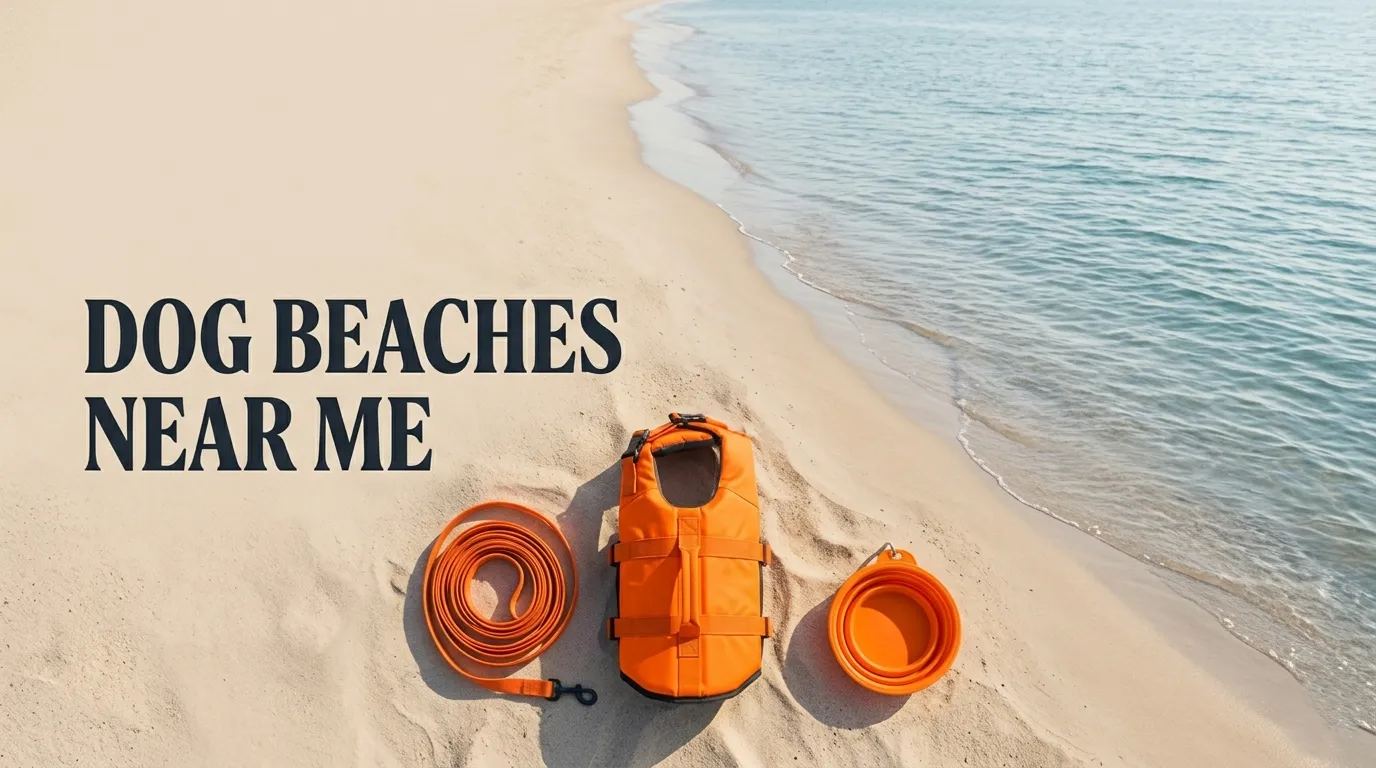
- Freshwater and Collapsible Bowl: Bring at least one gallon of cool fresh water per dog. Saltwater and freshwater pond water are never safe substitutes.
- Canine Flotation Device: Even strong swimmers tire in surf and rip currents. A life jacket with a sturdy dorsal handle is essential for ocean swimming.
- Long Training Leash: A 30-foot non-retractable leash works for supervised wading in allowed areas.
- Paw Wax or Booties: Sand above 125 degrees Fahrenheit causes second-degree paw burns in seconds. Test sand with the back of your hand for 10 seconds.
- Pet-Safe Sunscreen: Apply to pink noses, ear tips, and exposed belly skin. White dogs burn fastest.
- Microfiber Towel and Rinse Water: Rinse salt and sand from the coat and paws before your dog licks them clean.
- Canine First Aid Kit: Include a tick remover, styptic powder for torn nails, and a soft muzzle for pain-bite scenarios.
A soft muzzle belongs in every dog beach first aid kit.
A dog in extreme pain may bite its owner during an emergency extraction.
Dog Beach Safety
The ocean and freshwater beaches present specific, fast-acting threats to dogs.
Heatstroke, saltwater toxicity, and drowning happen in minutes, not hours.
Heatstroke is the most common cause of preventable dog death at beaches.
Signs include excessive panting, brick-red gums, and collapse.
Cool the dog immediately with cool water and drive to an emergency vet.
Do not use ice-cold water, which constricts blood vessels and traps heat.
Saltwater Toxicity manifests as vomiting, diarrhea, and neurological symptoms.
It requires immediate intravenous fluids at a veterinary hospital.
Sand Impaction occurs when dogs repeatedly ingest sand while playing fetch.
Signs include vomiting, constipation, and a painfully firm abdomen.
Paw pad burns from hot sand render a dog unable to walk.
Carry your dog off the sand if it lifts its paws and refuses to move.
Locate the nearest 24-hour veterinary emergency clinic before you leave home.
Save its address and phone number in your contacts.
Key Takeaway: Know the signs of heatstroke and the address of the nearest emergency vet before you unclip the leash.
Best Dog Beach for Small Dogs
The best beach for a small dog is a fenced, designated small-breed area.
Fort De Soto Dog Beach has a dedicated small dog section with shallow wading.
A crowded, open off-leash beach is a genuine danger for a tiny dog.
Large dogs with strong prey drives can mistake a small dog for an animal to chase.
Birds of prey, including ospreys and eagles, pose a real threat on open beaches.
A small dog unattended on the sand is a viable target for a hunting raptor.
A calm, shallow freshwater cove with gentle entry suits small breeds best.
The absence of surf eliminates the risk of a wave dragging a tiny dog out.
Always stay within arm’s reach of your small dog in any water.
A strong wind gust can push a small dog into deep water in seconds.
A canine flotation device is non-negotiable for small dogs near water.
It provides a grab-handle and prevents instant submersion.
Best Dog Beach for High Energy Dogs
A wide, hard-packed ocean beach with consistent wave action suits a high-energy
dog. Huntington Dog Beach and Cannon Beach provide long, straight stretches
for running.
The ideal beach has clear sightlines and minimal rocky hazards for a running dog.
A sudden concealed rock can tear a cruciate ligament at a full sprint.
A long, straight coastline allows a retrieving breed to chase a ball far into the
surf. This satisfies the breed instinct without the risk of a cliff or road nearby.
Avoid small, crowded, fenced beaches for a high-energy working breed.
The confined space and chaotic energy often trigger herding and nipping behaviors.
A tired dog is a well-behaved dog, but exhaustion in water is deadly.
End the session while the dog still has energy to walk back to the car.
Pack a floating retrieval toy that is brightly colored for high-visibility surf
fetch. Do not bring a stick, which can splinter and impale the soft palate.
Best Time to Take Dog to Beach
The best time to take a dog to the beach is early morning, between 7 a.m. and 10
a.m. The sand is cool, the crowds are thin, and the UV index is lower.
Late afternoon, after 5 p.m., is the second-best window in summer.
The midday hours from 11 a.m. to 3 p.m. are dangerously hot for paw pads.
Check the tide chart before choosing your beach time.
A low tide exposes wide, firm sand that is ideal for safe running.
A high tide can eliminate the dry sand entirely on some beaches.
This forces dogs onto hot, rocky, or debris-strewn backup areas.
Spring and fall offer the most comfortable all-day beach windows.
Winter beach visits require a drying coat for the dog after swimming.
Never take a dog to the beach during a county heat advisory.
The combination of ambient heat and reflected sun is fatal for many breeds.
Free Dog Beaches
Most dog-friendly public beaches are free to access on foot.
The cost comes from parking, which ranges from $0 to $15 per vehicle.
Truly free dog beaches with zero parking fees are typically remote, rural access
points. These beaches rarely have freshwater rinse stations or waste bag dispensers.
A county park annual pass can make a frequented dog beach effectively free.
Pay a flat fee once, and the daily parking cost disappears for the year.
Free beaches often lack enforcement, which means rules are self-policed.
This can lead to poorly managed off-leash interactions and waste left on the sand.
A $5 parking fee often funds the freshwater rinse station you desperately need.
Value the amenities over the principle of free access.
Do not park illegally on a residential street to avoid a beach lot fee.
Tickets and towing in beach neighborhoods start at $75 and ruin the day instantly.
Safety and Seasonal Warnings for Dog Beaches
Dog beaches concentrate environmental and biological hazards into a single zone.
Your dog faces risks that you, as a human, do not share in the same way.
Key safety and seasonal facts every dog owner should know:
- Blue-Green Algae: Do not let your dog swim in or drink water with a green, paint-like surface scum. Death can occur within 15 minutes of ingestion.
- Leptospirosis: Vaccinate your dog against lepto at least two weeks before visiting a freshwater beach. The bacteria enters through cuts or mucous membranes.
- Jellyfish and Sea Lice: Washed-up jellyfish, even dead and dried, still sting curious noses. Do not let your dog investigate them.
- Fish Hooks and Line: Buried fish hooks in the sand snag paw pads. Pack a pair of wire cutters in your first aid kit.
- Saltwater Toxicity: Force your dog to take fresh water breaks every 15 minutes during active fetch. This prevents them from gulping saltwater to self-hydrate.
- Sand Impaction: Do not throw a sandy tennis ball for endless retrieval. Switch to a sand-resistant floating bumper toy.
Contact the ASPCA Animal Poison Control Center at (888) 426-4435 for any
ingestion emergency. Save this number in your phone now.
Frequently Asked Questions About Dog Beaches
How do I find a dog beach near me?
Search “[your county] parks and recreation dog beach” for the official .gov listing.
Confirm the 2026 leash rules, hours, and any seasonal closures on that website.
Do not rely solely on third-party pet travel apps for legally binding rules.
Are dogs allowed on all beaches?
No, dogs are banned from many public beaches during peak human swimming hours.
State and national parks often restrict dogs to specific, signed areas only.
Always check the specific beach’s governing body website before visiting.
What is an off-leash dog beach?
An off-leash dog beach legally allows dogs to run without a physical tether.
Reliable voice control is almost always mandated by posted rule.
Carry a leash in your hand at all times for emergencies and ranger interactions.
What should I pack for a dog beach trip?
Pack fresh water, a collapsible bowl, and a canine flotation device.
Bring paw wax for hot sand and a microfiber towel for rinsing and drying.
Include a basic first aid kit with a tick remover and styptic powder.
Can dogs get sick from beach water?
Yes, dogs can develop saltwater toxicity from ingesting too much ocean water.
Freshwater ponds and lakes can carry leptospirosis bacteria and toxic blue-green
algae.
Vaccinate against leptospirosis and bring fresh water to prevent saltwater ingestion.
What is the best time of day to take a dog to the beach?
Early morning, between 7 a.m. and 10 a.m., is the safest time for cool sand and
fewer crowds.
Late afternoon after 5 p.m. is a good secondary window on hot summer days.
Avoid the midday hours from 11 a.m. to 3 p.m. when sand is dangerously hot.
A great dog beach day is the result of a specific plan, not a spontaneous trip.
The dog does not care about the beach’s famous name or its social media rating.
The dog cares about cool sand, fresh water, and a safe place to run.
Build your plan around a verified 2026 leash rule, a pre-packed fresh water supply,
and a beach type that matches your dog’s actual recall and energy level.
Check the official .gov website for the specific beach on the morning of your visit.
Confirm the lot is open, the rinse station is working, and no toxic algae advisory
is posted. The best dog beach is the one you both come home from healthy and
exhausted.