Iran Beaches 2026: Caspian Sea to Persian Gulf Honest Guide
Iran beaches span two distinct coastlines. The Caspian Sea lies to the north and the Persian Gulf extends to the south.
These two coastal regions offer completely different sand, water, climate, and cultural beach experiences. Neither resembles a Mediterranean or Caribbean resort beach.
This guide covers every major Iranian beach region with honest assessments for 2026. You will learn where to go, what to wear, and which beaches match your travel style.
Iran Beaches
Iran beaches divide naturally into the northern Caspian Sea coast and the southern Persian Gulf and Gulf of Oman coastline. The two regions share almost no characteristics beyond being in the same country.
The Caspian Sea coast runs along Iran’s northern border for roughly 400 miles. The beaches here have dark volcanic sand, gentle wave action, and a lush mountain backdrop.
The Alborz Mountains rise directly behind the Caspian coastal plain. Tea plantations, rice paddies, and dense forest cover the slopes leading down to the sea.
The Persian Gulf coast stretches along Iran’s southern border from the Shatt al-Arab waterway in the west to the Strait of Hormuz in the east. The water is warmer, saltier, and clearer than the Caspian.
The Gulf of Oman extends east from the Strait of Hormuz along Iran’s southeastern coast. The port city of Chabahar anchors this region with beaches influenced by Indian Ocean monsoon patterns.
Iran’s Cultural Heritage, Handicrafts and Tourism Organization identifies beach tourism as a developing sector. Infrastructure is improving but remains limited compared to established international beach destinations.
International visitors should understand that Iranian beach culture operates within Islamic norms. Dress codes, gender-separated areas, and modest conduct expectations apply at all public beaches.
| Region | Water Type | Sand Color | Climate |
|---|---|---|---|
| Caspian Sea | Fresh-brackish, cool | Dark gray-black volcanic | Humid subtropical |
| Persian Gulf | Saltwater, warm | Light brown, white | Hot desert coastal |
| Gulf of Oman | Saltwater, warm | Light brown, golden | Tropical monsoon |
Beaches in Iran
Beaches in Iran are concentrated in specific provinces. Mazandaran and Gilan provinces hold the Caspian beach infrastructure. Hormozgan and Bushehr provinces hold the Gulf beaches.
The Mazandaran coast is the most developed beach region in Iran. Cities like Ramsar, Nowshahr, Mahmoudabad, and Babolsar have beachfront hotels, restaurants, and promenades.
Domestic tourism drives the Caspian beach economy. Tehran is roughly a 3 to 5-hour drive from the Mazandaran coast through the Alborz mountain passes.
Gilan province lies west of Mazandaran along the Caspian. The Anzali Lagoon near Bandar-e Anzali is a unique coastal wetland with birdlife and boat tours rather than traditional beach access.
The Persian Gulf islands of Kish and Qeshm are the most internationally accessible Iranian beaches. Both islands have international airports with easier visa access than mainland Iran.
Kish Island operates as a free trade zone with visa-on-arrival access for most nationalities. The island has the best beach resort infrastructure in Iran.
Qeshm Island is larger and more geologically diverse than Kish. The Hara Mangrove Forest and tidal beaches offer a completely different experience than resort-style Kish.
Budget travelers will find the Caspian coast significantly cheaper than the Gulf islands. Domestic hotel rooms in Ramsar or Nowshahr run roughly $30 to $70 per night.
Key Takeaway: The Caspian coast is for domestic-style beach holidays. Kish Island is the best option for international visitors.
Iranian Beaches
Iranian beaches differ from international resort beaches in three fundamental ways that every visitor should understand before booking.
First, there is a strict Islamic dress code at all public beaches. Women must wear a hijab and modest clothing covering arms and legs. Men cannot wear brief-style swimwear.
Second, most public beaches operate gender-separated sections. Women-only beaches, men-only beaches, and family sections are the norm rather than mixed-gender beach areas.
Third, beach infrastructure is developing but not comparable to international resort destinations. Sun loungers, beach bars, and water sports rentals are limited or nonexistent at most locations.
The natural beauty of Iranian beaches is genuine. The Caspian shoreline backed by forested mountains creates a landscape unlike any Middle Eastern beach stereotype.
The Persian Gulf islands offer unique geological beaches. Hormuz Island has red sand from iron oxide soil. Qeshm has silver sand beaches and mangrove-fringed shores.
Swimming is permitted at designated beaches. The cultural norms around swimming are different from Western beaches and understanding them before arrival prevents uncomfortable situations.
These realities mean Iranian beaches suit culturally prepared travelers. Visitors expecting a Dubai or Mediterranean beach experience will find the cultural differences significant.
Key Takeaway: Iranian beaches require cultural preparation. The natural settings are beautiful but the beach experience follows Islamic norms.
Caspian Sea Beaches Iran
Caspian Sea beaches in Iran stretch along the northern provinces of Gilan and Mazandaran. The water is brackish, the sand is dark volcanic gray, and the mountain backdrop is lush and green.
The Caspian is actually the world’s largest lake, not a sea. The water has roughly one-third the salinity of ocean water, which creates a different swimming experience than saltwater beaches.
Water temperatures in the Caspian range from roughly 55 degrees Fahrenheit in winter to 75 to 80 degrees in peak summer. The swimming season runs from late May through September.
The beaches along the Mazandaran coast are primarily dark sand with a gentle slope. The sand is composed of eroded volcanic material from the Alborz Mountains.
Ramsar is the most famous Caspian beach destination. The city sits where the Alborz mountains meet the sea and has a scenic coastal boulevard with views of snow-capped peaks behind palm trees.
Nowshahr and Mahmoudabad offer similar Caspian beach experiences with slightly less tourism infrastructure than Ramsar. These towns are popular with Tehran weekend visitors.
The Caspian coast has the best beach hotel infrastructure in mainland Iran. Beachfront hotels in Ramsar and Nowshahr range from simple motel-style to mid-range resort properties.
Insider Tip:
- Caspian beaches are most crowded during July and August when Tehran empties for summer holidays.
- Midweek visits in June and September offer warm water with fewer crowds.
- The combination of beach and mountain scenery is genuinely unique and worth experiencing.
Persian Gulf Beaches Iran
Persian Gulf beaches in Iran run along the southern coastline from the Khuzestan plain in the west through Bushehr to Bandar Abbas and the Strait of Hormuz. The water is warm, salty, and clear.
Water temperatures in the Persian Gulf range from roughly 65 degrees in winter to 85 to 90 degrees in summer. The water is swimmable year-round for those tolerant of summer heat.
The sand along the mainland Gulf coast is generally lighter than the Caspian. Colors range from beige to pale brown depending on the location and local geology.
Bandar Abbas is the largest Gulf coastal city and the primary mainland beach access point. The city beaches are urban and functional rather than scenic, popular with local families.
The Bushehr coastline north of Bandar Abbas has historical port character and working fishing beaches. The beach experience here is more cultural than recreational.
Mainland Persian Gulf beaches have less tourism infrastructure than the Caspian coast or Gulf islands. International visitors typically bypass mainland Gulf beaches for Kish or Qeshm.
The extreme summer heat and humidity on the Gulf coast is a genuine limitation. June through September temperatures regularly exceed 110 degrees Fahrenheit with high humidity.
Winter months from November through March offer pleasant Gulf beach weather. This is the best season for mainland Persian Gulf beach visits.
Key Takeaway: Persian Gulf islands of Kish and Qeshm offer better beach experiences than mainland Gulf coast cities.
South Iran Beaches
South Iran beaches encompass the entire Persian Gulf and Gulf of Oman coastline. The region divides into three distinct beach zones with different characteristics.
The western Gulf zone from Khuzestan to Bushehr has industrial port character. The beaches here are primarily working waterfronts rather than recreational destinations.
The central Gulf zone around Bandar Abbas and the Strait of Hormuz provides access to the Gulf islands. Bandar Abbas serves as the mainland gateway to Qeshm and Hormuz islands.
The eastern Gulf of Oman zone around Chabahar is the most scenically dramatic mainland beach area. Indian Ocean monsoon influence creates different weather and water patterns than the Persian Gulf.
Chabahar’s beaches face the open Gulf of Oman rather than the enclosed Persian Gulf. This creates more dramatic wave action and a coastline that feels more oceanic.
The Chabahar coast has unusual geological formations including Martian Mountains and rock formations that draw photographers and adventure travelers.
South Iran beaches require domestic flights or long drives from Tehran. Bandar Abbas is roughly a 2-hour flight from Tehran. Chabahar is roughly 2.5 hours by air.
The cultural context on south Iran beaches is conservative. Bandar Abbas and Chabahar are not tourist resort towns. Dress code and behavioral norms are strictly observed.
Kish Island Beaches
Kish Island is Iran’s premier beach resort destination. The island in the Persian Gulf operates as a free trade zone with easier visa access, better hotels, and more developed beaches than anywhere else in Iran.
The beaches on Kish have light-colored sand and clear turquoise water. The coral reefs offshore create calm lagoon conditions at several beaches along the island’s coast.
Kish has separate women-only beaches and men-only beaches with privacy walls. These beaches allow swimming in swimwear within gender-segregated areas away from public view.
The women-only beach on Kish is one of the few places in Iran where women can swim freely without the full hijab and manto covering. Entry is restricted to women and young children only.
The Kish Free Zone Organization manages the island’s tourism development. The island has international-standard hotels, shopping malls, and restaurants that mainland Iranian beach destinations lack.
Dolphin Park and the Greek Ship wreck are Kish attractions that complement the beach experience. The coral reefs make Kish the best snorkeling and diving location in Iran.
Water sports including jet skiing, parasailing, and banana boat rides operate at designated Kish beaches. These are among the few organized water sports operations available at any Iranian beach.
Kish is the best Iranian beach destination for first-time visitors. The combination of easier visa access, better hotels, gender-segregated swimming, and organized activities makes it the most accessible option.
Key Takeaway: Kish Island is the best Iranian beach for international visitors. The separate women-only beach enables proper swimming.
Qeshm Island Beaches
Qeshm Island is the largest island in the Persian Gulf and offers a completely different beach experience than resort-focused Kish. The island’s beaches are geologically dramatic and culturally distinct.
The Hara Mangrove Forest on Qeshm’s north coast is a UNESCO-protected biosphere. The tidal beaches here are fringed with mangrove trees that are partially submerged at high tide.
Boat tours through the Hara Forest operate from Qeshm’s north coast ports. The mangrove channels create a beach experience unlike anything else available in Iran.
Naz Islands off Qeshm’s south coast are accessible by foot at low tide. The sand causeway appears for roughly two hours during extreme low tides, allowing walking access to the small offshore islands.
The beaches on Qeshm’s south coast facing the open Gulf have dramatic rock formations and tidal pools. The geological diversity here rivals Hormuz Island for visual impact.
Qeshm has less developed beach resort infrastructure than Kish. Hotels are concentrated in Qeshm Town and are generally simpler than Kish properties.
The Qeshm Free Zone offers visa-free access for most nationalities similar to Kish. The island is accessible by ferry from Bandar Abbas or by direct flight to Qeshm Island Airport.
Adventure travelers and geologically curious visitors will prefer Qeshm to Kish. The island’s beaches reward exploration in a way that Kish’s organized resort beaches do not.
Hormuz Island Beach
Hormuz Island is a small, roughly 16-square-mile island in the Strait of Hormuz. The beaches here are unlike any other beach destination on the planet.
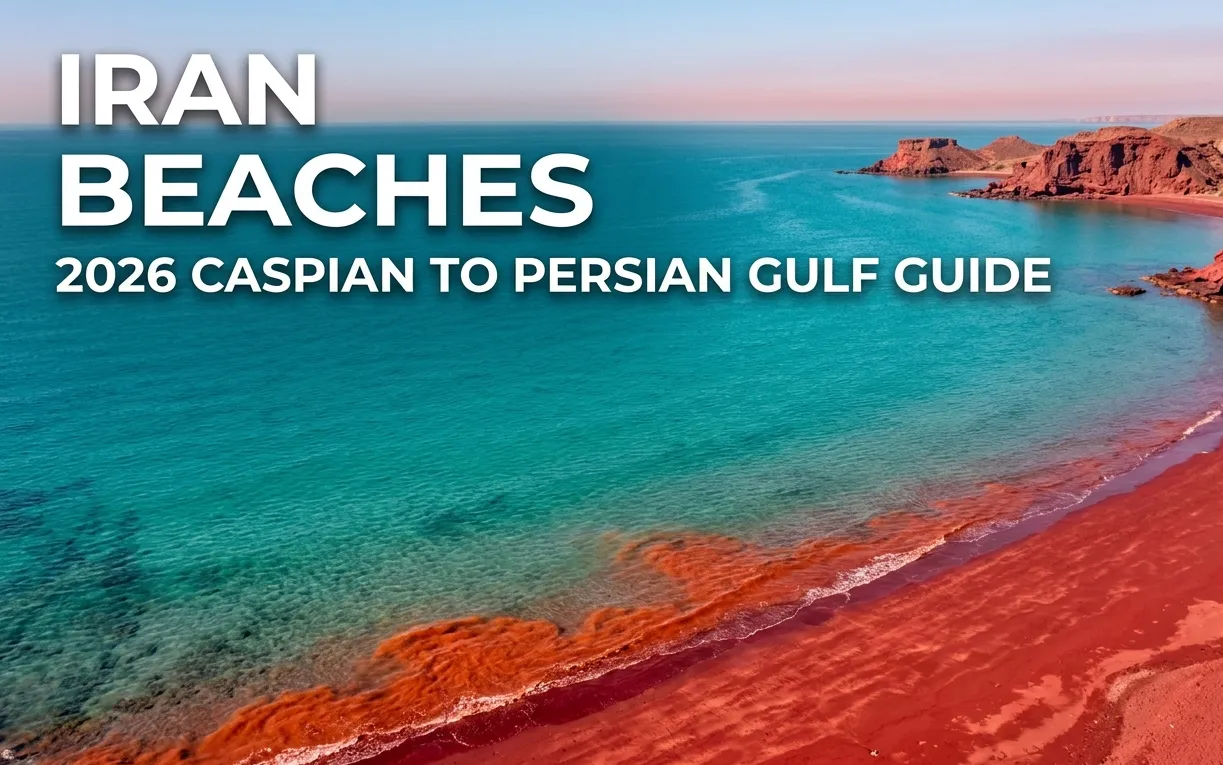
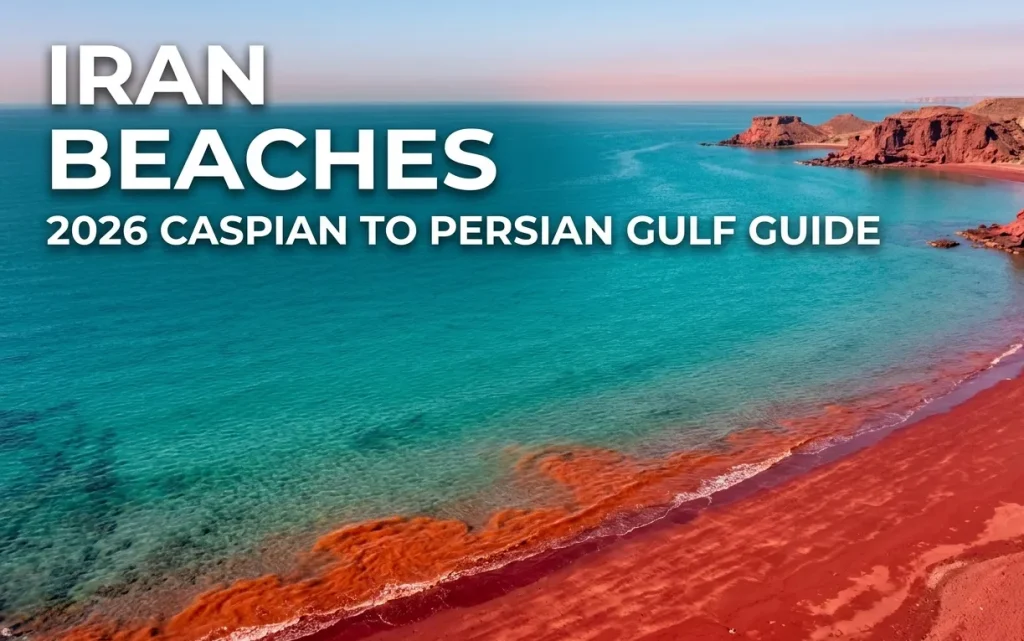
The island is famous for its colored soils. Iron oxide creates red sand beaches that look like Mars. Ochre, yellow, and silver-gray sand patches create a multi-colored shoreline that photographs like a geological wonder.
The Red Beach on Hormuz’s coast is the most famous. The iron-rich soil stains the sand and the waterline a deep rust-red. The contrast of red sand against turquoise Gulf water is genuinely unique.
The Rainbow Valley on Hormuz displays bands of different colored soil in the geological formations behind the beach. The combination of colored sand, rock formations, and sea creates a landscape photographers travel specifically to capture.
Hormuz has very limited tourism infrastructure. There are no resort hotels. Accommodation is in local guesthouses or eco-lodge style properties with basic facilities.
The island is accessible by ferry from Bandar Abbas. The crossing takes roughly 45 minutes. There is no airport on Hormuz Island.
Hormuz is for adventure travelers and photographers. Visitors seeking comfortable beach resort facilities should base themselves on Qeshm and visit Hormuz as a day trip.
Insider Tip:
- Visit Hormuz as a day trip from Qeshm. The ferry runs regularly from Bandar Abbas.
- Bring everything you need for the day. Facilities on the island are minimal.
- The red sand stains clothing. Wear dark colors you do not mind getting rust-colored.
Key Takeaway: Hormuz Island’s colored beaches are among the most unique on Earth. Visit as a day trip from Qeshm or Bandar Abbas.
Bandar Abbas Beach
Bandar Abbas is the largest Persian Gulf port city in Iran. The city beaches are urban, functional, and primarily for local residents rather than international visitors.
The city’s public beach park stretches along the Gulf waterfront. The sand is beige to light brown and the water is warm year-round.
Bandar Abbas beaches are popular with local families in the cooler winter months. Evening picnics and waterfront walks are the primary beach activities rather than swimming or sunbathing.
Dress code at Bandar Abbas beaches is strictly observed. The public beach areas are mixed-gender but fully clothed. Swimwear is not worn at public city beaches.
The city serves primarily as a transit point to Qeshm and Hormuz islands. The ferry terminal connects to both islands with regular departures throughout the day.
Beachfront hotels in Bandar Abbas include the Homa Hotel Bandar Abbas and a few mid-range options near the waterfront. Hotel quality is functional rather than resort-style.
International visitors typically spend minimal time at Bandar Abbas beaches. The city is useful for overnight transit between island visits rather than a beach destination itself.
Budget travelers will find Bandar Abbas significantly cheaper than Kish or Qeshm. Hotel rooms range from roughly $25 to $80 per night.
Chabahar Beach Iran
Chabahar is Iran’s only oceanic port city, located on the Gulf of Oman coast in the southeastern province of Sistan and Baluchestan. The beaches here feel more like the Indian Ocean than the Persian Gulf.
The coastline around Chabahar has wide sandy beaches with golden-brown sand. The water is clearer and has more wave action than the enclosed Persian Gulf.
Chabahar’s climate differs from the rest of Iran’s southern coast. The Indian Ocean monsoon brings a summer rainy season from June through September that is unique in Iranian coastal geography.
The monsoon creates greener coastal vegetation than elsewhere on Iran’s southern coast. The landscape around Chabahar has a tropical feel absent from the arid Persian Gulf shoreline.
The Martian Mountains near Chabahar are badland formations that create a dramatic backdrop to the coastal scenery. The combination of eroded rock, beach, and sea is visually striking.
Chabahar is the least developed of Iran’s beach destinations. Tourism infrastructure is minimal. Hotels are basic. International visitors are rare.
The region has a distinct Baluchi cultural identity different from Persian Iran. The local dress, food, and customs reflect Baluchistan’s cultural heritage.
Chabahar is for adventurous travelers seeking a genuinely off-the-grid Iranian beach experience. The beaches are natural and undeveloped, which is both their appeal and their limitation.
Key Takeaway: Chabahar offers Iran’s most dramatic ocean beaches. Infrastructure is minimal and the region is best for adventurous travelers.
Ramsar Beach Iran
Ramsar is the most famous Caspian Sea beach destination in Iran. The city sits on the Mazandaran coast where the Alborz Mountains drop directly to the sea.
The Ramsar beachfront has a palm-lined coastal boulevard with views of forested mountains rising behind the city. The combination of beach, palms, and mountain scenery creates a landscape more reminiscent of the Black Sea than the Middle East.
The beach sand is dark gray-black, typical of the Caspian coast. The water is brackish with gentle wave action and a gradual depth increase from the shoreline.
Ramsar has the best concentration of beachfront hotels on the Caspian coast. The Ramsar Parsian Azadi Hotel and Ramsar Hotel are two of the most established properties with direct beach access.
The Ramsar Palace (Mar Mar Palace) is a historic Pahlavi-era royal residence on the Ramsar coast. The palace gardens are open to visitors and provide a scenic coastal walking area.
Ramsar is a domestic tourism destination. International visitors are uncommon. The beach experience and hotel service standards reflect domestic rather than international tourism expectations.
The city also has natural hot springs with mineral baths near the coast. The combination of Caspian beach and mountain hot springs is a unique regional feature.
Budget travelers will find Ramsar affordable by international standards. Beachfront hotel rooms range from roughly $40 to $120 per night depending on property quality and season.
Iran Beach Dress Code
Iran beach dress code follows Islamic Republic regulations that apply at all public beaches. Understanding these rules before visiting prevents uncomfortable situations and potential legal issues.
Women must wear hijab (head covering) and modest clothing covering arms and legs at all public beaches. A manto (long tunic or coat) and headscarf are the minimum requirement for entering beach areas.
Women cannot wear swimwear at mixed-gender public beaches. Swimming in clothing with hijab is permitted at designated swimming areas, but this is impractical and uncomfortable for most visitors.
Men must wear modest swimwear at public beaches. Brief-style swimwear is not permitted. Board shorts and a t-shirt or rash guard are acceptable at mixed-gender beaches.
Separate-gender beaches exist on Kish Island and at some Caspian coast resorts. These enclosed beach areas allow women to swim in standard swimwear without hijab. Access is restricted to women and young children only.
Men-only beaches operate on the same principle. Men can swim in standard swim trunks at designated men-only beach areas.
The women-only beach on Kish Island is the most accessible option for female international visitors who want to swim properly. These facilities are enclosed with high walls for complete privacy.
Dress code enforcement varies by location and season. Kish Island is more accustomed to international visitors. Mainland Caspian beaches are more conservative and enforcement can be stricter.
Important: Verify current dress code requirements before visiting. Regulations can change and enforcement varies by location and political climate.
Key Takeaway: Kish Island’s women-only beach is the best swimming option for female visitors. Men-only and family beaches provide similar gender-segregated access.
Swimming in Iran Beaches
Swimming at Iranian beaches is permitted at designated areas. The experience differs fundamentally from international beach destinations due to dress codes and gender segregation.
The Caspian Sea offers the most comfortable swimming conditions in Iran. The water is less salty than ocean water, the waves are generally gentle, and summer water temperatures reach 75 to 80 degrees Fahrenheit.
Persian Gulf swimming is warm year-round. Water temperatures range from 65 degrees in winter to 90 degrees in peak summer. The high summer water temperature feels more like a warm bath than a refreshing swim.
Women can swim properly only at women-only beaches or private resort pools. At mixed-gender public beaches, swimming in clothing with hijab is technically permitted but practically difficult.
Kish Island offers the best swimming facilities for both men and women. The separate-gender beaches with privacy walls allow normal swimwear within the enclosed area.
Caspian coast resorts increasingly offer private beach areas with gender-segregated swimming. These are typically attached to higher-end hotels with walled beach access.
Swimming safety infrastructure is limited at most Iranian beaches. Lifeguard coverage is not standard. Swim at designated areas and never swim alone at Iranian beaches.
Water quality varies by location. Caspian Sea water quality near urban areas can be affected by runoff. Persian Gulf water at Kish Island is generally clear with good visibility.
Iran Beach Hotels
Iran beach hotels range from Caspian Sea resorts to Kish Island international properties. The quality and style vary significantly by region and target market.
Kish Island has the best beach hotel infrastructure in Iran. The Dariush Grand Hotel, Toranj Marine Hotel, and Shayan Kish Hotel offer international-standard accommodations with beach access.
The Toranj Marine Hotel on Kish is an overwater bungalow property built on stilts above the Persian Gulf. This is the closest Iran gets to a Maldives-style resort experience.
Caspian coast hotels in Ramsar, Nowshahr, and Mahmoudabad are primarily domestic-market properties. Service standards and English-language capability are lower than Kish Island hotels.
The Ramsar Parsian Azadi Hotel on the Caspian coast is one of the most established beachfront hotels in Iran. The property has direct beach access, a pool, and views of the Alborz Mountains.
Qeshm Island has simpler hotel options than Kish. Properties in Qeshm Town offer functional accommodations with limited resort amenities. Eco-lodges near the Hara Forest provide a more nature-focused stay.
Mainland Gulf coast cities like Bandar Abbas have business-oriented hotels rather than beach resorts. The Homa Hotel Bandar Abbas is the most established option.
Beach hotel pricing in Iran ranges from roughly $30 per night for basic Caspian properties to $150 to $250 per night for premium Kish Island resorts. Pricing is significantly lower than comparable international beach destinations.
Key Takeaway: Kish Island has Iran’s best beach hotels. The Toranj Marine Hotel offers overwater bungalows at a fraction of Maldives pricing.
Best Time to Visit Iran Beaches
The best time to visit Iran beaches depends on which coast you are targeting. The Caspian Sea and Persian Gulf have nearly opposite optimal seasons.
Caspian Sea beaches are best from late May through June and September through early October. These shoulder months offer warm water, pleasant air temperatures, and fewer domestic crowds than peak summer.
July and August on the Caspian coast bring peak Iranian domestic tourism. Hotels fill, beaches crowd, and humidity peaks. Avoid these months if you want a quieter Caspian beach experience.
Persian Gulf beaches are best from November through March. Daytime temperatures range from 65 to 85 degrees Fahrenheit and the humidity is manageable.
June through September on the Persian Gulf is extremely hot. Temperatures regularly exceed 110 degrees Fahrenheit with oppressive humidity. Outdoor beach time is limited to early morning and evening.
Kish Island peak season is November through March when Gulf weather is pleasant. This coincides with the Persian Gulf high season for hotel pricing.
Chabahar and the Gulf of Oman coast have a monsoon season from June through September. The summer brings rain and rougher sea conditions that affect beach access.
Nowruz, the Persian New Year in late March, brings domestic travel surges to all Iranian beach destinations. Hotels book out and prices rise during the two-week Nowruz holiday period.
Insider Tip:
- November and March are the best months for Persian Gulf beaches.
- June and September are the best months for Caspian beaches.
- Avoid all Iranian beach destinations during Nowruz (late March) unless you book well in advance.
Safety and Cultural Warnings for Iran Beaches
Iran beaches present specific cultural, legal, and safety considerations that international visitors must understand before visiting. The Islamic Republic’s laws apply at all beach locations.
Key safety and cultural facts every Iran beach visitor should know:
- Islamic dress code is mandatory at all public beaches. Women must wear hijab and modest clothing. Men must wear modest swimwear. Non-compliance can result in detention or removal from the beach.
- Alcohol is strictly prohibited in Iran including at beaches and beach hotels. Possession or consumption carries severe legal penalties.
- Public displays of affection are not permitted at beaches or anywhere in Iran. This includes holding hands, kissing, or any physical contact between unrelated men and women in public.
- Photography restrictions apply. Do not photograph government buildings, military installations, or local people without permission. Photography at women-only beaches is strictly prohibited.
- Lifeguard coverage is not standard at Iranian beaches. Swim only at designated areas and never swim alone.
- Water quality varies. Urban Caspian beaches near river mouths can have runoff issues. Kish Island beaches generally have the best water quality.
- Domestic political sensitivities can affect travel. Monitor your home country’s travel advisories for Iran before planning a visit. Verify current entry requirements as visa policies change.
- Internet and communication restrictions apply in Iran. Many international websites and social media platforms are blocked. Arrange a VPN before arrival if needed.
Verify all travel advisories, visa requirements, and local regulations through official sources before planning travel to Iran. Conditions change and independent verification is essential.
Frequently Asked Questions About Iran Beaches
Can tourists visit beaches in Iran?
Yes, tourists can visit beaches in Iran with proper visas and adherence to local laws.
International visitors are welcome at Caspian Sea beaches and Persian Gulf islands.
Kish and Qeshm islands offer easier visa access than mainland Iran for most nationalities.
What should women wear at Iranian beaches?
Women must wear hijab and modest clothing covering arms and legs at all public beaches in Iran.
Standard swimwear is permitted only at enclosed women-only beaches with complete privacy walls.
Kish Island has the most accessible women-only beach facilities for international visitors.
Are there separate beaches for men and women in Iran?
Yes, most Iranian beaches have gender-segregated sections or separate men-only and women-only areas.
Women-only beaches with high privacy walls allow normal swimwear within the enclosed area.
Mixed-gender public beaches require full Islamic dress code for both men and women.
Which is better, Caspian Sea or Persian Gulf beaches in Iran?
The Caspian Sea offers better summer beach weather with forested mountain scenery and gentle water.
The Persian Gulf offers warmer water, island resort options, and better snorkeling and diving.
Choose the Caspian for scenic coastal drives and mountain views. Choose the Gulf for swimming and island resorts.
Is Kish Island worth visiting for beaches?
Kish Island is worth visiting for the best beach resort experience available in Iran.
The island has women-only beaches, coral reef snorkeling, and the most developed hotel infrastructure.
The overwater bungalows at Toranj Marine Hotel offer a unique Iranian beach experience.
Can you swim at Iran’s beaches?
Swimming is permitted at designated beaches with gender-segregated access or appropriate dress code.
Women can swim properly only at enclosed women-only beaches like those on Kish Island.
Men can swim at men-only beaches or public beaches in appropriate modest swimwear.
Plan Your Iran Beach Visit
Iran’s beaches offer genuinely unique landscapes from the forest-backed Caspian shore to the red sands of Hormuz Island. The natural beauty is significant and unlike any conventional beach destination.
Prepare thoroughly for the cultural context. The dress code, gender segregation, and limited resort infrastructure define the Iranian beach experience as much as the sand and water.
Book Kish Island accommodation first if you want the most accessible international-standard beach experience. Arrange domestic flights from Tehran to Kish or Qeshm early during peak winter season.
Visa policies, dress code enforcement, and hotel operations change. Verify current conditions through official sources before booking your 2026 travel dates.
Iran’s beaches reward culturally prepared travelers with genuinely memorable coastal experiences. The colored sands of Hormuz, the mangrove beaches of Qeshm, and the mountain-backed Caspian shoreline are worth the preparation required to visit them.